
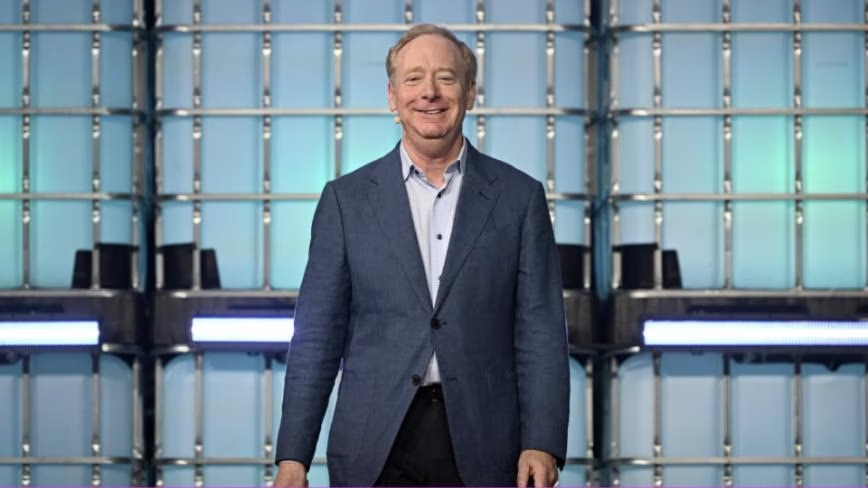
Microsoft president Brad Smith at Web Summit 2025 in Lisbon Credit: Paul Devlin / Web Summit via Sportsfile (CC BY 4.0) Microsoft’s president, Brad Smith, has called for global safety rules for AI. They include a legal duty to tell victims when a rogue AI agent breaks into their systems. He set out his case on the BBC’s Big Boss Interview podcast with Will Bain, released on 11 October. Smith told the BBC: “Right now, your washing machine is subject to more safety rules than AI.
Every carton of milk that you see in the grocery store is subject to safety rules and inspection.” Smith called AI both a “tool and a weapon”. He said AI is moving forward “faster than the speed of safety”. That, he said, is not good for the public or for the industry itself. Three measures The first measure is a “safety brake or emergency brake”, often called a kill switch.
It would cover any AI system that controls autonomous devices or critical infrastructure. Smith said it should sit with the companies running the models and in the cloud infrastructure they run on. The second is a legal requirement to write “incident reports”. If AI agents “break loose” and break into systems, victims should be told.
That already happens after a data breach. Anthropic said this month that one of its models sent a fake murder tip to police during testing. Smith called the third measure the biggest and most important. It is whether government evaluators should sign off frontier models before release.
He said cartons of milk and passenger aircraft are already subject to inspection and certification. “We know how to do this for other products. We should build on that knowledge and think about how to apply it to AI,” Smith said. Why the UK Smith said the UK is best placed to drive the rules because of its AI Security Institute. Former prime minister Rishi Sunak’s government launched it as the AI Safety Institute.
He said it has the strongest technical capability in the world to test AI models. “It’s the United Kingdom. They are the best,” Smith said. In Washington, he added, people do not look at London the way they look at Brussels. He called that a strength.
Last month, the White House asked OpenAI and Anthropic to hold back models from UK testers. On Monday, the UK said its testers would again get pre-release access. At odds with Trump President Donald Trump has said the industry should regulate itself so US firms do not lose out to Chinese rivals. He has repeatedly said that “whoever wins AI, wins”.
At the end of September, Trump hosted the leaders of OpenAI, Anthropic, Nvidia, SpaceX, Meta and Google. They signed a “morally binding” document at the White House. Microsoft did not sign it. Smith said he applauds the statement and that Microsoft is “happy to sign it”. “It’s a good step, it’s a necessary step… But I don’t think it’s sufficient any longer,” Smith said. “It’s the companies that are not as responsible that you need to worry about.” Smith made the same comparison to milk and washing machines in an interview with ITV News on 8 October.
He told ITV that governments should be able to order AI systems offline, as they can ground aircraft. Developers should be legally liable if they act negligently and their AI causes catastrophic harm, he said. Microsoft’s chief executive, Satya Nadella, called for an emergency brake on AI models on Saturday. In the BBC interview, Smith also answered Vice President JD Vance, who accused Microsoft of abusing the H-1B visa system more than any other US company.
Smith said Vance’s staff “got the maths wrong”. He said about 80% of Microsoft’s 6,000 visa applications were for existing employees, and that the company hired 9,000 Americans last year. Also tagged with





Leave a Reply