
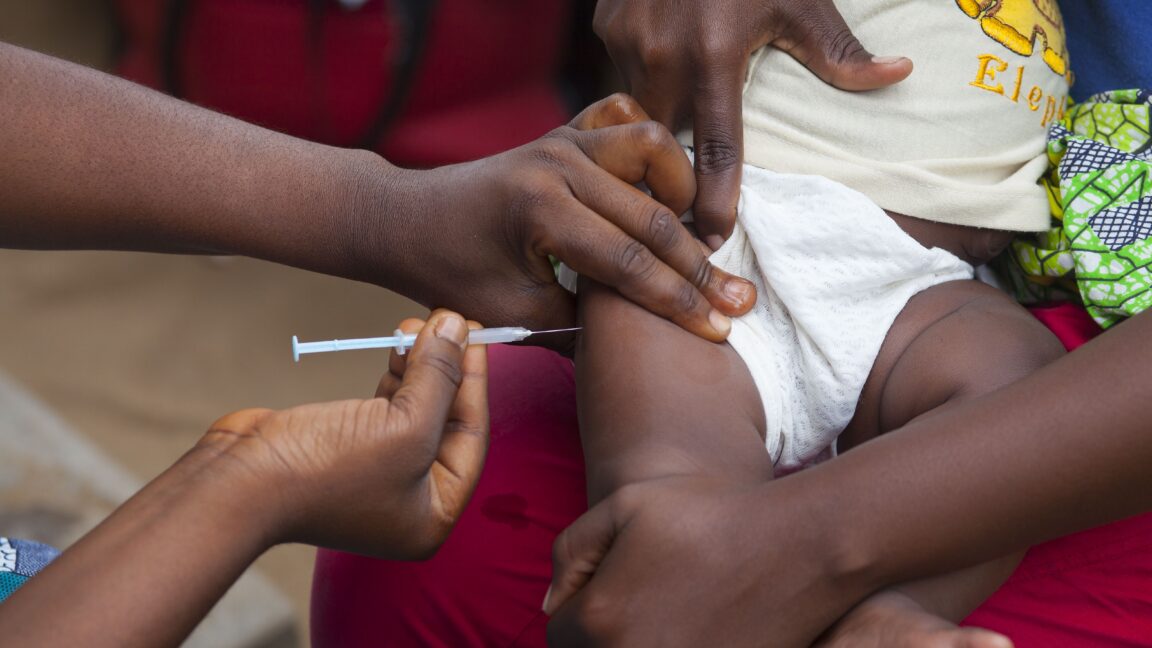
Text settings Story text Size Small Standard Large Width * Standard Wide Links Standard Orange * Subscribers only Learn more Minimize to nav Government officials in Guinea-Bissau have formally rejected a clinical trial that would be run by Danish researchers and funded by the US to look for alleged nonspecific harms from the newborn dose of the hepatitis B vaccine. The vaccine dose is currently recommended globally for all newborns and has been used safely and effectively for decades. In an email to Ars Technica, one of the trial’s lead researchers, Christine Stabell Benn of Bandim Health Project and the University of Southern Denmark, said that Guinea-Bissau’s Council of Ministers “formally reaffirmed its non-acceptance of the study on 16 October.” The revelation that the study was formally rejected last week comes after news on Monday that judicial police in Guinea-Bissau raided Bandim Health’s offices and seized vaccines. Stabell Benn highlighted that the police search came after the trial was rejected.
Of the trial’s rejection, Stabell Benn wrote: “We regret the decision because we considered the study scientifically and ethically justified, but we respect the government’s authority to decide whether research may proceed in the country.” Trial ethics The World Health Organization and many outside experts have sharply disagreed with Stabell Benn and her colleagues on the trial’s justifications and design. It has been widely decried as “unethical” because it would withhold the newborn dose of hepatitis B vaccine from half of the participants. With the country’s high rates of chronic hepatitis B infections, this would put thousands of babies at risk of developing a lifelong infection that can lead to liver cirrhosis, cancer, and premature death. Experts have further said that there is no scientific justification for the study, given the vaccine’s long use and strong safety record.
The WHO wrote in February that the trial “posits hypothetical safety outcomes without sufficient credible evidence” to justify putting newborns at risk. Outrage erupted over the trial after the US Centers for Disease Control and Prevention announced in December that it had awarded an unsolicited grant of $1.6 million to Bandim Health, which Stabell Benn runs with her husband Peter Aaby. The researchers are known for pursuing studies on nonspecific harms from vaccines and have been lauded by anti-vaccine advocates, including US Health Secretary Robert F. Kennedy.
But Aaby and Stabell Benn’s scientific peers have been critical of the quality of their work; the researchers are currently under investigation by Danish authorities for alleged scientific misconduct in their previous studies. Their hepatitis B vaccine trial was reportedly halted in January by Guinea-Bissau authorities. But outcry erupted again after a report that the US CDC, under Kennedy, had once set another $1.6 million aside to fund the trial and intended to move forward with it. Stabell Benn and colleagues have publicly lamented their tie to Kennedy.
They have also consistently argued that their hepatitis B study is not unethical because Guinea-Bissau does not currently offer routine hepatitis B vaccine doses to newborns. Therefore, newborns not given the vaccine in the trial wouldn’t have received it outside the trial anyway. The country—which experienced a coup in November 2025—plans to introduce a birth dose in 2028, but it lacks the resources and infrastructure to do so now. Outside experts, including the WHO, point to ethical guidelines, such as the Declaration of Helsinki, which require trials to provide the “best proven intervention” to participants, regardless of the current standard in the location where the trial is conducted.
For hepatitis B prevention, the best proven prevention would be the newborn dose of the vaccine, which is globally recommended to be given within the first 24 hours of life. As the WHO wrote explicitly: “Resource constraints cannot be used to justify withholding proven care in a research study involving people.” Mistrust Stabell Benn and colleagues appear impervious to this point. In a LinkedIn post Wednesday, Frederik Schaltz-Buchholzer, a Bandim Health researcher involved in the trial, blamed the backlash on the “Anglophone media” that “framed [the trial] as dangerous because there would be a control group that would have followed the current vaccine schedule” in Guinea-Bissau. Schaltz-Buchholzer’s post went on to claim that the media controversy has led to distrust of the hepatitis B vaccine in Guinea-Bissau and fears that the vaccine would pose a danger to newborns vaccinated in the trial, which he referred to as the intervention group, writing: In the Bissau-Guinean context, it was widely understood that this trial was dangerous for the intervention group.
For instance, rumours spread on social media with an omnipresent desconfiança (mistrust) that this was actually a novel vaccine to be tested by the Americans. Based on the Anglophone media coverage framing the trial as dangerous, Bissau-Guinean influencers speculated that the reason to test the hepatitis B vaccine in Guinea-Bissau was that the vaccine is dangerous, and that Bissau-Guinean newborns are disposable. In her email to Ars Technica, Stabell Benn declined to say what reasons Guinea-Bissau officials gave for why the trial was rejected or why their office was searched and vaccine doses were seized. Ars Technica could not immediately reach Guinea-Bissau officials for comment.
But local distrust of the researchers could have played a role in the rejection and police operation. Stabell Benn said police were directed to investigate the vaccine doses directly, saying: In its communiqué, the Council of Ministers instructed the competent authorities to investigate the origin, acquisition, transport, storage and traceability of vaccines intended for the proposed study. The Judicial Police subsequently searched the Bandim Health Project premises on 19 October and sealed the fridge containing a batch of hepatitis B vaccines. The vaccines were intended for the proposed study.
The study had not begun, and none of the vaccines had been administered. We cooperated with the authorities. Stabell Benn said the trial will not proceed and that Bandim has no plans to move it to a different location. “The underlying scientific question remains important,” she said. “But any future proposal would have to arise from an appropriate local context and partnership and undergo all required scientific, ethical, and governmental reviews.” Beth Mole Senior Health Reporter Beth Mole Senior Health Reporter 17 Comments














Leave a Reply