
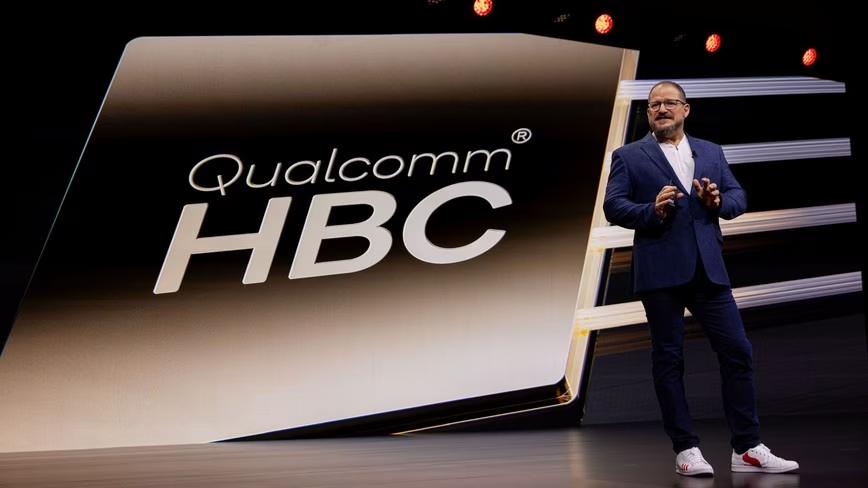
Qualcomm chief executive Cristiano Amon on stage at Snapdragon Summit 2026 in Maui Credit: Qualcomm “Some of the companies at the forefront of AI are telling Qualcomm, ‘By 2028, I need to make sure that I have the ability to run at least a hundred billion parameter model into a phone.’” Qualcomm chief executive Cristiano Amon said this on Sources, Alex Heath’s podcast. Heath recorded the interview at Qualcomm’s Snapdragon Summit in Maui and published it on 8 October. Amon said the companies want that model “running kind of all the time.” He would not name them. Heath asked whether AI companies were talking about phones. “AI companies are starting to do phones,” Amon said.
He gave ByteDance’s Doubao phone, made by Nubia, as an example from China. “There’s more coming,” he said. Why the phone, not the cloud Heath pointed out that personal agents such as Muse and Grok Bot run browsers on virtual machines in the cloud, not on the phone. Amon replied that some work will stay in the cloud and some has to happen on the device. The phone holds a user’s personal context and sensor data, he said.
It also holds the apps an agent needs to operate. For Amon, the launch of OpenClaw made the idea of an AI smartphone clear: an agent that plans, routes tasks and acts for the user. “Humans are not going to go travel to a data center, ring the bell and say, ‘Give me some AI.’” Memory prices hit cheaper phones Amon said memory prices have risen five to six times. Because of them, the smartphone market is down 20% this year, he said. Mid-range and cheaper phones have been hit hardest, while premium models held up. “It’s not a demand problem,” he said, adding that there is now pent-up demand.
Buyers purchase about 1.2 billion phones a year, according to Amon. The market is still smaller than in 2019, he said. Research firm Omdia has said phone prices will stay high after the shortage ends. Memory was also the first objection on X.
Elon Musk replied to a post about Amon’s comments: “Problem is RAM supply.” Glasses, data centres and 6G Amon called smart glasses the wearable he is most bullish on. He put the market at 50 to 60 million units, with about 40 designs using Qualcomm chips. The company launched new glasses platforms at the summit. On data centres, Amon talked about Modular, the software company Qualcomm bought from Swift creator Chris Lattner.
He said Qualcomm will make its platform open source under the Apache 2.0 licence, for any chip. “We will celebrate every single Modular deployment on Nvidia, on AMD, on Broadcom, on any other chip, on Intel.” For 6G, Qualcomm plans demonstrations at the 2028 Los Angeles Olympics. Amon expects early deployments in 2029 and 2030, with scale after 2030. Get the TNW newsletter ✕ Close Get the TNW newsletter Get the most important tech news in your inbox each week.








Leave a Reply