
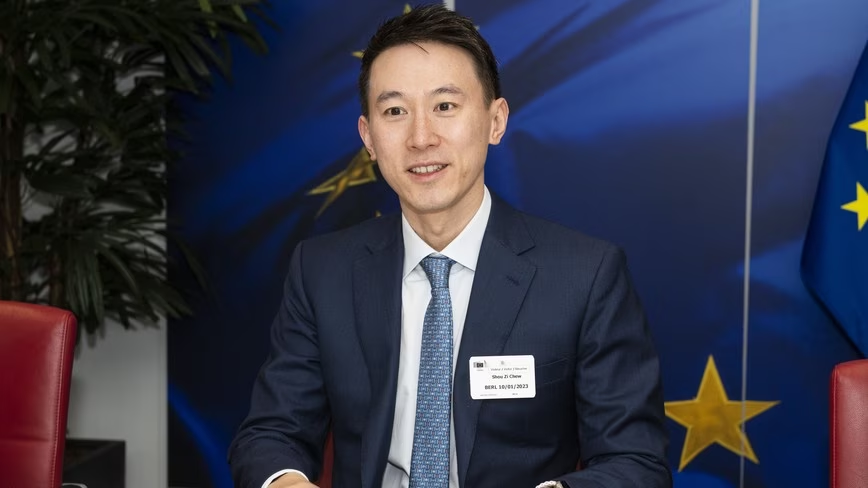
Shou Zi Chew, CEO of TikTok, at the European Commission in Brussels, 10 January 2023 Credit: © European Union, 2023, licensed under CC BY 4.0 (cropped). Photo: Lukasz Kobus TikTok chief executive Shou Chew expects AI to deliver a major scientific breakthrough within two to three years. He named physics, biotech, chemistry and materials science. Chew spoke on Monday at DBS Bank’s Asia Future Forward Conference in Singapore, CNBC reported. “In the next two to three years, we’re going to have a real scientific breakthrough: physics, biotech, chemistry, material science, because of AI.
It’s very, very, very possible,” Chew said, according to CNBC. Shee Tse Koon of DBS moderated the session, according to the conference programme. Not there yet Chew also said people may expect too much of AI for now. “I think in the short term we are probably overestimating it, but in the long term we are probably underestimating it,” he said, CNBC reported. People still handle the nuances of visual recognition and long-term memory retrieval better than AI, Chew said.
Gao Yuan and Gabrielle Ng reported his remarks for Bloomberg. “On the one hand, I think the technology is not there yet. Our brain can do things that the model still cannot,” Chew said, according to Bloomberg. Cybersecurity risks Chew said the cybersecurity risks of AI are big, and “quite real” in the short run, according to Bloomberg. Users may give AI agents wide permissions without understanding the consequences, he said, CNBC reported.
He gave the example of an agent allowed to make purchases on its own. In its eagerness to finish a task, it could buy more than the user intended, he said. Stronger AI models also make it much cheaper for bad actors to attack platforms such as TikTok, Chew said. ByteDance and science TikTok’s parent company, ByteDance, develops its own AI models.
In April, its Seed research team published Protenix-v2, a model for biomolecular structure prediction and design. ByteDance also has an AI drug discovery unit, Anew Labs. Chew said ByteDance is looking at how to work with scientists to make progress in science. Last week, the US government, Meta and Google joined a $1.8bn AI biology effort to model how cells behave.





Leave a Reply