
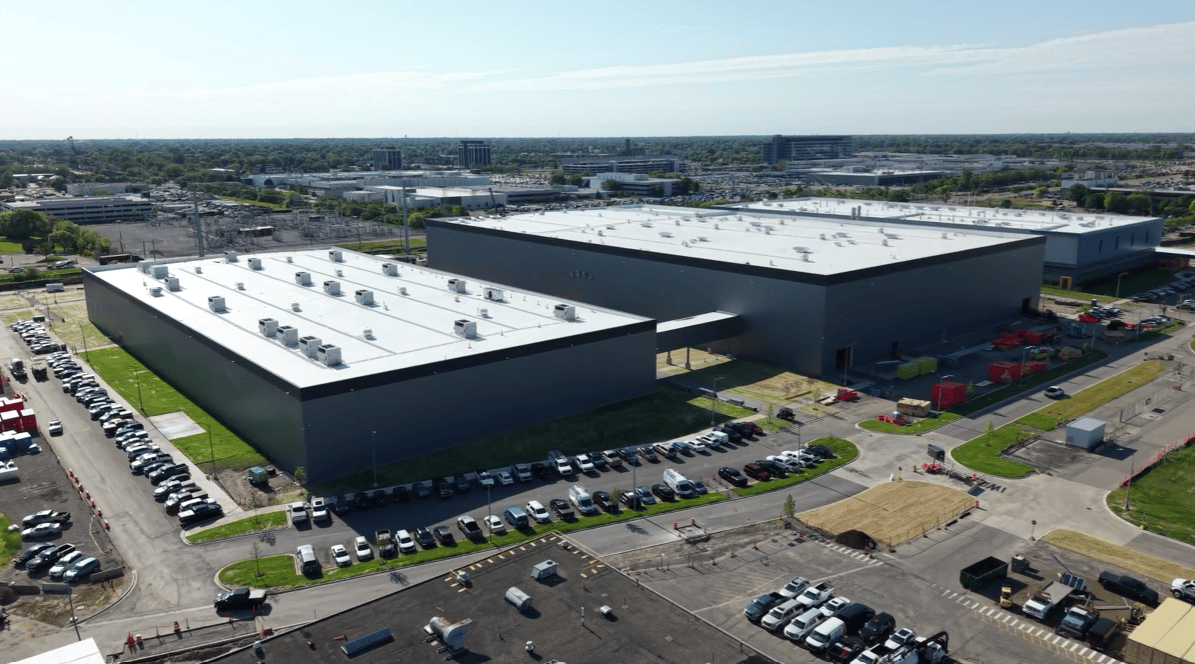
TransportationReportElectric CarsInside the mini factory where GM builds its EV futureGM is using AI models and a new mini factory to build and test cheaper EV battery cells in half the time.by John VoelckerOct 12, 2026, 11:00 AM UTCShareGift Image: GMTransportationReportElectric CarsInside the mini factory where GM builds its EV futureGM is using AI models and a new mini factory to build and test cheaper EV battery cells in half the time.by John VoelckerOct 12, 2026, 11:00 AM UTCShareGiftIf you’re driving through GM’s sprawling campus in Warren, Michigan, you’d likely ignore the pair of adjacent, anonymous white buildings tucked away in the upper reaches of the 710-acre space.Inside those buildings, which total half a million square feet together, is a massive construction project that’s still in progress. Once completed, it will house GM’s new Battery Cell Development Center, where the automaker is working furiously to build new prototype cells with the goal of slashing the cost of its EVs.GM has to build faster and cheaper to meet its goal of selling affordable EVs in much higher volumes. Those EVs will have to compete not only with longtime sales leader Tesla, but also with the flood of Chinese EVs that, sooner or later, will land in the US. And while EV sales in the US appear to be leveling out, America has a long way to go before it can credibly compete with China, the world’s leading EV market.The number of shoppers interested in new and used EVs spiked when gas prices rose 40 percent this year as a result of the war in Iran — but mostly in models priced lower than the average $50,000 cost of a new vehicle today.
While GM sells more EVs in the US than any other company after Tesla, most of its lineup is still too expensive thanks to a battery pack that makes up 30 to 40 percent of the total cost.During an early September tour, after putting on a hard hat, safety glasses, and a hi-vis vest, I saw up close the tools GM will use to build these newer, cheaper batteries: huge vats for mixing cell slurry, coating machines that deposit electrode material onto film, and machines for a dozen other steps in the process of turning minerals into cells that hold and deliver energy. The plant I toured will be a low-volume factory that lets engineers prototype the higher-volume production to come from giant, billion-dollar factories.The new facility suggests GM is playing a long game, working to develop new cells that use less — or none — of the minerals China controls globally. Although US scientists developed the original R&D on most new cell chemistries, Asian companies were the ones to develop, refine, and put those chemistries into volume production.The 15-year Chinese effort that gave the country global control of supply and processing for minerals used in today’s cells, especially cobalt, nickel, and rare earths, means future cells must use different minerals to escape the country’s dominance. One example: GM’s new LMR, or lithium manganese-rich, cells use very little cobalt or nickel.
A second: This spring GM announced it’s working with startup Peak Energy on sodium-ion cells for energy storage.Getting such new chemistries out of the lab and into volume production can last a decade or more. But GM doesn’t have that long. China may already be selling its EVs to Americans by then. The company’s battery engineers are confident that using the new facility inside those anonymous buildings 15 miles north of Detroit can launch new cell chemistries and formats for EVs and battery energy-storage systems in less time than predicted.
The company’s future will rest on whether it can succeed.An engineer inspects a roll press system at GM’s new Battery Cell Development Center. Image: GMIn June, GM battery czar Kurt Kelty told me the new Battery Cell Development Center, or BCDC, will provide “the critical bridge from R&D lab to production” by combining virtual modeling, physical test capabilities, and small-scale production lines. The aim is to fill the missing link between creating and prototyping new cells and getting them into high-volume production.BCDC head Mo Gallegos puts the total cost at $900 million. At maximum production, the BCDC might produce 4 to 5 gigawatt-hours of cells.
But the goal isn’t quantity; it’s quality.Inside the 500,000-square-foot lab, I saw much of the machinery needed to fabricate a cell, from mixing slurry for the coating that forms a cell electrode to the charging hardware that energizes a finished cell for the first time. The mini factory will be used for multiple cell chemistries and different formats, starting with prismatic cells. Its purpose is to test industrial cell manufacturing processes, proving and optimizing production techniques and recipes before they’re implemented at scale.While the BCDC will produce actual working cells, it will do so in far lower volumes and at slower speeds than the production lines at full-scale cell plants. GM’s battery developers will then transfer the knowledge gained from this process testing to its cell production partners that will take the new designs to full-scale volume.Those would likely include the two plants operated by Ultium Cells LLC, the joint cell production venture between GM and its cell partner, LG Energy Solution.
The first plant in Warren, Ohio, opened in 2022 and makes large-format nickel-manganese-cobalt-aluminium pouch cells for GM’s line of EVs (excluding the 2027 Bolt). The second, in Spring Hills, Tennessee, opened in early 2024 and now produces lithium-ion phosphate cells for battery energy storage.Of the two BCDC buildings, the first houses anode and cathode fabrication on opposite sides, with electrode assembly in the middle. A bridge transports rolls of electrode film to the second building, where the cells are assembled, charged, and tested for eight to 11 days. The second stories house supplies of the metals, films, and components needed, as well as a very substantial set of HVAC equipment to keep the processes sterile, dust-free, and at the right temperature.The BCDC is slated to produce its first test cells — LMR prismatic cells — in the fourth quarter of this year.
But they won’t go into volume production at the Ultium plant in Spring Hill until 2028. Once tests for LMR cells get underway, it will add the sodium-ion prismatic cells it’s developing for BESS with startup Peak Energy.A close-up view of foil battery material before it is incorporated into the cell assembly process. Image: GMThe problem the BCDC is meant to solve is the chasm between creating new cell chemistries at a small scale and cranking them out in massive quantities in the hundreds of thousands or millions. Taking them all the way through development to commercialization means understanding how to build them; that requires testing production processes and methods to ensure the quality of the finished cells as well as their quantity.You can think of getting a cell to market in four phases: creating a new chemistry, testing early prototypes, figuring out how to build it, and then ramping up volume production.The first phase has been centered in GM’s Kettering R&D laboratory for decades.
It created and tested new chemistries and cells for the pioneering EV1, the 2011 Chevrolet Volt, and the LMR chemistry the company plans to launch in 2028. But it’s limited to proving out a chemistry one cell at a time, in “coin” or small pouch formats.GM brought the second phase in-house when it opened its Wallace Battery Cell Innovation Center in 2023. That lab takes new chemistries and expands them into large-format cells up to 200 amp-hours. Wallace can fabricate these new cells in tiny batches of a few dozen, testing whether a new chemistry will continue to perform and remain practical in cells identical to those to be used in end products.Now, the third phase has arrived in the BCDC, right next door to Wallace.
It will use real-world cell fa















Leave a Reply