
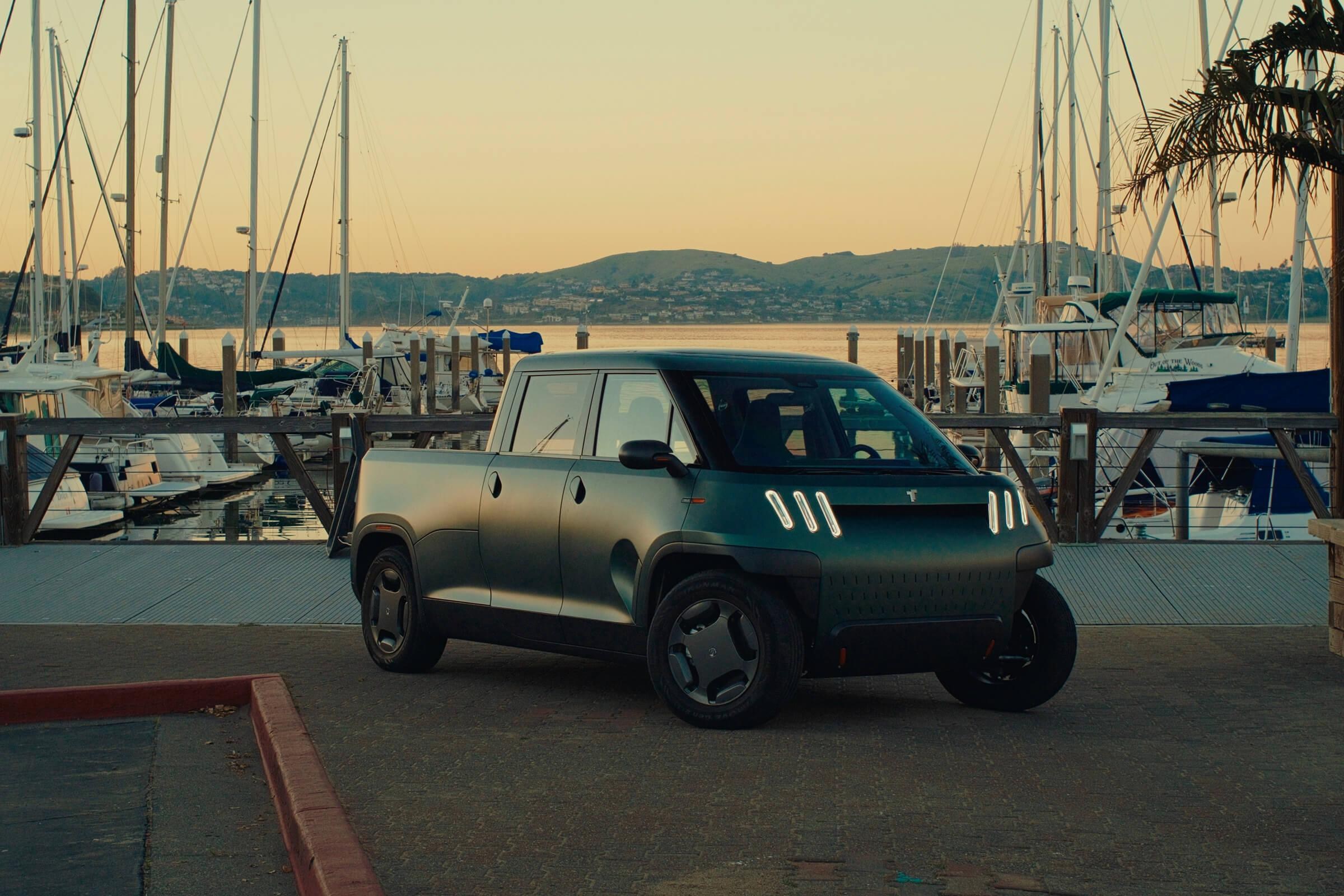
TransportationTechElectric CarsThe Telo MT1 is a big truck trapped in a tiny truck’s bodyTiny pickup trucks might just become a thing in the US if the California-based startup Telo has its way.by Abigail BassettPhotos: TeloOct 10, 2026, 11:00 AM UTCShareGiftTransportationTechElectric CarsThe Telo MT1 is a big truck trapped in a tiny truck’s bodyTiny pickup trucks might just become a thing in the US if the California-based startup Telo has its way.by Abigail BassettPhotos: TeloOct 10, 2026, 11:00 AM UTCShareGiftI’m bouncing down the road in San Carlos, California, zipping past behemoth tech companies like EA and Oracle, in America’s smallest electric truck.The Telo MT1 (which stands for “mini truck”) unquestionably turns heads because it looks so remarkably different from everything else on the market right now.It has a nearly cab-over design, meaning that front-seat passengers sit almost directly over the front axle. It looks a lot like a Japanese kei truck, with a super-short nose and four doors. People stop to stare as we sit at stoplights or roll silently past.The interior is surprisingly spacious, and while the seats are firm, they’re not uncomfortable, at least for short jaunts on the bumpy roads around Telo’s HQ. Telo Trucks cofounder and CEO Jason Marks drove us to the company’s offices ahead of my short one-block test drive, and from the passenger seat, the ride was firm but stable, thanks to a low center of gravity provided by the battery pack beneath the floor.Behind the wheel, the MT1 feels like a lighter, more nimble pickup truck with a stiff, slightly bouncy ride without any payload in the bed, combined with all the low-end power, torque, and acceleration of an EV.
Once we circle back around to the road in front of Telo’s offices, Marks has me come to a full stop and stomp on the accelerator to get a feel for just how much power the little truck puts down, remarking that this was the same road where Tesla used to do its customer test drives of the Roadster many years ago.People stop to stare as we sit at stoplightsMarks says that the production version of the Telo will accelerate 0–60mph in an estimated four seconds. The truck easily rockets from a standstill, just like any other electric vehicle on the market today, a feat for a small startup with just 30 employees.Despite its diminutive appearance, the tiny Telo truck can go toe-to-toe with the giant SUVs and Teslas that populate this area. The Telo is, as Marks likes to point out, actually the same size as a two-door Mini Cooper, but far more practical with a tow rating of 8,000lbs, a full-size bed (96 inches), and a bevy of neat hidden features that Telo hopes will offer a viable, if somewhat pricey, alternative to the giant pickup trucks that dominate the American market.“I hope that our truck shows how amazing and fun and useful — especially useful — a small pickup truck can be, because the current big trucks are literally killing us,” Forrest North, Telo’s cofounder and CTO, said during our interview at Telo’s headquarters. “I mean, they’re fun to be up super high and look out and feel like you’re dominating the world, but they’re killing an extra, roughly, 5,000 people per year, so do we want to just give them a pass for that?”PreviousNext1/6Marks and North both live and work in the San Francisco Bay Area with their families, and both own pickup trucks: Marks because he has a 150lb three-legged dog he shuttles back and forth to the office every day, and North because he has a passion for the outdoors. Large pickup trucks can be useful, but they’re far from suitable for city life.
That disconnect, as well as the founders’ passion for urban transportation, is what brought the two, along with Yves Behar, together to start Telo in 2022.Marks previously worked on automotive safety and validation at National Instruments, while North is a former battery engineer at Tesla, founder of Mission Motors (one of the first electric motorcycle companies to break the land speed record for an electric motorcycle), and cofounder of Recargo, which developed EV charging app PlugShare. Behar is the founder of fuseproject, an industrial design and brand development firm. Marks and North met through a mutual friend in the startup space and discovered they’d gone to the same high school in Washington, where they both pole-vaulted. It was a “kindred spirit moment,” according to Marks.“I hope that our truck shows how amazing and fun and useful — especially useful — a small pickup truck can be, because the current big trucks are literally killing us.”— Telo cofounder Forrest NorthOriginally, their idea wasn’t about trucks at all — it was about electric motorcycles.
Their initial pitch to an unnamed Silicon Valley VC firm included a slide deck comparing three concepts: an electric motorcycle, a small car, and a tiny truck. Everyone they talked to kept gravitating toward the tiny pickup. Sensing the enthusiasm, North pushed Marks to consider pivoting to building a truck, even though the motorcycle they’d planned was nearly complete. They even went so far as to poll about 200 people on the street and found that nearly 90 percent would rather have the truck.
The next week, they pivoted from motorcycle to truck.“It’s clear to me that the trucks have just kind of jumped the shark,” North said. “The only thing they can do now is be big.” Telo aims to change the conversation about what electric transportation in urban centers can look like.PreviousNext1/5Forrest North, left, and Jason Marks were initially going to build an electric motorcycle — until a number of investors expressed interest in a different concept: a tiny electric truck. For a small truck, the Telo MT1 packs a lot of range. At launch, the truck will come with a 77kWh battery pack, or a larger 106kWh pack that the company estimates will deliver up to 350 miles of range. The MT1 has a unique battery layout: a split pack with both 800V and 400V architecture.
The 400V setup makes the Telo chargeable on Tesla’s V3 Supercharger infrastructure, while the 800V will let customers take advantage of new, higher-powered stations coming to market in areas like San Francisco.Telo currently builds its battery packs in-house. Each cell is individually fused so that a single failure won’t trigger a cascade across the pack. According to Marks, in-house manufacturing allows them to maximize energy density and longevity — a feat that hinges on thermal management. The passive thermal management system operates while the vehicle is parked, maintaining cooler temperatures even in direct sunlight, while active liquid cooling engages only when the vehicle is running.
Additionally, North noted that Telo’s latest cells deliver roughly 20 percent more energy than those they sourced just a year ago.For a small truck, the Telo MT1 packs a lot of rangeI drove one of two prototypes that Telo has been using for road testing. From the outside, the Telo looks smaller than its 152 inches of length suggest. With the lower rear section of the passenger seats (called the midgate) laid flat, you get a full-size, 96-inch truck bed.To make up for the lack of a frunk, which most EVs have, Telo also developed a “monster” tunnel (named because, like in a kids’ story, it’s a “monster under the bed”), which passes door to door beneath the front of the truck bed. It’s accessible from either side and is large enough for a pair of roll-aboard carry-on suitcases to slide in endwise.
Marks said that while they knew the front of the MT1 would be difficult to engineer, adding the monster tunnel created a tough engineering challenge because it sits exactly where the battery pack connects.The interior is still being finalized, but Marks said that it will get two 13-inch digital displays that will support both Android Auto and Apple CarPlay. The steering wheel also has small scroll wheels, but most fe








Leave a Reply