

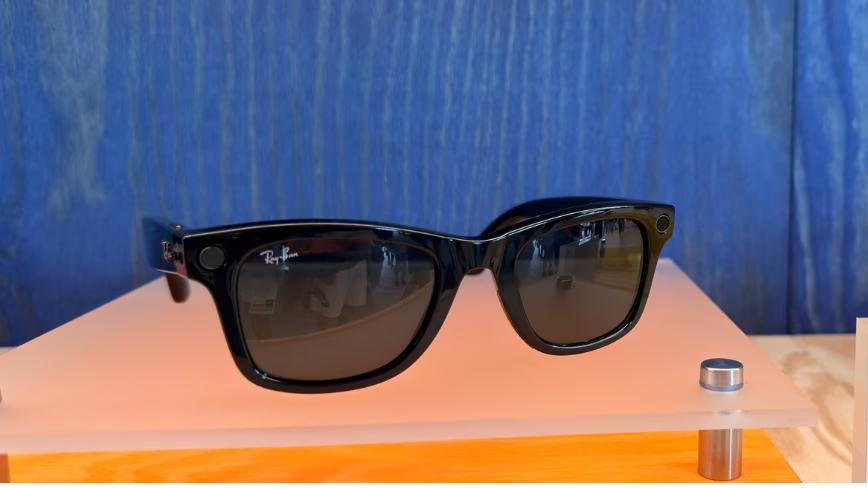
Andrew “Boz” Bosworth, chief technology officer at Meta and head of Reality Labs. Credit: Meta Andrew Bosworth used an AMA on his personal Instagram to argue that the conversation about Meta’s glasses should not be shaped by a relatively small number of bad actors. Katie Notopoulos reported the exchange for Business Insider. Most people use the glasses normally, he said, much as they would a phone camera, only more convenient and more hands-free. He pointed to the indicator light and the anti-tampering measures that stop recording when it is covered.
The first defence is probably true and does not answer the question Almost certainly most wearers are doing nothing objectionable. That is true of most technologies and it has never been the test for a device carried through public space. The phone comparison is where the argument gives itself away. A raised phone is a visible act that the person opposite can see and respond to, and the entire selling point of the glasses is that recording no longer looks like anything.
More in the moment is the same property as harder to notice. The convenience and the problem are one feature. The second defence has already failed in public The recording light is the mechanism Meta has staked its answer on, and it has been closing holes in it all year. A software update stopped a loophole where a wearer could start recording, wait, then cover the light, and it bricked cameras on units where the light had been drilled out.
That enforcement was real and it was not small. Meta described the action as covering fewer than one in a thousand glasses ever sold, which on seven million pairs in a year is a great many devices. The fix is also already beaten. TNW reported this month that a $2 sticker defeats the feature, which is a poor foundation for a privacy guarantee. The roadmap is the strongest rebuttal The Information reported this week that Meta is preparing a camera-free version of the glasses, codenamed Luna, with six microphones and no camera at all. TNW covered the report, which points to an unveiling at Connect on 23 September and shipments in October.
Companies do not remove the defining feature of a product to placate a small number of bad actors. They remove it when the category has a perception problem they cannot moderate their way out of. Bosworth said at the end of the AMA that there is more to say at Connect. That is five days after he said the discourse had been captured by a fringe.
What Luna would actually change Taking the camera out addresses the bystander problem directly, and that is a real answer rather than a cosmetic one. It also removes the thing most people buy the glasses for. Six microphones is not nothing, though. The visual privacy question would be solved and replaced by an audio one, and there is no equivalent of the recording light for a microphone.
Nobody has established a convention for signalling that a face-worn device is listening. Luna would ship into that gap. Europe is not treating this as discourse The enforcement is concrete and it is mostly happening on this side of the Atlantic. Paris prosecutors have opened a criminal inquiry into sexual harassment linked to smart glasses used to film women in the street, and the French cybercrime unit has been testing the devices. Norway is weighing restrictions on camera-equipped wearables.
Hamburg’s data protection commissioner has suggested the glasses may already fall foul of German rules on concealed recording equipment. The regulatory question is also further along than the product one. The LED update arrived alongside French and European data protection scrutiny, and the European Data Protection Board has a report coming on the category. The moderation record is mixed by its own reporter’s account Bosworth said harassing content will be removed and accounts taken down where the behaviour is systematic. Business Insider, which examined how the policy was working over the summer, found the moderation uneven.
The targeting has also been narrow. Videos of men harassing women have drawn action, while prank clips tormenting retail workers have been reported as a growing problem. The competitive read Meta is not the only company weighing this. Apple is targeting 2027 for its own glasses and has not settled the camera question. If the market leader ships a camera-free model this autumn, that becomes the reference point for everyone still deciding.
The bad actors framing looks weaker every week the roadmap moves the other way. What to watch Watch Connect on 23 September. If Luna appears without a camera, the product has conceded what the AMA did not. Watch what Meta says about the microphones.
A camera-free device that listens continuously needs its own indicator, and the company has not proposed one.









Leave a Reply