
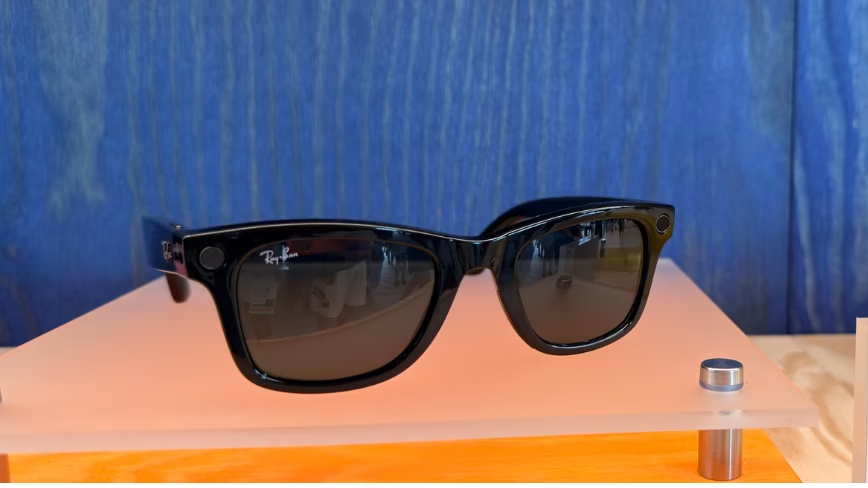
Meta Ray-Ban Smart Glasses Credit: TNW The Paris prosecutor’s office has launched at least one criminal inquiry into sexual harassment allegations linked to smart glasses, Reuters reports, which is the strongest indication so far that France intends to have covert street filming dealt with by the criminal courts and not merely by the privacy regulator. The issue involves a trend on social media in which men who wear glasses with cameras go up to women in public, film them without their permission, and then upload the videos online. The office has not provided any figure regarding the number of complaints it has received, nor has it stated whether anyone has been identified, Reuters said on Friday. Meanwhile, France’s data protection authority has addressed the issue from the other side: in June, it issued a warning urging people to stay vigilant, saying cameras and microphones built into ordinary-looking eyewear can capture individuals almost invisibly.
According to the authority’s statement to Reuters, fewer than 10 complaints have been received so far about the use of these glasses in the workplace, along with a series of inquiries from companies asking whether they can ban them on their premises. Nacera Bekhat, the person in charge of economic matters at the CNIL, said the devices posed “real challenges” in informing people that they are being filmed and in obtaining consent where required. The regulator’s position in June was more direct: it said an indicator light has only a limited effect and is not adequate on its own. Ines Legendre, a legal expert with the child online safety group e-Enfance, told Reuters that turning on a light does not constitute consent to be filmed, “nor to have your image sent on to thousands of people later”.
Meta has made two updates to the glasses since June, as a result of which the camera stops recording when the indicator light is blocked. Ines Girard, a researcher at the Center Hubertine Auclert who specializes in technology-facilitated gender-based violence, stated that the responsibility should not lie with those who are being recorded, saying that “we can’t react to surveillance technology by asking the people who are being surveilled to be more vigilant.” The law currently covers only some of these situations; Article 226-1 of the French Penal Code provides for a prison sentence of up to one year and a fine of €45,000 for recording someone’s image without consent, but this article applies to private places, not the pavement. The glasses made by Meta in association with EssilorLuxottica have a market share of about 76 percent, a figure reported by Reuters without identifying its source. Counterpoint Research, which is normally used as the benchmark for this sector, previously reported that Meta’s share was 82 percent in the second half of 2025, before competitors began entering the market in large numbers.
EssilorLuxottica has reported selling 7 million units the previous year. A representative from Meta told Reuters that the company had “built privacy into our AI glasses from the ground up”. France is not acting alone; last month, the German organization HateAid filed a criminal complaint against Meta, Ray-Ban, Oakley, and various retailers. On Thursday, Australia’s finance minister, Katy Gallagher, requested advice from the public service commission on whether glasses should be banned in commonwealth workplaces.
In Britain, the courts together with an increasing number of venues have imposed restrictions on them, and the Information Commissioner’s Office launched an investigation in March. According to Reuters, some UK cinemas have banned the devices completely, although in August the UK Cinema Association stated that it was aware of no such complete bans among its members. The European Data Protection Board plans to conduct its own examination of smart glasses with national regulatory authorities, and Meta Connect, where the next generation of the glasses is expected to launch, will take place on 23 September.











Leave a Reply