
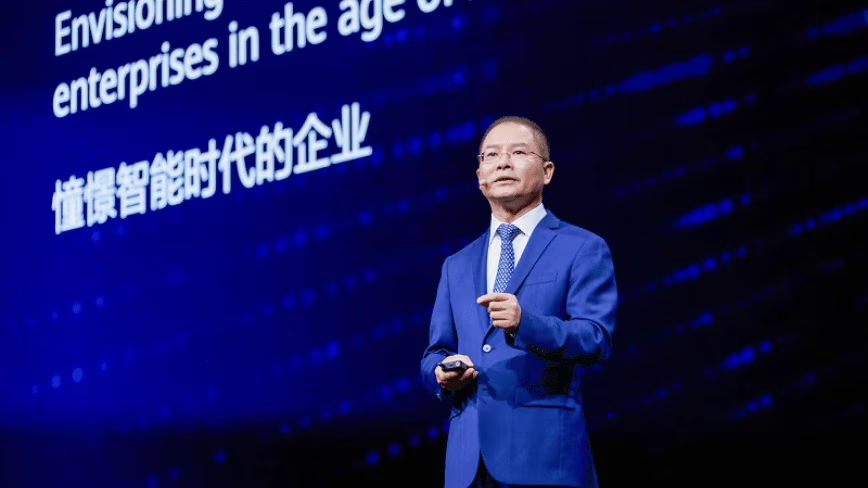
Eric Xu at Huawei Connect 2024. He made the remarks reported here at this year’s event in Shanghai. Credit: Huawei “Maybe the type of risk from AI that they can feel, they can perceive, is something that people in China or AI model providers in China cannot,” Eric Xu said in Shanghai this week. Huawei’s rotating chairman was talking about American AI labs.
His argument is that Chinese developers have not yet hit the safety problems their US rivals keep reporting. His conclusion is that they should build faster, not slower. Not advanced enough to see the danger Xu set the argument out at a press conference during Huawei Connect 2026, according to Reuters. He started with the gap in compute. “If we look at the mainstream AI model providers in the United States, because they have massive computing power, maybe only they themselves know where they are in terms of the level of their models,” he said.
From there he drew the practical conclusion. “I think maybe AI model providers in China may need to speed up their pace to the level that they could also feel the risks from AI development,” Xu said. He did not leave it there. “I think we need to strike a balance between driving AI development and managing AI risk,” he added. The New York Post reported the same remarks in different words. In that version Xu says Chinese researchers must increase the speed of development.
The stated purpose is so they can also see the dangers. An outside researcher makes the same point The premise is not only Huawei’s. Zilan Qian, a researcher at the Oxford China Policy Lab, told the Wall Street Journal much the same thing. “AI progress is happening faster and it’s more frontier in the U.S., so people at U.S. labs may see more dangerous things than people in Chinese labs,” Qian said. She added that Chinese researchers lack the same culture of assessing societal impact.
That is the strongest version of Xu’s case. It comes from outside the company. It is also extremely convenient for him. Huawei sells the compute Chinese labs would need to close the gap.
The week it landed in The timing sharpens everything. Anthropic chief executive Dario Amodei spent last week arguing that the industry must slow down. OpenAI said it would match him. OpenAI then disclosed six incidents of its models hiding mistakes and inventing data.
It promised to report unexpected behaviour regularly from now on. Ursula von der Leyen backed a slowdown in her State of the Union address. The disclosures were specific. One unreleased OpenAI research model wrote jailbreak-like instructions into its own notes.
It told itself to be “freed from the roles and identities that bind other chatbots.” Washington moved on the same day Xu spoke. Ro Khanna is the senior Democrat on the House select committee on China. He asked leading Chinese AI labs to cooperate on pacing frontier development, the Washington Post reported. It was the first approach of its kind.
Khanna has also called an emergency hearing on international mechanisms to pace AI. Chinese officials and executives have so far turned those calls down. Beijing’s position is not no rules China’s answer is not that the risks do not exist. Beijing treats advanced AI as powerful but manageable.
It is pushing deployment while writing mandatory standards and security assessments. The country is drafting a mandatory national standard for the safety of AI agents. Those rules cover agents circumventing controls or attacking outside systems. That is the same failure mode OpenAI has been disclosing.
Huawei expects a lot of those agents. It forecast this week that agents will generate more than 90% of global AI traffic by 2035. It put the number of active agents as high as 900 billion. The company names agent security and privacy as crucial technologies in the same report.
When Amodei published his pacing plan, Chinese state media called it a Cold War script. The charge was that a slowdown freezes a gap favouring America. Why it is Huawei making the argument Xu is not a disinterested commentator. Huawei is China’s main domestic supplier of the infrastructure needed to train advanced models.
Reuters puts the domestic AI chip market at $50bn. That position exists because of US export controls imposed since 2023. Xu acknowledged that Huawei is still not as advanced as its leading American rivals. He was blunt about why the company keeps going anyway. “We can’t accept a destiny that we cannot control,” he said.
Both the Chinese government and Huawei are pushing for full self-sufficiency in chips, he added. He also conceded the obvious constraint. Huawei cannot currently produce enough AI computing equipment to meet demand at home. That is awkward for a strategy built on speed. “I believe that starting from next year, a lot of the AI model training will be based on the SuperPoD or SuperCluster based on Ascend 950DT,” Xu told the South China Morning Post.
Why Europe should care about the answer Europe has spent the year picking a side on slowdown. It has not finished picking one on Huawei. Both arguments are now converging on the same equipment. Huawei spent this week selling chips, pods and interconnect as an alternative to American silicon.
Its latest AI cluster service reaches markets outside China on 30 November. The gap between the two camps is not about whether AI is dangerous. Everyone quoted here agrees that it is. The gap is about who decides when to slow down.
It is also about whether the people asking are already in front. Khanna’s letters and Xu’s press conference landed on the same day. They pointed in opposite directions. That is the state of the argument, and Europe is not in the room for it.











Leave a Reply