
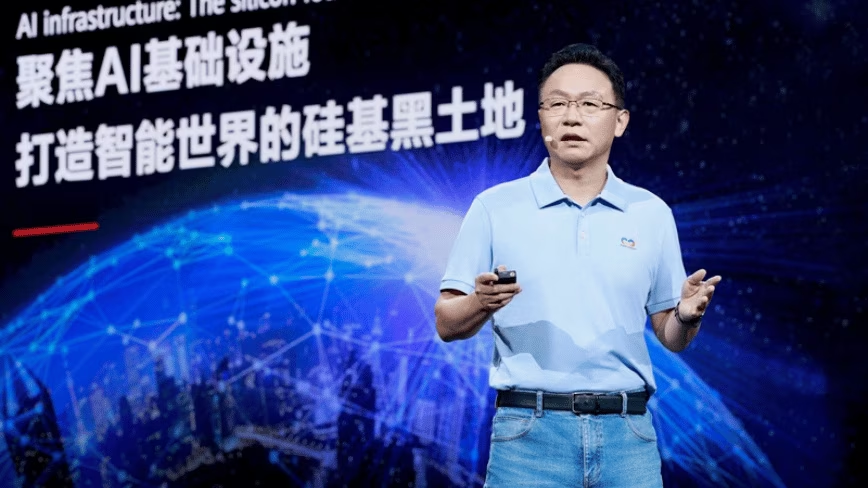
David Wang delivers the opening keynote at Huawei Connect 2026 Credit: Huawei AI “may well be the final technological revolution in human history,” Huawei rotating chairman David Wang told Huawei Connect 2026 in Shanghai. His opening keynote ran under the title Advancing the Agentic World, Building a Solid Silicon Foundation. Huawei then spent three days setting out the machines it wants to run that revolution on. Most of the coverage went to one sentence in that speech.
Huawei’s next AI processor, the Ascend 960DT, arrives in the first quarter of 2027. That is three quarters earlier than its roadmap said. The 960PR, built for inference, follows in the third quarter. Wang also placed an Ascend 970 in 2028 and an Ascend 980 in 2029.
He credited the Tau Scaling Law for the cadence. The chip dates were one item on a long list. Huawei also launched an optical engine and two upgraded SuperPoDs. A memory storage cluster, a switch series and a cloud platform followed.
Holding all of it together is a new interconnect architecture. The bet is on wiring, not silicon The centrepiece is the Atlas 960E SuperPoD. Huawei calls it the industry’s first to use near-packaged optics. One pod holds 4,096 NPUs and delivers 8 EFLOPS at FP8 precision.
Memory runs to a petabyte of HBM per pod. The optics are the point. Huawei built its own near-packaged optical engine, called Hi-ONE. Each unit moves 7.2 Tbit/s and carries a built-in light source.
Fitting 5,500 of them removes 48,000 800G pluggable optical modules from the pod. Huawei says that cuts power draw by more than 550 kilowatts. It also doubles the time the system runs without a fault, lifting availability to 99.8%. The company has filed an implementation agreement on the technology with the Optical Internetworking Forum, a standards body.
The pod got smaller Not every number moved in Huawei’s favour. TechCrunch flagged a catch spotted by China tech analyst Rui Ma. Huawei had previously described an Atlas 960 SuperPoD scaling to 15,488 Ascend 960 chips. The pod announced this week holds 4,096. “The chip itself is coming WAY earlier, but the SuperPoD they announced is much smaller than what they originally laid out,” Ma wrote.
The per-chip gap with Nvidia has not closed either. The Register puts the 960DT at up to 288GB of memory and four petaFLOPS of FP4. That is roughly half the FP8 and a third of the FP4 compute of Nvidia’s B300. Nvidia cannot sell the B300 in China.
A million processors, on paper Underneath all of it sits UnifiedBus. Huawei has now built an entire computing architecture around that interconnect. Yang Chaobin, who runs its ICT business group, said it folds more than ten protocols into one. Bandwidth rises from hundreds of gigabytes per second to terabytes, and latency falls from seven microseconds to two.
Yang also gave the reason for the effort. In a conventional 100,000-NPU cluster, he said, as little as 20% of the compute goes to the model. The rest sits idle while data moves. Huawei’s own lab simulation compares two ways of building such a cluster.
Pods of 4,000 NPUs reach 2.75 times the model FLOPs utilisation of eight-NPU servers. Stack the pods and the numbers get very large. A two-tier, four-plane Clos network links 512,000 NPUs. A multi-rail topology takes that figure to a million.
Huawei has not built one. The Register describes the million-NPU configuration as theoretical rather than proven. The other half is software Huawei spent as much stage time on developers. CANN does for Ascend roughly what CUDA does for Nvidia.
It has now moved to community-driven open source. External developers make up 61% of the CANN community, outnumbering Huawei’s own for the first time. Ascend supports more than 90 third-party open-source projects. Huawei says it is now an official PyTorch accelerator backend.
That makes it the first Chinese compute platform listed on the PyTorch website. Its Kunpeng ecosystem claims 4.16 million developers and 7,200 partners. Chinese chipmakers have spent the year chipping at that software gap, and Huawei is not alone in targeting Nvidia’s lock-in. Labs have also started building data centres with no Nvidia inside.
Supply is the part Huawei cannot fix Rotating chairman Eric Xu was blunter with reporters. Huawei now holds a bigger AI chip market share than Nvidia inside China, executives told Bloomberg. It cannot make enough of them. Xu said the company is prioritising Chinese customers and has no broad global expansion plan.
He put the moment China catches up with its own hardware demand at 2030. Huawei recently raised the price of the Ascend 950DT by 60%, citing tight component supply. DeepSeek plans to deploy at least 160,000 of those chips, more than Huawei can currently fill. “Now we can make our own chips, and even if they are inferior, at least we are going down the path of solving those challenges and not having to worry every single day,” Xu said. Why it matters outside China The compute is already travelling.
Standard Bank, Africa’s largest bank by assets, is rebuilding its core banking system on Huawei Cloud Stack. Pakistani firm Sky47 has built a national AI cloud platform on the same stack. Huawei’s latest AI Cluster Service reaches markets outside China on 30 November. Europe is the awkward case.
Brussels spent this year pressing member states to strip Huawei out of telecoms networks. That argument is still unresolved, and it was about radio equipment. The kit Huawei showed in Shanghai sits underneath everyone’s AI. It is being sold in markets where nobody has had the argument yet.










Leave a Reply