
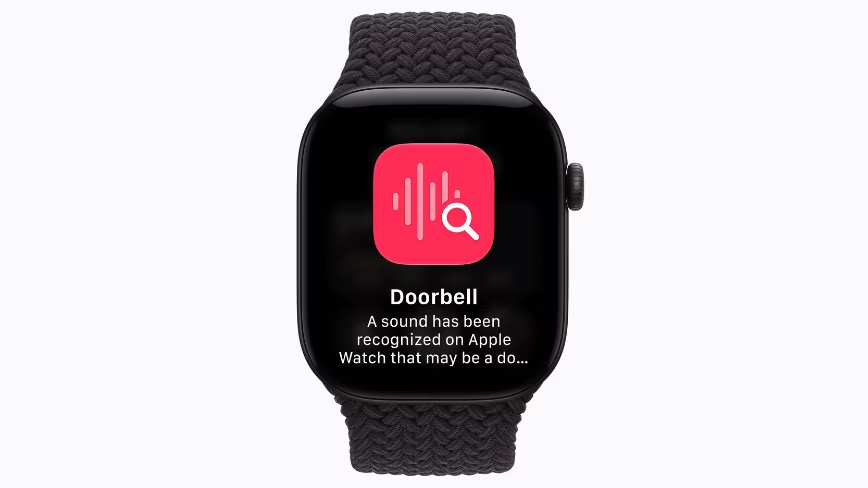
Sound Recognition on Apple Watch Series 12 alerts people who are deaf or hard of hearing to sounds such as sirens, alarms, doorbells and a baby crying, even when their iPhone is not nearby. Credit: Apple Apple announced Siri Recap and Live Rewind for its new watches on 9 September. The first summarises the conversations a wearer has during the day. The second puts the last 15 seconds of speech on screen as text.
Lawyers in four US states now say the features may test state eavesdropping law. Those laws require everyone in a conversation to agree before anyone records it. Bloomberg’s Natalie Lung put the question to attorneys in California, Massachusetts, Pennsylvania and Washington on 11 September. Those states generally prohibit intercepting a private or confidential conversation without the consent of everyone involved.
Around half a dozen more require the same, including Illinois and Florida. None of the lawyers she spoke to was convinced that Apple’s protections would shield a wearer. Both features are opt-in and arrive in beta later this year. A user enables them when setting up the watch, or afterwards from Siri Settings.
A user can also confine Siri Recap to set hours or set places, or switch it on by hand from Control Center. Apple announced the pair alongside the iPhone 18 Pro, which ships without Siri AI in Europe. Whether processing counts as recording Apple says neither feature creates an audio file. The attorneys raised a narrower question.
Speech processed continuously, with no conventional recording at the end of it, may still count as interception under state law. Joe Simons, a criminal defence attorney in Boston, said the nuances have not been litigated in Massachusetts. He expects the issue to arrive there as a case of first impression. Phil Lauer, a defence attorney in Pennsylvania, drew a finer line.
The technology is “very close to being legal, because it’s not an individual who is actually receiving and using this data,” he said. He added that the opposite argument can also be made, because the device picks up audio and interprets it. How the courts see it is a question that is going to come up, Lauer said. Mark Blair, a principal at the Seattle firm Blair Kim Moeller, went further.
Interception does not cover only the person who keeps a recording for later playback, he said. A wearer could face a criminal charge even after the content is gone from the watch. Blair said a wearer has to announce that they have an Apple Watch and that it is recording. “Absent that, it is a criminal violation,” he said. What Apple’s own document says happens to the audio Apple set out both flows in an Audio Intelligence privacy overview.
For Live Rewind, microphone audio runs into a buffer inside the Secure Exclave on the S11 chip. New audio continuously overwrites the old. A double-press of the Digital Crown sends the preceding 15 seconds to the paired iPhone. On-device speech recognition turns that into text, and the phone then discards the raw audio.
Siri Recap works differently. A lightweight model on the S11 chip decides whether speech is happening nearby. Apple says that model neither transcribes nor records. Once it detects a conversation, audio enters the protected buffer.
The watch encrypts it and sends it to the Secure Exclave on the paired iPhone, which alone holds the key. The watch deletes its own copy as soon as the transfer completes. Max Weinbach wrote on X that Apple has shipped a Secure Exclave inside the iPhone since the iPhone 16. The phone transcribes the audio.
An on-device model then cuts the transcript to less than half its length, stripping filler words and anything that suggests tone. A safety model screens what comes out. Apple then encrypts the condensed text and sends it to Private Cloud Compute. Calendar data, Now Playing information and broad location labels such as home, work or school travel with it.
The text carries no precise location and no specific points of interest, Apple says. Categories such as “grocery store” may appear. Recaps vanish after seven days unless a user saves them. Apple disputes that anything is recorded Apple rejects the description of these features as recording conversations.
People have long had tools for taking notes, including phones and wearables, and these are no different, the company said. Audio runs on secure hardware that the operating system, Apple and anyone else cannot reach. Because no recording exists, nobody can share, forward or hand over anything. Business Insider reported an exchange from launch week.
Tom’s Guide editor in chief Mark Spoonauer asked chief executive John Ternus about the backlash against smart glasses. Some people call them “pervert glasses,” a phrase Apple marketing chief Greg Joswiak called quite a marketing slogan. Apple wanted the people around a user to feel comfortable about the feature existing, Ternus said. Joswiak made a further point about the missing file.
Apple never holds the audio, so nobody can compel it to produce one, he said. The notes stay at a high level and skip the material that other products collect, he said. One feature chimes, the other does not Live Rewind announces itself. The watch plays a chime even on silent or with headphones connected.
A full-display animation runs, and a microphone indicator appears. Siri Recap carries no equivalent signal while it runs through the day. Apple’s document gives the reason: there is no audible signal because the watch keeps no raw audio. Adam Schwartz went at that gap.
The Electronic Frontier Foundation’s privacy litigation director said people have no practical means to consent to or decline recording, and should think twice out of respect for the conversational privacy of others. Always-on monitoring of conversations is an unacceptable burden on that privacy, Schwartz said. Colin Zick, who chairs the privacy and data security practice at Foley Hoag, drew a comparison with Zoom. That company no longer lets users save or download the closed captions from a meeting. “What does that suggest?
That they’re worried about this very issue,” Zick said. His advice is to treat the watch features as an interception under the wiretapping statute and ask permission first. The devices that already do this press a button first Purpose-built recorders exist, and they behave differently. Plaud and Pocket start listening only when a user presses a button.
TNW covered Plaud’s $250 recording earbuds in August, and reported in July that people are recording every conversation with AI note-takers while the person across the table has no idea. Sarah Perez wrote for TechCrunch that Plaud tells customers to obtain legally required consent before recording, and that Amazon’s Bee terms make users alone responsible for the law on minors’ data privacy. Taking a photo or a video needs an obvious movement, she wrote. A double-press on a crown does not.
What has not been tested Apple saves no audio, so a court would have no audio to weigh. Perez noted that nobody knows how the system will handle text-only transcripts. The absence of audio could make them harder to authenticate, she wrote, and the rules on evidence vary by state. Todd Dailey, who spent 22 years at Apple, wrote on LinkedIn that lawyers have long nights ahead.
Two more items sit just outside the current question. Apple is still deciding on cameras for the smart glasses it plans for next year, and it is working on camera-equipped AirPods. Meta’s glasses carry a recording light, and TNW reported in July that a $2 sticker defeats it. Also tagged with













Leave a Reply