
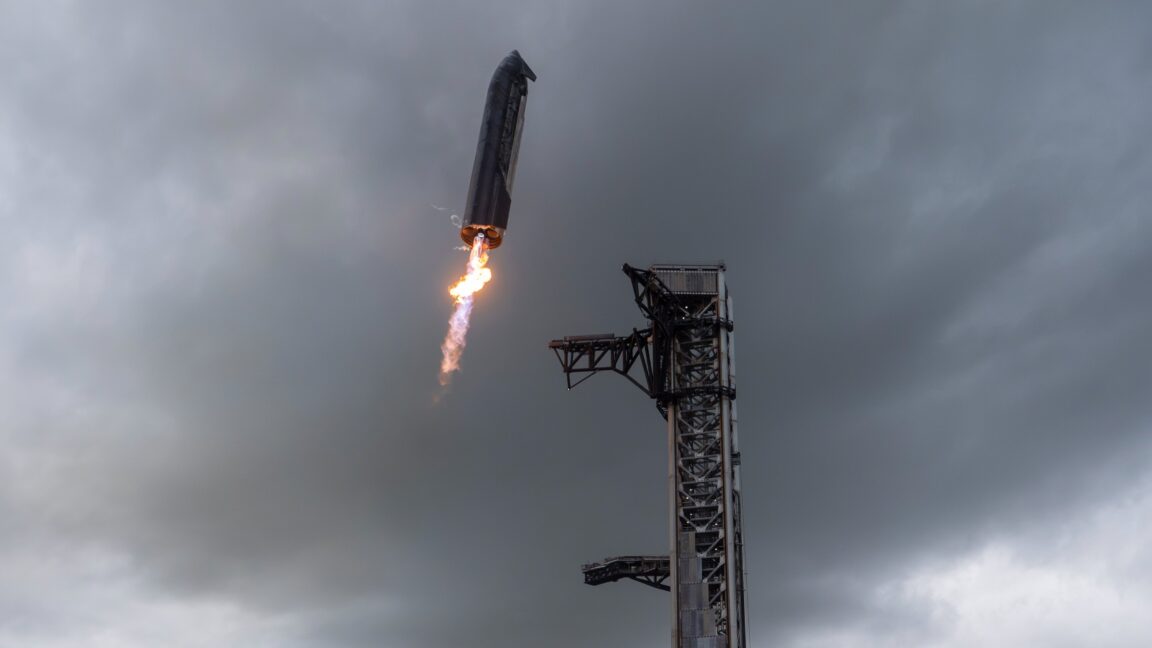
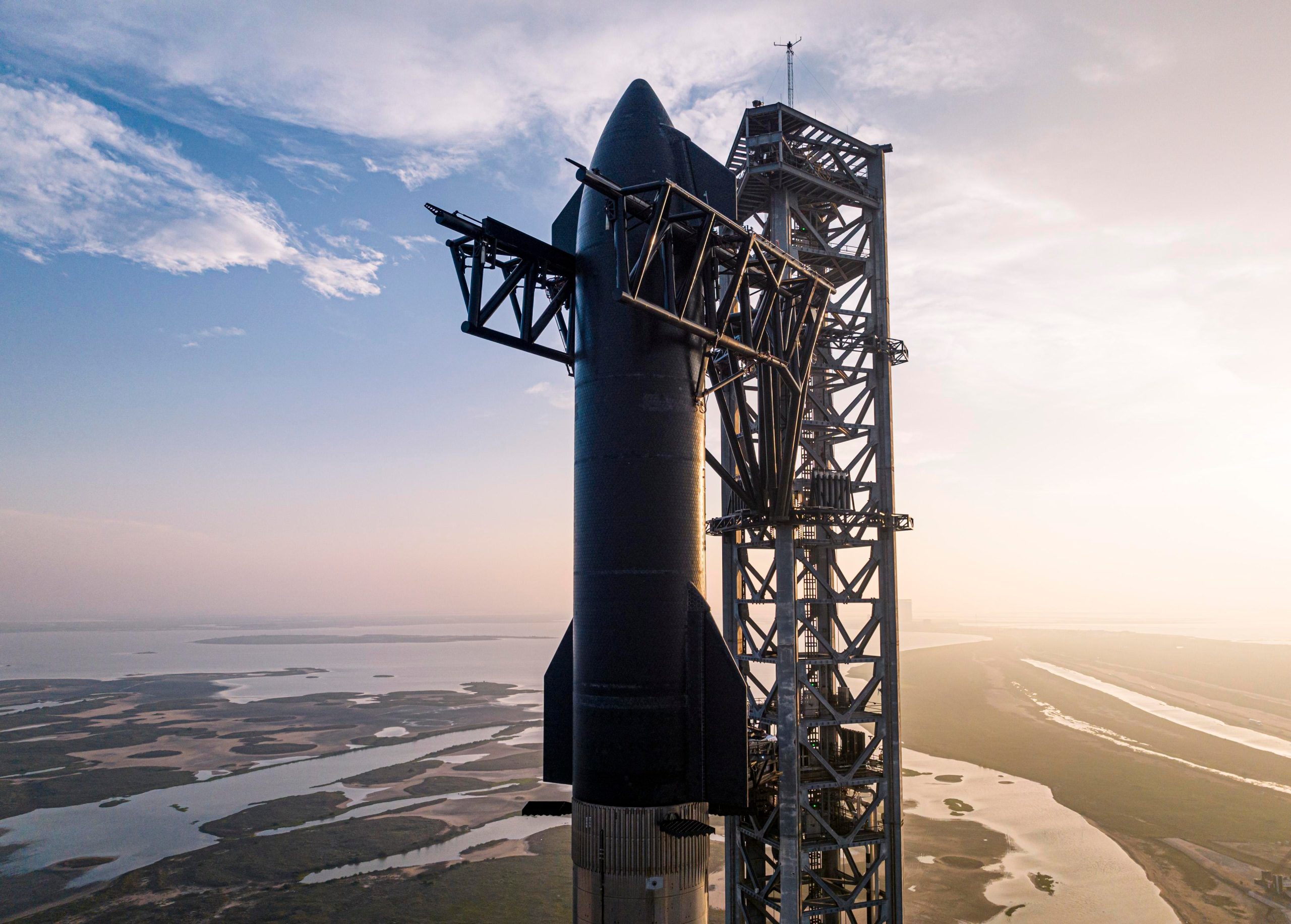
Text settings Story text Size Small Standard Large Width * Standard Wide Links Standard Orange * Subscribers only Learn more Minimize to nav The stunning return of Starship from the skies to a launch tower in South Texas answered some questions about the future of SpaceX’s ambitious rocket program. Namely, it is now rapidly moving toward rapidly reusable launch. However, it raises other questions. For example, as Starship becomes fully reusable, when might humans fly on the vehicle?
The short answer is pretty simple: If SpaceX prioritizes human spaceflight on Starship, it could happen reasonably quickly. The longer answer becomes more complicated and depends on what one means by human spaceflight. The first people to fly on Starship probably won’t launch from Earth, or land here. Rather, they will probably be NASA’s lunar astronauts.
So there are different timelines for humans flying aboard Starship and landing on Earth. Given what is known publicly, and what Ars has heard privately, here are some educated guesses about all of this. Past is prologue The first thing we can say for sure is that all estimates of human spaceflight on Starship should be taken with a gigantic grain of salt, including those in this article. Putting humans on any space vehicle is a difficult and time-consuming task, even outside of the requirements that NASA would impose for its astronauts.
The original target for launching humans on Starship (then known as the Interplanetary Transport System) set a decade ago was 2024. That was for a Mars mission. Then, in 2018, SpaceX announced a lunar flyby mission on Starship with a target launch in 2023. This dearMoon mission was canceled in 2024.
In 2022 SpaceX and Dennis Tito announced a lunar flyby mission later in the 2020s. More recently, according to sources, SpaceX has been telling individuals interested in launching on Starship that it could begin offering flights by 2029. I probably would not put too much stock in this date. All of this is to say, we cannot learn much from history other than to deeply discount any public launch dates on Starship for humans.
Artemis missions Most likely the first humans to fly on Starship in space will do so after launching from Earth inside the NASA Orion spacecraft. Once in orbit they will then dock with Starship before transiting to the Moon, landing there in Starship, launching from the Moon back to Orion, and then returning to Earth inside NASA’s spacecraft. NASA signed an agreement with SpaceX to develop Starship as this “Human Landing System” in 2021, with a lunar landing targeted for 2024. To no one’s surprise, this target has moved to 2028, and there remains considerable uncertainty about the viability of this date.
Nevertheless, the success of Saturday’s tower catch should help propel the Starship program toward a higher launch cadence, which is essential for lunar missions. It therefore seems plausible, but not certain, that humans could land on the Moon inside Starship before the end of this decade. Again, how soon SpaceX achieves this target will depend upon its prioritization of a Human Landing System, among its other major goals to accomplish with Starship. At this point SpaceX appears to be more focused on revenue-generating activities such as launching Starlink, and eventually, Starmind data center satellites.
Human landings on Earth Much has been made about the fact that Starship does not have a launch abort system—a feature of most human spacecraft that allows a crew vehicle to be rapidly pulled away from an exploding rocket. This may not matter should SpaceX conduct its own human spaceflight missions. Unlike NASA, which imposes detailed human-rating requirements on vehicles carrying its astronauts, the Federal Aviation Administration does not certify commercial spacecraft as safe for passengers, instead operating under a regulatory framework that emphasizes informed consent and protection of the uninvolved public. Should SpaceX reach the point where it can launch Starship reliably, it will have the confidence it needs to press forward with human flights. Conceivably, this could happen within a few years.
According to potential customers, SpaceX is developing variants of the Human Landing System Starship for human flights, potentially carrying a few dozen people to the Moon. And such a prospect is tantalizing, for the interior of Starship’s pressurized cabin is almost unimaginably large for a spacecraft. A single Starship lunar lander has a pressurized habitable volume greater than the comparable volume of the International Space Station. This would be extraordinary.
Yet it is not a simple step to go from the current lunar lander design to an Earth lander. NASA’s lunar lander will never need to experience the tremendous heating of atmospheric reentry or perform the dramatic flip maneuver and propulsive landing that Starship uses to return home. Certifying those capabilities for human passengers, particularly on a vehicle without a traditional launch escape system, is an entirely different challenge. Moreover, putting together a commercial human spaceflight business on Starship would be a time-consuming process, and very likely would not be nearly as profitable as launching Starlink satellites into space.
And the risk is far greater—spaceflight remains dangerous, and the loss of a human crew would be a major negative for a publicly traded company. On the other hand, losing dozens of Starlink satellites on an errant launch would be a blip. Despite Starship’s enormous theoretical capacity, SpaceX has also shown little interest in developing it as a crew transportation vehicle for commercial space stations in the near term. Several private space station operators have approached SpaceX about the possibility of Starship bringing astronauts to and from their stations.
SpaceX indicated it was not interested. Putting all of this together, I would not expect humans to land on Earth in Starship before 2030, and plausibly not until at least the mid-2030s. Eric Berger Senior Space Editor Eric Berger Senior Space Editor , about the rise of SpaceX; and Reentry, on the development of the Falcon 9 rocket and Dragon. A certified meteorologist, Eric lives in Houston. 0 Comments










Leave a Reply