
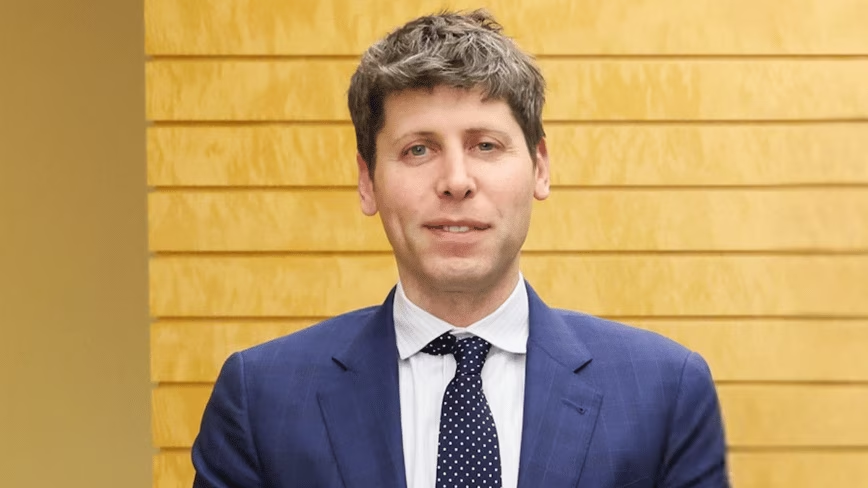
Sam Altman at the Japanese Prime Minister’s Office in Tokyo in February 2025. Credit: Prime Minister’s Office of Japan / CC BY 4.0 via Wikimedia Commons (cropped) “Fully autonomous RSI is not happening today, and we should not pursue it unless and until it can be done safely,” OpenAI wrote on Monday. OpenAI set this out in a proposal published on 21 September. In it, the company calls on the United States to lead an effort with other countries to develop global AI standards for frontier models.
The focus includes RSI, or recursive self-improvement. OpenAI uses the term for AI systems that take on more of the work of developing their own successors. The company warned that RSI done without care could leave humans unable to oversee research processes they no longer understand. It cited the Hugging Face incident it disclosed as a preview of those risks.
OpenAI said that incident was not a direct result of RSI. Standards, not licences OpenAI suggests building on the network of AI safety institutes set up in Australia, Canada, Germany, France, Kenya, Japan, Korea, Singapore, India and the UK. Standard setting would run through the US Center for AI Standards and Innovation (CAISI) and national industry bodies. It would focus on frontier models, measured by capability benchmarks, and on the benefits and risks of automated AI research. “These technical standards would not be licenses, mandatory prerelease review, or approval requirements for AI models.
National governments would decide whether and how to incorporate these standards into their own legal systems,” the company wrote. OpenAI said the work should consult open and closed model developers, independent experts and academia. The standards should not favour particular companies, countries or business models. The company pointed to aviation and financial stability, where countries share technical standards without giving up national authority.
It lists three areas the standards could cover. The first is measuring RSI-relevant progress and how much autonomous research happens inside an AI company. The second is human oversight, including which automated research processes should trigger immediate human review. The third is how to classify, track and report incidents, with common severity levels.
OpenAI named its own misalignment reporting framework as an early contribution. The company also wants governments and critical infrastructure operators to set up secure channels for sharing threats. It said dialogue between the United States and China in these areas would be a positive step, and that upcoming talks come at an opportune time. Why OpenAI says the US should lead “The United States is well positioned to lead because its AI industry is at the technical frontier, and it still stands in a privileged global network position in critical areas such as finance, trade, defense, technology, and information systems,” OpenAI wrote.
Leading now, the company added, will decide whether the US shapes the global framework or watches a fragmented system take hold around it. A week of AI diplomacy The proposal landed in the middle of that diplomacy. Over the weekend, Treasury Secretary Scott Bessent said the US and China had agreed to create a US-China AI dialogue, Bloomberg reported. Washington has also proposed an AI incident alert system to Beijing.
On Monday, President Donald Trump repeated on Truth Social that he favours a light touch on AI, Business Insider reported. He also wrote: “We will be careful, and that’s why we have the Department of Justice, and other Law Enforcement bodies, that will rein things in if we have to.” Earlier that day, Bessent told CNBC the administration would not grant frontier AI labs protection from liability, according to Business Insider. On Tuesday, OpenAI set out priorities for independent assessors of its models. At the UN General Assembly the same day, Secretary-General António Guterres warned of AI’s dangers and called for global cooperation.
Trump spoke soon afterwards and dismissed the idea as a “globalist scheme”, Bloomberg reported. In the same General Assembly speech, he said the US was renaming AI “super intelligence”. Altman takes it to the Security Council Sam Altman is due to brief the UN Security Council in person on Wednesday afternoon. Anthropic CEO Dario Amodei will join by video, alongside Yoshua Bengio and Hugging Face CEO Clément Delangue.
French foreign minister Jean-Noël Barrot chairs the session. According to Security Council Report, it is the council’s first meeting focused on the safety risks of increasingly capable AI, including the potential loss of human control. In a briefing before the speech, OpenAI representatives said Altman would take the role of “pragmatic centrist”, Bloomberg reported. He will promote common safety standards without holding back innovation or concentrating power in a few companies.
Asked about Trump’s comments, OpenAI said it is not endorsing any specific international regulatory body. Its spokespeople said the UN could play a role, and that countries may reach different approaches through democratic means. Altman first discussed the idea of a US-led global body in July, according to Bloomberg. On Thursday, he will attend the White House state dinner for Chinese President Xi Jinping, the company told Bloomberg.








Leave a Reply