
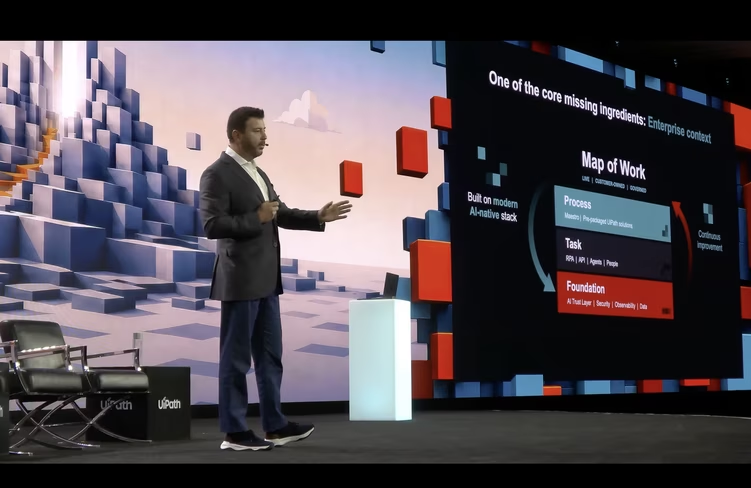
Daniel Dines, founder and CEO of UiPath, presents the Map of Work at UiPath FUSION in Las Vegas, 23 September 2026 Credit: UiPath “Without this manual, nobody will really succeed in deploying autonomous AI that we can trust to make decisions and understand how we actually work,” UiPath founder and CEO Daniel Dines said on Wednesday. Dines used his keynote at FUSION, UiPath’s annual conference at the Wynn Las Vegas, to make the case for that manual. He then introduced the product UiPath built to write it: UiPath Cartographer, which builds what the company calls a “Map of Work”. The event marked ten years since UiPath’s first, held in London in 2016 for about a hundred people, Dines said.
The company then had around $3 million to $4 million in annual recurring revenue and a few dozen customers. He told the audience it is now crossing $2 billion, with more than 10,000 customers. The main stage at UiPath FUSION in Las Vegas, 23 September 2026 — Credit: UiPath Three things LLMs cannot do Dines said he wrote a book, The Work That Remains, with AI. He used Claude and ChatGPT side by side, one as ghostwriter and sparring partner, the other for editorial review.
Every attendee will get a copy. Writing it, he said, led him to three limits of large language models. The first is consequence. An LLM does not bear the consequences of its actions, and he said most enterprise actions have them.
The second is learning. “LLMs don’t learn. They have memory, and memory is a very different thing from learning,” Dines said. The third is what he called exactness. LLMs are probabilistic, he said, while a payment has to be right every time.
Dines said he sees no technology on the horizon that fixes these three limits. For an LLM to work inside a company’s processes, Dines said, it needs a complete, detailed manual of that work. No company has one, he added, and consultants’ versions go out of date within weeks. How Cartographer builds the map Cartographer takes in process charts, process-mining diagrams, documents and standard operating procedures.
It can also question a subject-matter expert, ask them to record their screen and ask why they took a different path. From that, it produces a first Map of Work. Dines called that first map “inevitably incomplete”. Coding agents then build automations from the map.
When an agent handles a case, a human reviews its suggestion and makes corrections. UiPath stores those corrections in what it calls a Decision Ledger and feeds new exceptions back into the map, Dines said. According to UiPath’s announcement, its coding agents are now generally available. Claude Code, Cursor, Codex and Antigravity can also work natively on its platform.
Cartographer is available now, and the company did not give pricing. Daniel Dines and Kei Yamamoto of SMBC at UiPath FUSION in Las Vegas, 23 September 2026 — Credit: UiPath SMBC: 73% is not enough Kei Yamamoto of Sumitomo Mitsui Financial Group (SMBC), which Dines called one of UiPath’s largest customers, said the bank has automated more than six million hours since 2017. That freed roughly 3,000 employees for other roles, he said. This year, an accounting agent built with UiPath received more than 10,000 reimbursement requests in one month. “If a process has three steps and each is 90% accurate, end-to-end accuracy drops to about 73%, not acceptable for accounting,” Yamamoto said.
SMBC now combines rules, historical data, generative AI and human checkpoints, so exceptions go to people. Yamamoto said the bank plans to test Cartographer next. Customers on caution On a customer panel, Nikki Harper of Mayo Clinic said teams first have to understand a process end to end. William Abrams of Medline said production at 73% accuracy is “unthinkable” for his company, because its hospital customers expect 99%.
He added that agents running across the business seem like more autonomy than Medline or its customers are comfortable with yet. A second panel covered UiPath Test Cloud and what UiPath calls a “dark testing factory”, where testing runs autonomously. Forrester analyst Diego Lo Giudice said the goal should not be full autonomy for its own sake. “The dark testing factory has a future if it builds trust,” Lo Giudice said. The cover of Daniel Dines’s book The Work That Remains, shown during his FUSION keynote on 23 September 2026 — Credit: UiPath “Keep hiring juniors” Dines closed on the workforce.
He said AI cannot provide initiative or will, and that people give AI its goals. He called the decline in hiring juniors the wrong approach, a view he has voiced before. He has also told bosses not to cut jobs too fast because of AI. Junior hires now have to learn from the people around them, not by writing simple functions AI can already write, he said.
Senior staff, in turn, need to mentor them.






Leave a Reply