
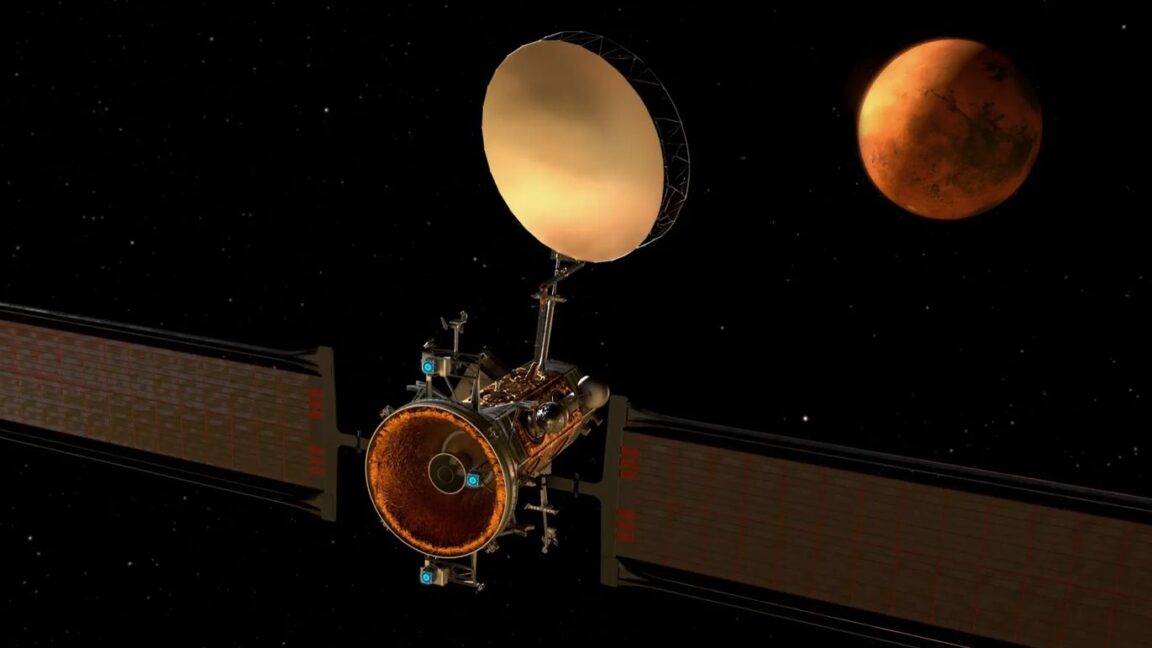
Text settings Story text Size Small Standard Large Width * Standard Wide Links Standard Orange * Subscribers only Learn more Minimize to nav In theory, developing a spacecraft that will fly to Mars, insert itself into orbit around the red planet, and relay transmissions back and forth to large satellite dishes on Earth is a relatively straightforward proposition. NASA’s procurement of a “Mars Telecommunications Network” spacecraft, however, has turned out to be one of the most engrossing dramas of the year for the US space agency. The agency finally reached a decision earlier this month, selecting Blue Origin to develop, launch, and operate a $700 million spacecraft at Mars. However, the main competitor for the award, Rocket Lab, was not happy—at all.
On Friday, the company filed a protest of NASA’s decision with the US Government Accountability Office. “NASA’s award decision appears to be inconsistent with the eligibility criteria mandated by Congress,” the company said on X. “In addition, the agency’s punitive review of Rocket Lab’s technical volume was inconsistent, making incorrect assertions and conclusions.” In response, Blue Origin said the protest could potentially delay the mission’s goal of launching in 2028. “We remain confident in the strength of our proposal, in NASA’s rigorous selection process, and in Congress’s clear intent to support competition for the Mars Telecommunications Network program,” the company said. “We look forward to advancing this urgent mission. With limited Mars launch windows, any delay will greatly risk the timely deployment of this critical communications capability.” One Big Beautiful spacecraft Rocket Lab’s protest announcement references “eligibility criteria mandated by Congress,” and this appears to be the heart of the issue at hand. The origin of the Mars Telecommunications Network spacecraft came as part of the supplemental funding package for NASA provided by the “One Big Beautiful Bill” passed by the US Congress in 2025. It was not widely expected in the space community, but the new start was welcome, given that NASA’s spacecraft orbiting Mars are aging.
This NASA-specific legislation, led by Sen. Ted Cruz (R-Texas), included some curious wording. It specified that the Mars orbiter must be selected from among US companies that “received funding from the Administration in fiscal year 2024 or 2025 for commercial design studies for Mars Sample Return; and had proposed a separate, independently launched Mars telecommunication orbiter supporting an end-to-end Mars sample return mission.” The reference to “commercial design studies” meant companies that proposed faster and more affordable missions to return samples from Mars, which were selected in 2024 and 2025. Rocket Lab is one of several companies eligible to compete based on this commercial design study requirement.
Other eligible bidders include: Blue Origin, L3Harris, Lockheed Martin, Northrop Grumman, SpaceX, Quantum Space, and Whittinghill Aerospace. This seems reasonable, as those companies had all been working with NASA on Mars spacecraft concept studies. But why, some Capitol Hill sources wondered, must the bidder for a relatively straightforward orbiter around Mars have previously proposed an orbiter as part of an “end-to-end” mission to return samples from Mars? Slide from Rocket Lab Q2 2025 Investor Update.
Credit: Rocket Lab Slide from Rocket Lab Q2 2025 Investor Update. Credit: Rocket Lab This “end-to-end” language, according to sources, was intended to favor Rocket Lab and its proposal for a telecommunications orbiter. Around the time of the legislation’s passage, Rocket Lab seemed to believe it was the only company to propose a qualifying “end-to-end” mission, which it claimed to shareholders during its Q2 2025 investor update. Why was this decision made?
There is still a lot we do not know about this procurement. Perhaps most important is why Congress wrote the language in the bill the way it did. Sources said that while Cruz’s office was responsible for the language overall, Sen. Roger Wicker (R-Miss.) was involved with the Mars Telecommunications Network language.
So why did NASA ultimately decide to select a spacecraft based on Blue Origin’s Blue Ring technology instead? It’s possible the agency did not have confidence in Rocket Lab completing development of the spacecraft and its Neutron rocket by late 2028, when the mission is due to launch. It’s also possible that selection officials felt like Blue Ring was a more capable spacecraft that better fulfilled the agency’s needs. We don’t know the answers to these questions because NASA has yet to publicly release a “source selection statement,” which provides the technical rationale for why a decision was made.
It is strange that, nearly two weeks after an award was made, this document is still not public. All we really know is that Rocket Lab, from its statement, feels as though NASA’s review of its technology was “punitive” and “inconsistent.” All of this continues to produce uncertainty around an award process that has been hotly contested in technical proposals, political maneuvers, and on social media, where Rocket Lab and Blue Origin have been sniping at one another. While the spacecraft may not be super exotic, there is a lot at stake here. This is the first time NASA is using a fixed-price contract to select a US company to build a spacecraft, launch it, and operate the network around another planet.
The winner of this competition, Blue Origin, at least for now, will have a first-mover advantage in future Solar System exploration for NASA. Eric Berger Senior Space Editor Eric Berger Senior Space Editor , about the rise of SpaceX; and Reentry, on the development of the Falcon 9 rocket and Dragon. A certified meteorologist, Eric lives in Houston. 11 Comments














Leave a Reply