

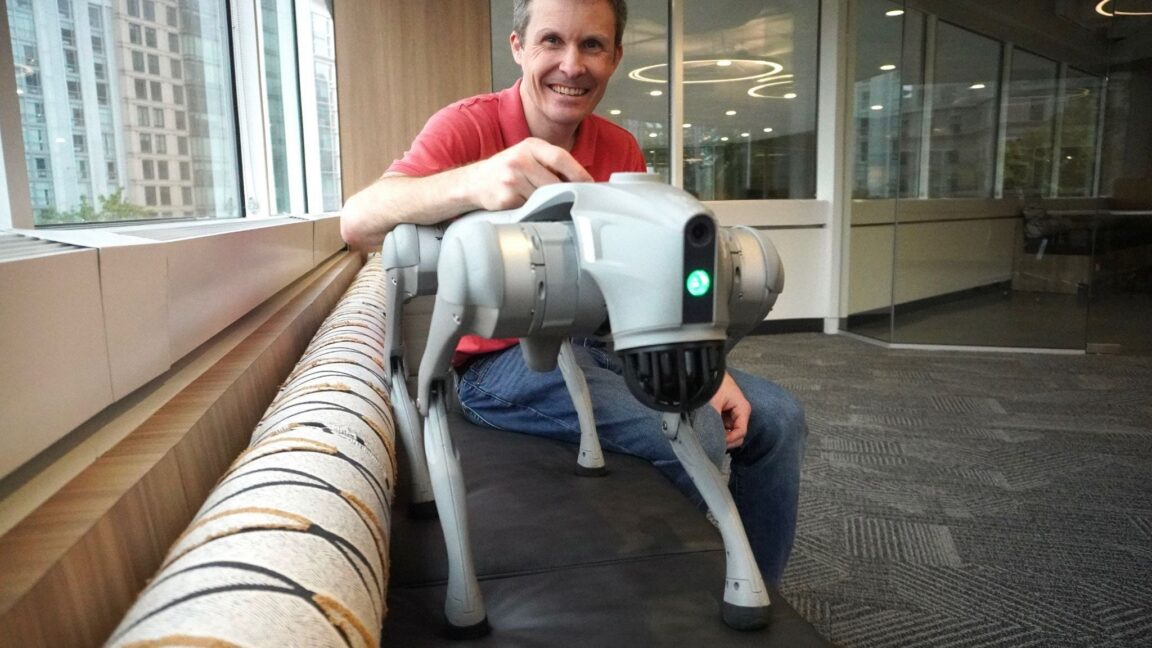
Photo with Greg Keith Credit: Greg Keith TL;DR44% of organizations are scaling AI enterprise-wide (McKinsey), yet 95% of generative AI pilots show no measurable bottom-line impact (MIT). Greg Keith’s Scaling Instability Curve framework marks the point where delivery velocity outpaces architectural maturity. He argues organizations become unstable when governance fails to scale alongside technology, and that the first question before any change should be “Why are you doing this?” AI has crossed a decisive threshold in the enterprise. McKinsey’s 2026 global survey found that 44% of organizations now report scaling AI across the enterprise, up from 38% a year earlier, with the figure reaching 54% among companies generating at least $1 billion in annual revenue.
The question facing technology leaders then is whether every organization is ready for the speed AI makes possible. The warning signs are already visible in the gap between adoption and organizational change. McKinsey found that workflow redesign has the strongest association with AI’s EBIT impact, yet a 2025 MIT study found that 95% of generative AI pilot projects do not have a measurable impact on organizations’ bottom line. Against this backdrop, technology appears to be moving into established systems faster than many companies are changing the way those systems operate.
The warning signs may already be visible in the gap between adoption and organizational change. Cloud economics adds another layer of pressure. The FinOps Foundation’s 2025 research, covering organizations responsible for more than $69 billion in public-cloud spending, found workload optimization and waste reduction remained the leading priorities. AI spending was already being managed by 63% of respondents.
In that sense, scale could turn a seemingly efficient technology decision into a materially different financial commitment. The technology itself is rarely the entire problem. An organization can introduce another platform, increase headcount, automate a process, or restructure a team while leaving the underlying decision-making untouched. The danger may emerge gradually, through recurring failures, longer recovery periods, escalating costs, and increasing friction between the people responsible for making the system work.
Greg Keith, founder of MGKgroup, has spent more than 25 years across engineering, data, cloud, architecture, and technology leadership observing those patterns. His Scaling Instability Curve is a framework developed from those recurring real-world experiences. Keith positions it as an observational framework that marks the point where delivery velocity outpaces architectural maturity and operational control. Created to address systemic engineering drag, it details how rapid system growth can lead to a compounding phase of high costs, blurred team ownership, and slower deployments.
In his view, organizations become unstable when governance and decision-making fail to scale at the same pace as the organization itself. The pattern, Keith argues, often begins with a reasonable response to an emerging problem. A company may hire more people, change a platform, or adopt a new technology, expecting the intervention to relieve pressure. Yet the original cause can remain untouched.
Keith says, “I often return to one question as the test for whether a proposed change deserves to happen: ‘Why are you doing this?‘” He argues that the question removes emotion from the decision and forces leaders to establish what they are actually trying to gain. His “Shiny New Penny” observation applies directly to the current AI cycle. Keith has watched organizations encounter a new tool at a conference or through industry enthusiasm and quickly decide it will solve their problems. AI has intensified that instinct. “AI is a tool that should be used as such,” he argues.
Its purpose is to help teams work more effectively and at a higher pace rather than serve as an automatic substitute for people. Experience, according to Keith, becomes particularly consequential when systems fail under pressure. He uses commercial aviation to point out the difference. The value of an experienced pilot can become most apparent when an unexpected event leaves no time for collective experimentation. “That’s what you’re paying for,” he argues. “It’s that kind of experience to know exactly what to do when there’s no choice.” His concern is that junior teams using AI can move faster while lacking the experience required when a production failure becomes critical.
Cloud costs provide another expression of the same problem. Keith recalls an AWS database deployment that appeared capable of reducing costs, only for transaction-based charges to push spending sharply higher once the system encountered heavy I/O demand. The lesson was not that the technology was inherently flawed. The issue was that the economics changed at scale, while the organization had failed to account for that change before committing to the architecture.
Keith argues that leaders should watch the movement of the organization, rather than wait for a major failure. Small fluctuations are expected during growth. A more serious signal appears when failures become more frequent, or recovery takes progressively longer. “The small vibrations are not a big deal,” he explains. “But if you start to notice that you’re having failures more often or the recovery of a failure is taking longer each time, that’s a good indicator that something more serious is happening.” The discipline, ultimately, is one of institutional attention. Leaders need to understand why a change is being made, listen to the teams closest to the problem, and recognize the early movement along the Curve before instability becomes a crisis.









Leave a Reply