
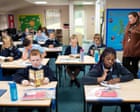
Year six pupils at Willowpark primary academy in Oldham, Greater Manchester. Photograph: Oli Scarff/AFP/Getty ImagesView image in fullscreenYear six pupils at Willowpark primary academy in Oldham, Greater Manchester. Photograph: Oli Scarff/AFP/Getty ImagesOracy added to year 6 tests in changes to national curriculum in EnglandSpeaking and listening assessment criticised by unions, saying pupils ‘are already among the most tested in the world’A new assessment of speaking and listening will be added to the battery of tests faced by 11 year-olds in England, as part of the changes to the national curriculum to be announced by the government this week.The assessment of oracy skills will come on top of existing tests known as Sats for maths, reading and spelling, punctuation and grammar, as well as assessments of writing and science for pupils in year 6, the final year of primary school.Younger children in state schools also have a national phonics check in year 2, when most are aged seven, and a multiplication tables test in year 4.Teaching GCSE topics younger risks turning schools into ‘early exam factories’, Powell warnsRead moreThe reforms to the national curriculum, which the education secretary, Lucy Powell, heralded as “the biggest in a generation” will also add a reading test for pupils in year 8 at secondary school, as well as an oral exam that will count towards GCSE English language grades in year 11.The year 6 oracy assessment will be carried out by teachers but was criticised by teaching unions. Daniel Kebede, the general secretary of the National Education Union (NEU), said teachers were already being “pummelled with demands to drill children in repetitive ways” to pass similar assessments.Kebede said: “The NEU fully supports plans to boost oracy in schools, beginning in primary, but what is not needed is for this to be a formal test in year 6.“Primary children in England are already among the most tested in the world.“There is so much evidence that it is high-quality, low-stakes ongoing assessment of how a child is doing – by their teacher – that helps children progress and learn, and that formal tests do not support learning.”The additions come as Powell has vowed to “slim down” the academic content in other parts of the curriculum, creating more time for a wider range of skills including vocational subjects to be taught.Michael Gove, the former Conservative education secretary, praised Powell as “a sincerely dedicated reformer” and backed her plans for prescribing dedicated reading time in schools.But Gove said he feared planned reductions could lead to students learning less in key academic subjects such as science, history and geography.Gove told Sky News: “One of the problems in any education reform is that if you listen too much to those who say that the current model is asking too much, that you do what we’ve often done in the past, which is you indulge the soft bigotry of low expectations, particularly for poorer students.”skip past newsletter promotionafter newsletter promotionSchools in England must set aside time for pupils to read for pleasureRead moreBut speaking to the BBC, Powell said the Department for Education’s reforms would add breadth to what children were learning in school, including what she described as “human skills” needed in the AI era.“This is about raising standards in more subjects, and giving young people more pathways and more options to success,” Powell told the BBC’s Laura Kuenssberg.“What I would say to the Conservatives and to others is that you can’t take all the credit for the good and not take responsibility for the bad.“We have nearly a million young people not in education, employment or training in this country today and they were all educated under the Conservative government.
We have high levels of persistent absence that have not gone down over the last 15 years.“The disadvantage gap has not narrowed at all, so disadvantaged kids – especially white working-class kids – have been left behind by a narrow straitjacket view of what good education is.”Explore more on these topicsNational curriculumSchoolsLucy PowellSatsPrimary schoolsDepartment for EducationEnglandShareReuse this content












Leave a Reply