
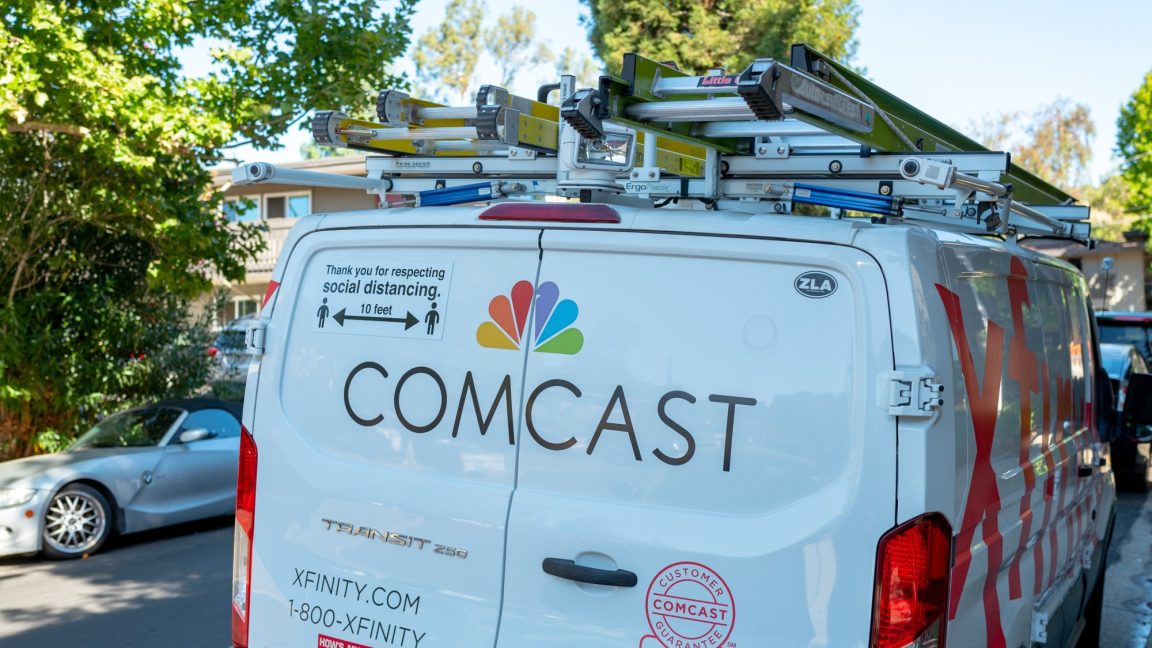
Text settings Story text Size Small Standard Large Width * Standard Wide Links Standard Orange * Subscribers only Learn more Minimize to nav AT&T on Friday accused Comcast of false advertising in a lawsuit challenging the marketing claim that Comcast’s cable broadband service and Wi-Fi is “fiber-powered.” “This case challenges Comcast’s false advertising campaign for its residential Internet service, marketed under the Xfinity brand to consumers nationwide,” AT&T’s lawsuit said. “At the center of that campaign is Comcast’s claim that Xfinity Internet and its associated Wi-Fi service are ‘Fiber-Powered.’” While Comcast has deployed plenty of fiber throughout the US, its cable Internet service makes the final connection to homes with coaxial cable. This results in upload speeds being far slower than download speeds. In contrast, fiber-to-the-home service can provide symmetrical upload and download speeds. Comcast has deployed fiber-to-the-home in only small portions of its cable territory while advertising its service as fiber-powered in the majority of areas where cable makes the final connection.
AT&T’s lawsuit said that in describing its cable broadband as fiber-powered, Comcast “conveys to reasonable consumers the misleading impression that Xfinity Internet is a fiber-to-the-home service comparable to AT&T Fiber. In fact, the vast majority of Xfinity Internet runs over a hybrid fiber-coaxial (‘HFC’) network, where the critical ‘last mile’ connection to the customer’s home uses copper coaxial cable, not fiber.” AT&T has its own history of ads that mislead customers about the nature of its network. It used to advertise 4G LTE service as “5GE” or “5G Evolution,” and displayed a 5GE network icon on 4G phones. AT&T claimed that its 5G Evolution ads “served to educate customers about the billions of dollars AT&T has invested to give customers an outstanding experience,” but the NAD found the term was likely to mislead consumers into thinking they had 5G connections.
AT&T: Fiber-powered is “literally false” AT&T’s lawsuit said that Comcast’s fiber-powered claim “is literally false” because the cable firm’s HFC “architecture is fundamentally different from true fiber-to-the-home services like AT&T Fiber, which deliver fiber optic cables directly to the customer’s premises.” “Describing that service as ‘Fiber-Powered,’ ‘Powered by fiber,’ and ‘the most reliable, fiber-powered Wi-Fi’—particularly alongside Comcast’s own representations that fiber connections outperform ‘copper-based’ alternatives—is literally false or false by necessary implication,” AT&T wrote. “In that context, Comcast unambiguously conveys that Xfinity Internet is delivered to the home over fiber or is equivalent to fiber-to-the-home service, like AT&T Fiber.” AT&T sued Comcast in US District Court for the Northern District of California, telling the court that Comcast violated US and California competition laws. AT&T alleged that Comcast’s fiber-powered advertising is a fraudulent business act or practice and an unfair method of competition. “Comcast should be required to restore to AT&T any and all profits earned as a result of its false and misleading advertising or provide AT&T with any other restitutionary relief the Court deems appropriate,” the lawsuit said. The lawsuit asked for a permanent injunction “requiring Comcast to cease describing its hybrid fiber-coaxial service as ‘Fiber-Powered.’” AT&T said that even if the court doesn’t find Comcast’s advertising to be literally false, it should determine that it is “misleading because it deceives or has the capacity to deceive a substantial segment of reasonable consumers into believing that Xfinity Internet is delivered to the home over fiber alone.” Comcast is cutting jobs in its cable division, which for the past few years has been losing Internet customers to fiber and fixed wireless competitors. Comcast lost 144,000 residential broadband customers in Q3 2026, up from a 91,000-customer loss in the same quarter a year ago.
Comcast is struggling against cheaper Internet service providers, including fiber ISPs. Comcast co-CEO Mike Cavanagh complained in an earnings call last month that some competitors are offering what he called “irrational pricing.” Comcast CFO Jason Armstrong said fiber ISPs are offering $30 to $40 monthly broadband deals in certain markets, and he said this is irrational because deploying fiber costs $1,500 or more per home. What’s fiber-powered Wi-Fi? In December 2025, a Reddit user reported receiving a Comcast advertisement for “fiber-powered Wi-Fi” with speeds of up to 300Mbps for $40 a month before taxes and fees.
The Reddit user asked what fiber-powered Wi-Fi technology is and whether Comcast provides an adapter to connect fiber to its Wi-Fi equipment. “Trying to understand what equipment is this Wi-Fi, because I have a hard time merging radio waves with light waves. Doesn’t match any of my tech knowledge, and I’m very curious about it,” the Reddit post said. A person commenting in response explained that it’s still the same cable service and that “fiber-powered” is Comcast’s new marketing term to describing the existing cable-and-fiber network. “It’s marketing,” the Reddit user wrote. “Now that so many places are offering fiber to the premises, Xfinity needs to work the word ‘fiber’ into their advertising to hide the fact that they still use decades-old, unreliable, DOCSIS technology to get Internet to your home. Their backbone network is fiber, so they call it ‘fiber-powered.’” AT&T previously challenged Comcast’s fiber-powered claims through the advertising industry’s self-regulatory system operated by BBB National Programs’ National Advertising Division (NAD).
The NAD determined in June that Comcast accurately described its mix of cable and fiber technology in a disclosure, but that Comcast didn’t make the disclosure prominently enough. The NAD said: In the challenged advertising, “fiber-powered” appears alongside several other claims, including pricing offers accompanied by separate disclosures. As a result, the coaxial cable disclosure does not stand out within the larger block of disclosures, reducing its prominence. NAD also noted that in certain advertisements, including the “Overview Ad,” the disclosure appears several panels away from the “fiber-powered” claim and may require consumers to scroll to view it.
In addition, the advertising does not include an asterisk or other signal directing consumers to the disclosure. While the disclosure appears in readable black font against a contrasting background, NAD concluded that the disclosure should be more prominent or placed closer to the triggering claim to increase the likelihood that consumers will notice and read it. The NAD recommended that Comcast make the disclosure “more prominent and more proximate to the ‘fiber-powered’ Wi-Fi claim as necessary to ensure that the disclosure is clear and conspicuous.” Comcast said it would comply with the decision, but AT&T’s lawsuit makes it clear that it isn’t satisfied with the current state of Comcast’s advertising. We contacted Comcast and will update this article if it provides a response.
AT&T filed similar lawsuit against Charter AT&T has a similar ongoing battle against Charter, which also describes its cable Internet service as fiber-powered. Charter modified its disclosures in response to an AT&T complaint to the NAD in March, and AT&T sued Charter in August. “Charter deceives consumers by manipulating the word ‘fiber’ in its advertising so it can tout its ‘Spectrum Fiber Broadband Network’ and hide the fact that its network mainly connects to customers’ homes using copper wire,” sa














Leave a Reply