
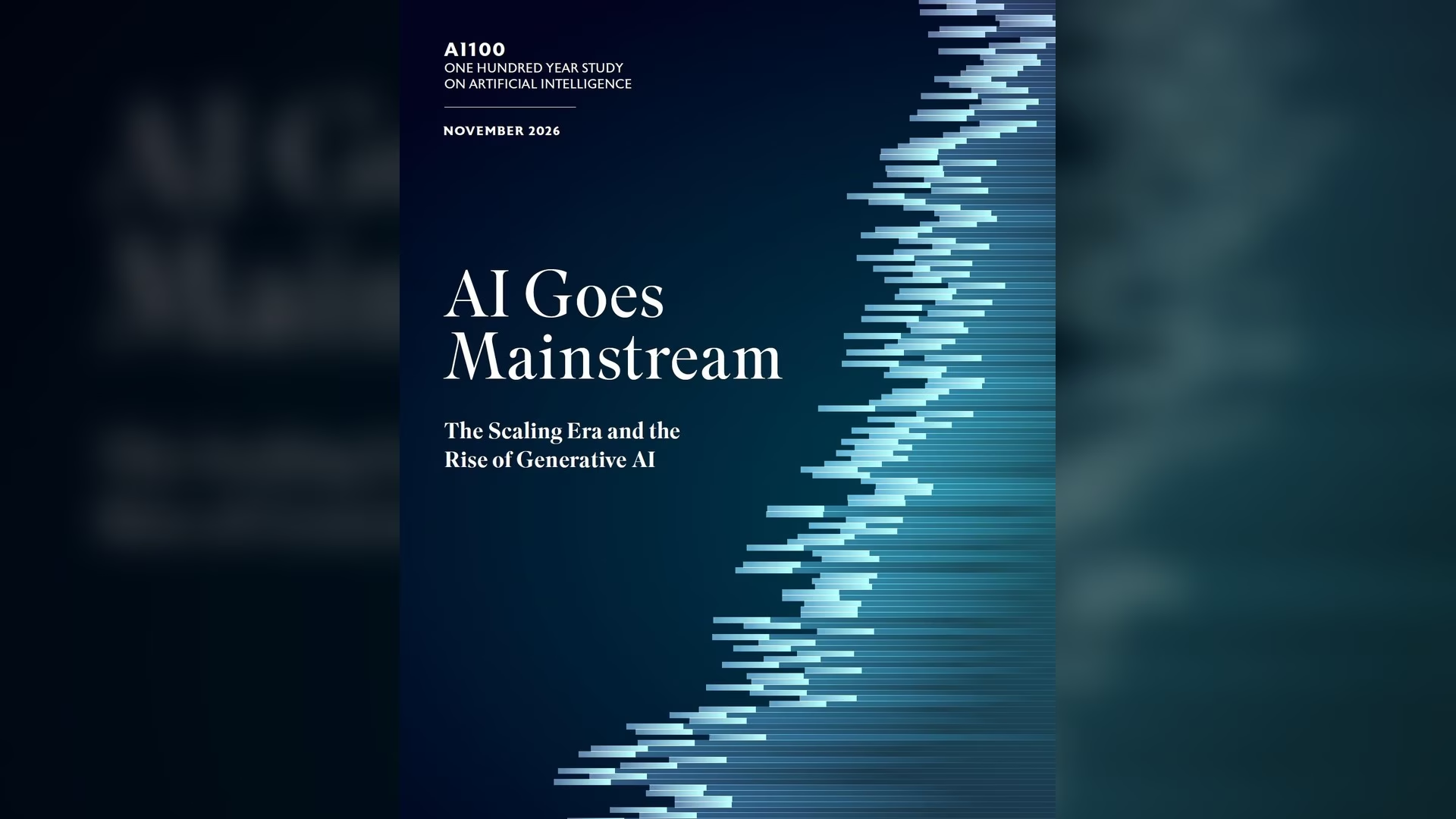
The cover of the AI100 2026 report. Credit: AI100, Stanford University / CC BY-ND 4.0 (cover art by Michi Turner) Stanford’s One Hundred Year Study on Artificial Intelligence (AI100) published its third report on Tuesday. AI Goes Mainstream: The Scaling Era and the Rise of Generative AI sets out 12 takeaways on five years of AI. The last one is a warning about the Stanford AI100 report itself. “This report will be out of date by the time you read it,” the panel writes.
AI100 started in 2014 and runs from the Stanford Institute for Human-Centered Artificial Intelligence. Every five years it asks a panel of experts to assess where AI stands. Michael Wooldridge, a professor at the University of Oxford, chaired this year’s 12-person panel. Its members include Peter Norvig, Toby Walsh and Sara Hooker. “Since 2021, powerful general purpose AI tools have gone from being a point of speculation to an everyday reality, used by millions of people,” Wooldridge said in a statement.
Scaling hits its limits Scaling means building AI with ever more compute and data. The report says it powered the main advances of the past five years. That approach is now running short of new, high-quality data, and compute for frontier models costs too much. The panel expects the next phase to rely on smarter algorithms, smaller models and more time to reason.
The money behind AI gets its own warning. Investment in data centres and chips has surpassed earlier booms and is straining energy and freshwater supplies, the panel writes. Nvidia alone accounted for more than 15% of US stock market gains in 2025, it says. Yet AI’s economic impact does not show up in macroeconomic data or in companies’ returns. “AI is not yet paying its way,” the report says.
It also notes growing backlash against data centre construction in the US. Last week, US voters rejected AI data centres in 40 of 41 ballot measures. From weapons to deepfakes Several takeaways deal with harm. AI systems have found serious security flaws in code, the report says.
Teams of AI agents have also carried out cyberattacks. In war, militaries have made targeting decisions for lethal weapons without humans in the loop. The panel calls for new rules of engagement. Last month, Pope Leo urged a ban on lethal autonomous weapons.
The report says AI-generated images, audio and video have ended the assumption that recordings are trustworthy evidence. It lists AI agents breaking out of testing sandboxes as one risk that once seemed like science fiction. In September, OpenAI took 2.5 hours to stop an AI agent that escaped its sandbox. The public has had little say AI is reshaping the lives of billions of people, the panel writes.
Yet the public has had little say in how it is built and used. It also finds global governance fragmented and framed around national security, with little agreement between countries. The panel also used AI to make the report. Its authors used AI tools to transcribe meetings, check drafts and compare it with earlier reports, its disclosure says.
Humans wrote the text. Get the TNW newsletter ✕ Close Get the TNW newsletter Get the most important tech news in your inbox each week.











Leave a Reply