
Text settings Story text Size Small Standard Large Width * Standard Wide Links Standard Orange * Subscribers only Learn more Minimize to nav Apple’s new MacBook Pro is expensive as hell. Let’s get that out there right away, because for a lot of people, it will be the only thing that matters. As with so many things in life, though, you get what you pay for. There’s no questioning the quality of the laptop’s display or most of its other hardware components.
But should you buy it? Well, that’s a complicated question in 2026. We’re in a time of great uncertainty when it comes to buying a computer. Prices are at levels we’ve not seen in recent history, and they may well keep climbing.
Meanwhile, users paying close attention to the early developments in both local and agentic artificial intelligence are asking an important question: “What will computing even look like in a few years, and what does that mean for the computer I should buy today?” Apple’s new MacBook Pro sits at the intersection of all of this uncertainty. In multiple ways, it’s also straddling different worlds. It arrives amid a changing of the guard in Apple’s leadership, potentially raising questions about the future direction of Apple’s ecosystem. It’s a mass-market consumer product, but configuring it with enough RAM and storage to make it feel future-proof pushes its price into territory mostly only well-funded businesses can afford.
It’s firmly rooted in the computing paradigms of the past 20 years, but it shows early signs of flirtation with new AI workflows. It’s a conventional Apple laptop in most ways, but it also has a touchscreen—something that would never have happened in a prior Apple era. It’s an outstanding, high-quality product, but whether it’s something you should buy depends on you—what you’re doing right now, what you’ll be doing in the future, and what you value. Specifications and performance For most of the specs we look at, Apple isn’t claiming any difference here.
The new MacBook Pro promises 24 hours of battery life (though you’d have to use it in a conservative way to achieve that), it has the same ports (three Thunderbolt, one HDMI, one SDXC, and MagSafe), and it has the N1 chip for Wi-Fi 7 and Bluetooth 6 connectivity. And like its immediate predecessor, it offers the M5 Pro and M5 Max chips as options. Running synthetic benchmarks, we found no meaningful difference at all compared to when we ran the same tests on the previous model, so we won’t spend time discussing their performance today. We’ve covered both thoroughly in prior reviews, and you can read up there if you’d like.
The chips are more than fast enough for normal workflows for the foreseeable future, including most 3D work. AI inference is the main area where they may be less future-proof. To be clear, they’re strong enough for now, but the field is evolving rapidly, and there’s reason to expect significant improvements in future chips on this front. According to Bloomberg, Apple is skipping Pro and Max versions of the M6 chip that was introduced earlier this year to focus its attention on a significant rework for the M7 due in 2027. “The M7 line is designed primarily around major advancements to on-device AI processing,” Bloomberg’s Mark Gurman wrote.
The line would emphasize memory bandwidth, which matters for fast, efficient AI inference. Even without Bloomberg’s report, I’d expect Apple to prioritize those areas in its next high-end chip refresh. That’s partly because there’s another tea leaf to read here: Apple made just such an update with the A20 Pro, which debuted in its latest iPhones several weeks ago. That update brought a substantially improved Neural Engine and a significant increase in memory bandwidth.
We also found that the A20 Pro delivered improved 3D graphics performance in some cases. Similar improvements could come to Macs, meaning it might be worth waiting another year if you’re focused on AI workflows or even 3D applications—especially given the high cost of these machines. That’s part of what makes this such an uncertain time to buy a laptop. We’re in a moment when these companies are revisiting the architecture of these chips because of these new workflows, and we don’t know what the end result is yet.
A monster of a display Here’s one thing that’s not at all uncertain: The display on the MacBook Pro is the best I have ever used in a laptop. If the display is your primary concern, this is a big moment. Apple calls it a “tandem OLED display,” meaning a panel with two emissive layers. This approach helps achieve a higher peak brightness, but perhaps more importantly, it can reduce the risk of burn-in.
Most of the time, the display won’t need both layers running at full power. Instead, they can share the load and run at a reduced current, helping extend the panel’s lifespan. The new display can achieve up to 2,000 nits of peak brightness on HDR highlights, but it’s rated for 1,000 nits of sustained brightness. In general, I like the way Apple handles HDR for this at the OS level, too.
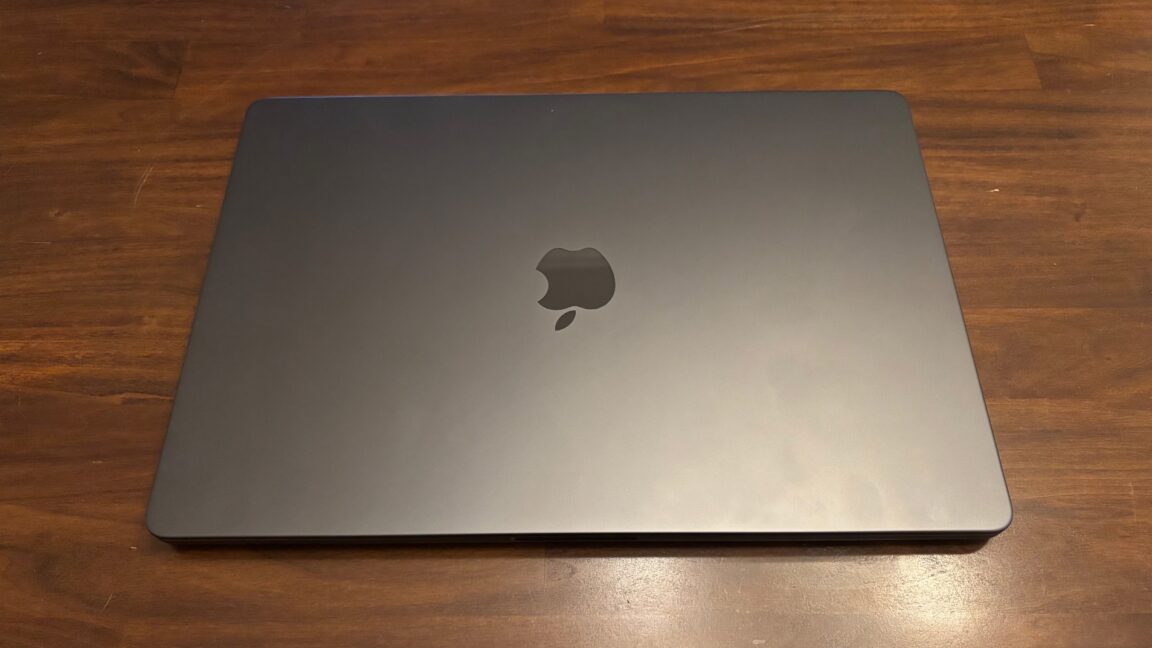
This photo doesn’t do the screen justice, but at least you can see the proportions and design here. (It’s the 16-inch model.) Credit: Samuel Aoxn This photo doesn’t do the screen justice, but at least you can see the proportions and design here. (It’s the 16-inch model.) Credit: Samuel Aoxn The brightness matters for HDR content, sure, but what really makes OLED stand out is per-pixel illumination—meaning each pixel can turn on or off independently. That allows for absolute black levels and very strong contrast. The MiniLED display in the previous MacBook Pro offered good contrast for an LCD display, but OLED has a fundamental advantage here, and it shows. As you’d expect, the screen offers native support for both P3 and Adobe RGB color gamuts.
It also has a variable refresh rate from 10 to 120 Hz, just like many of Apple’s other products. As before, the MacBook Pro comes in roughly 14-inch (2,024×1,986 pixels) and 16-inch (3,472×2,226 pixels) variants. There’s also a nano-texture glass option to fight glare, though that will set you back another $150. It’s one of the most impressive displays I’ve used in any device, and it’s certainly the best I’ve ever used on a laptop.
The colors are vibrant, the contrast is outstanding, the blacks are inky, and it can get very bright when it needs to—not just with highlights but full-screen brightness as well. And on the whole, it’s extremely precise. Uniformity appears basically flawless. It’s what you’d expect from an ultra-high-end TV or reference monitor, not a laptop or computer screen, and it’s genuinely striking.
We’ll see about longevity, but OLED has come a long way in recent years, and my first impressions are that Apple has made all the right choices here. I find myself trying to find something negative to say about the MacBook Pro’s screen to avoid sounding too effusive, but I can’t think of anything substantive. The best I can do is complain that Apple’s proprietary “PROLED XDR” label is silly and eye-roll-inducing. Branding aside, the screen is the main reason to pay extra for this model.
Design With its lid closed, the new MacBook Pro looks identical to its predecessor. The dimensions are largely the same. It’s slightly thinner, but you’d have to check the spec sheet or handle them side by side to notice. Pick it up, though, and you’ll find that it’s noticeably lighter than the last model, by about half a pound.
It’s not in a totally different weight class, but you can notice the change, and it’s a nice improvement. The reduction is partly due to the display technology switch; it’s easier to make a light OLED screen than a light MiniLED one. Open the MacBook Pro and turn it on, and you’ll see one of a few other notable differences, depending on whether you’re behind or in f










Leave a Reply