
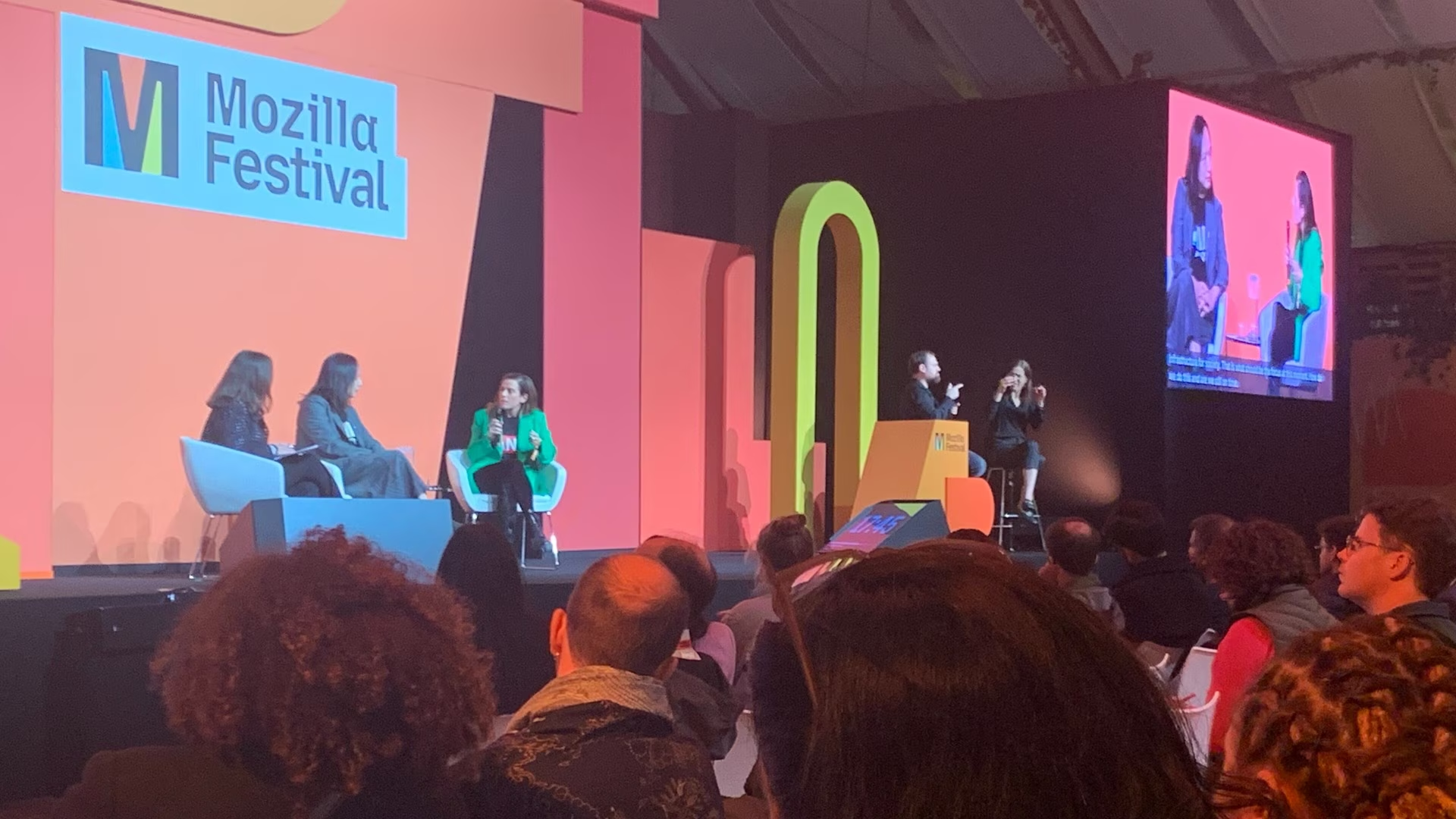
A main stage panel at Mozilla Festival 2025 in Barcelona Credit: Photo: Zblace / CC BY-SA 4.0 via Wikimedia Commons (cropped) What would technology look like if it were built by communities rather than controlled by a handful of companies? That question sits at the heart of this year’s Mozilla Festival, which returns to Barcelona from October 28 to 30. Organised by the nonprofit Mozilla Foundation with the City of Barcelona, the festival is taking place in the city for the second consecutive year as part of Open Tech Week. More than 2,000 technologists, artists and activists are expected at Recinte Fabra i Coats, a former textile factory turned arts centre, for more than 200 talks, workshops and art installations.
This year’s theme is “Wilding”, a call for technology to grow in a more open, shared and community-led way. “Technology today is fueled by a closed, controlled, and often extractive system, and Mozilla Festival exists to be a counterpoint,” said Zeina Abi Assy, the festival’s director. The main stage brings together people working across activism, technology, and culture. Egyptian activist Alaa Abd El-Fattah, who was released from prison last year following a presidential pardon, will speak alongside Issam Hijazi, founder of social network UpScrolled, and Ruha Benjamin, a professor at Princeton University. Other speakers include Elizabeth Alexander, president of the Mellon Foundation; inventor and author Gitanjali Rao; and artist Stephanie Dinkins.
Poet and comedian ALOK Vaid-Menon will host. The programme will examine the technology each generation inherits, the social tensions created by AI, and ways to build digital tools around care and shared power. But the festival also takes those questions beyond the conference stage, bringing artists and musicians into the conversation about who controls digital systems and whose stories they preserve. One session, led by Sudanese music producer Khaled Alsedeg, explores how digital archives can help preserve Sudan’s musical traditions.
Another installation, Wild Lots, uses city data to imagine vacant urban land returning to nature. The project was first presented at New York’s Open Data Week earlier this year. Young people will have their own programme, too. In one session, teenagers aged 13 to 17 will role-play and test ideas for rules governing AI, online platforms and mental health.
Another workshop draws on an AI guide developed with and for girls in The Gambia. “Wilding is simple: the future of tech shouldn’t grow in a monoculture owned by a handful of companies,” said Nabiha Syed, CEO of the Mozilla Foundation. Last year’s festival attracted around 2,200 people from 79 countries. During that edition, Mozilla and Barcelona signed an agreement to keep the event in the city through 2027. The festival also reflects Mozilla’s broader campaign for a more open internet.
Earlier this year, the foundation backed a poster campaign in New York criticising Elon Musk and Mark Zuckerberg. For Mozilla, the challenge is not simply to criticise the concentration of power in technology, but to bring together people who want to build something different, from community-owned digital tools to ways of preserving culture beyond the reach of major platforms. Also tagged with Get the TNW newsletter ✕ Close Get the TNW newsletter Get the most important tech news in your inbox each week.










Leave a Reply