
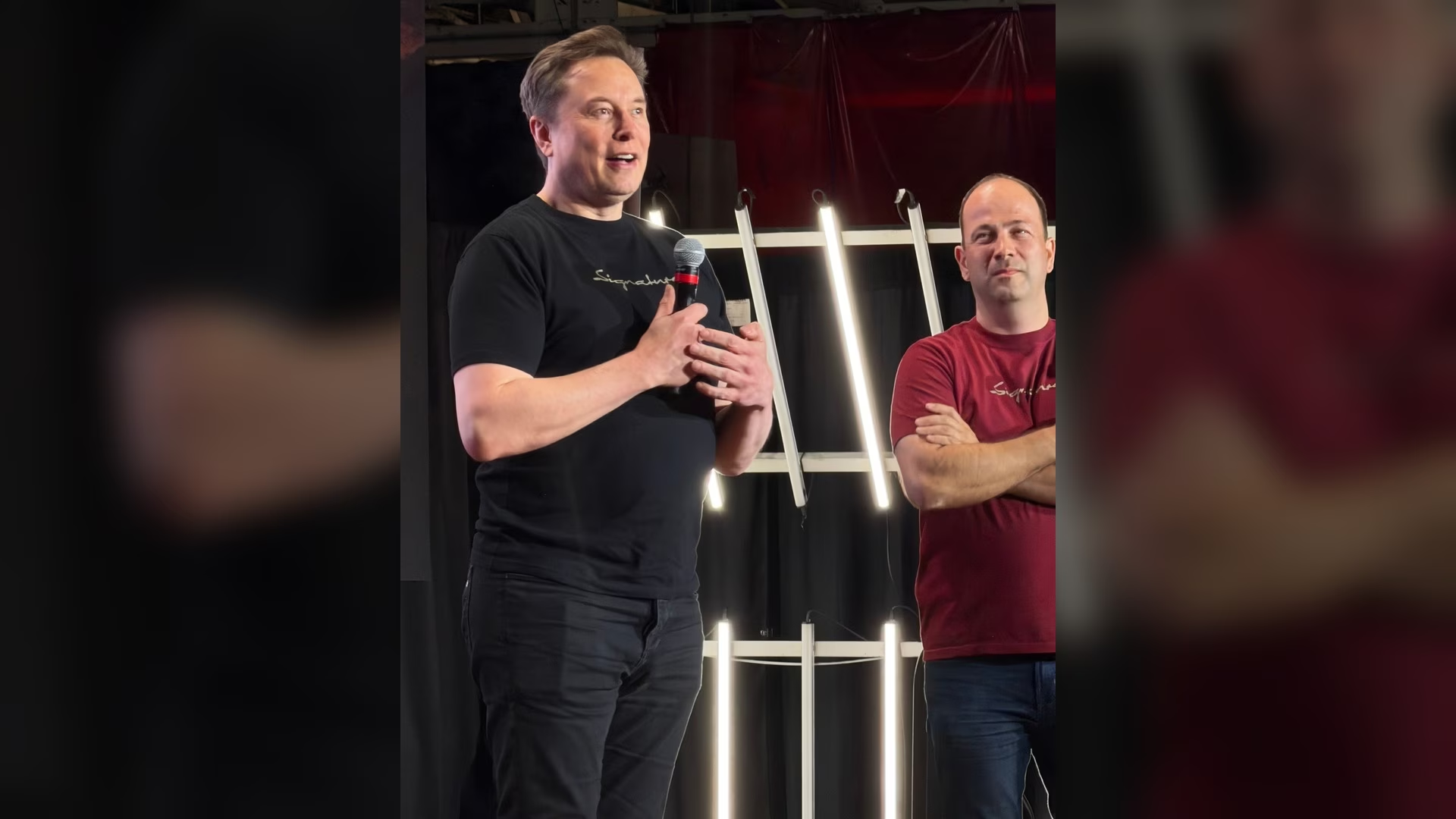
Elon Musk speaking at a Tesla event. Credit: Steve Jurvetson / CC BY 4.0 via Flickr (cropped) Tesla needs to build between 10,000 and 20,000 Optimus humanoid robots so they can learn to perform tasks through practice, Elon Musk said during the company’s third-quarter earnings call on 21 October. Tesla has only recently started production on a new Optimus line in Fremont, California. “In order for Optimus to get the training data we need, we actually need to make a lot of Optimi,” Musk said. The plan is to let the robots practise a wide range of tasks at what Musk calls an Optimus Academy.
The data they generate, through a process known as self-play, will then be used to improve the AI that controls them. Musk compared the process to raising a child, arguing that robots need to learn through experience rather than rely entirely on pre-programmed instructions. “They initially are sort of wobbly and they don’t know how to do things, and eventually they learn to wipe their own ass, which is a big milestone,” he said. “They learn to read and do all sorts of things… And they learn this by playing. And we actually need Optimus to play at scale in order to have it be really good at tasks in the real world,” Musk said. Tesla already collects data from its cars to improve their driving software, but Optimus does not yet have a comparable fleet generating real-world training data.
Ashok Elluswamy, who leads Tesla’s AI software team, said the robots would initially learn by watching humans perform tasks. “We have to bootstrap it by making the robots and having them do self-play, which is really how a human learns to navigate the world,” he said. Earlier this month, Business Insider reported, citing people familiar with the matter, that trainers at Fremont wore camera-equipped helmets to record tasks for Optimus to learn from. TNW has not independently verified that report. Tesla has installed most of a production line designed to eventually manufacture one million robots a year, Musk said.
However, reaching a rate of 20,000 robots a week will take at least another year, as parts of the design are still being refined. “There’s like 10,000 things that have to go right for production of the robot, and it’ll move as fast as the slowest, least likely of the 10,000,” he said. One of the biggest engineering challenges is the robot’s hand. It needs to be strong enough to withstand repeated use while remaining sensitive enough to handle fragile objects. “It’s hard to make a hand that can handle lots of wear and tear but is still squishy enough to pick up delicate objects,” he said. Musk said Tesla could release a video in the next month or two showing Optimus performing tasks that have not been pre-programmed.
The company’s AI5 chip, which he said should offer around 10 times the computing power of the current AI4, is expected to enter the robot around April 2027. Tesla expects to begin delivering Optimus to other companies towards the end of 2027. Initial uses will focus on industrial jobs that are dangerous, repetitive or require work around the clock. “I remain convinced that Optimus will be the biggest product on Earth,” Musk said. He also claimed Tesla was ahead of competing humanoid robotics companies, though he did not provide evidence to support the comparison. “To the best of my knowledge, there is no one that is even close to Tesla with respect to a general-purpose humanoid robot,” Musk said. “At some point there will be more humanoid robots on Earth than there are humans,” he added.
Tesla is not the only company testing humanoid robots in industrial settings. A competing robot recently completed an eight-hour shift at a Siemens factory in Germany, showing how manufacturers are beginning to test the technology in real working environments. Also tagged with Get the TNW newsletter ✕ Close Get the TNW newsletter Get the most important tech news in your inbox each week.




Leave a Reply