
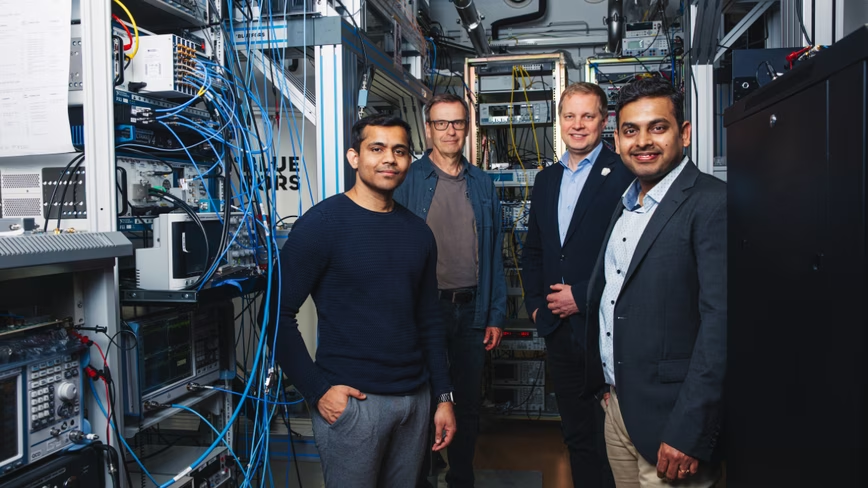
Coherence Quantum’s founding team in Espoo. From left, Aashish Sah, Erkki Soininen, Mikko Möttönen and Credit: Coherence Quantum / Svante Gullichsen Think of a quantum computer as a very delicate machine that needs to operate in extreme cold. The processor is the part that does the actual computing, but it needs a lot of supporting equipment to work. The processor sits inside a special refrigerator that cools it to temperatures close to absolute zero.
Cables run from outside the refrigerator to the chip, carrying the signals that control its tiny computing units, called qubits. The problem is that the more powerful quantum computers become, the harder it gets to manage all those connections. Too many cables take up space, complicate the system, and can limit how far the technology can scale. That’s what Coherence Quantum wants to address as the Finnish startup is developing technology to make controlling quantum computers easier as they scale up.
The Espoo-based company, spun out of Aalto University, has raised €2.78 million in seed funding led by Lifeline Ventures, with participation from Mårten Mickos, the former CEO of MySQL. To put this in the simplest way, what they are doing is like trying to control thousands of tiny devices inside a freezer so cold that almost everything has to be specially designed to work there. Every device needs connections to the outside world, and the more devices you add, the more complicated the wiring becomes. And this is where Coherence Quantum wants to make those connections easier to manage.
To better understand what a quantum computer is and what this amazing team of smart people is doing, I had to ask Aashish Sah (CEO), Suman Kundu (CTO), Erkki Soininen (CPO), and Mikko Möttönen (Founding Advisor) a few questions. “Just by moving from hundreds to a thousand qubits, you would need at least 3,000 control lines,” Aashish Sah, the company’s chief executive and co-founder, told me in an exclusive interview. “The standard fridges we have currently can fit about a thousand control lines. So there’s already a bottleneck that companies are experiencing.” To understand why this matters, Sah started with the two words that could make sense of the company’s own description: “cryogenic” and “quantum”. A circuit that obeys different rules “We need cold temperatures to observe quantum behaviour,” he said. The qubits Coherence Quantum works with are not exotic particles but, in his words, “electrical circuits made on a chip”, cooled until they stop behaving like ordinary electronics and start following the rules of quantum mechanics.
Quantum computers use that behaviour to process information in ways a classical machine cannot. There are six or seven ways to build a qubit, Sah said, including trapped ions, neutral atoms, and particles of light. Coherence Quantum focuses on two that are built directly into chips, superconducting and spin qubits, and both only work close to absolute zero. Nobody has yet built a quantum computer that solves useful problems at scale. “We’re not there yet; we are still trying to get there,” Sah said.
The main obstacle, as he describes it, is size: going from hundreds of qubits to thousands, and eventually to hundreds of thousands, a target that “keeps updating based on our better understanding of algorithms and applications”. A fridge unlike the one in your kitchen The founders kept calling it “the fridge”, so I asked what that actually means, and what a dilution refrigerator looks like. Suman Kundu, the CTO, has worked with the machines for more than a decade. Low-temperature physics once meant handling liquid helium and liquid nitrogen by hand, he explained.
A modern dilution fridge circulates everything within a closed system and cools a chip down to around 10 millikelvin, making it more of a laboratory instrument than a kitchen appliance. Even that may not be cold enough, as the founders say qubits often behave as though they were at 50 to 70 millikelvin, several times warmer than the fridge around them, because heat and noise leak in along the wiring. Bringing that figure down makes the qubits more stable, which in quantum computing means fewer errors. Today, heavy instruments at room temperature generate the signals that run a quantum processor and send them down into the fridge.
Those cables bring heat as well as signals. According to Sah, more than 99% of a control signal sent from room temperature dissipates inside the fridge, warming it and creating noise that disturbs the qubits. At the scale the industry is aiming for, he called the approach “physically and economically unsustainable”. They also have four patent applications, and Sah started with this one.
It covers components that, he said, cut heat-induced qubit disturbance by a factor of 100. “If it doesn’t dissipate close to the qubit, it doesn’t create noise to the processor,” he said. Before the interview, I had read up on Sah’s own research, on filters built into the chip that block noise at the qubit’s frequency. The work began during his doctorate at Aalto, in the lab of Mikko Möttönen, co-founder of IQM and QMill and now Coherence Quantum’s founding advisor. He calls the problem the “isolation and control challenge”.
A qubit retains its fragile quantum state only when it is isolated from its surroundings, yet it must be wired to electronics to run any calculation. “If you isolate it, it will live for a very long time,” he said. “This is a perfect quantum system, but you cannot do anything useful.” Every wire that lets engineers control a qubit is also a route for its energy to leak away, he explained. Physicists measure how long a qubit stays in its excited state as its relaxation time, known as T1: once a qubit is nudged from its lowest-energy state into a higher one, T1 describes how long it stays there before slipping back. The longer it lasts, the more useful work it can do. His first approach used filters that blocked noise at the qubit’s own frequency while driving it at a third of that frequency.
That worked, but driving the qubit so hard pushed it into unwanted states. The follow-up, a tunable filter that switches a qubit’s connection to the outside world on and off over time, became the company’s second patent application. The third arrived by accident while working on the tunable filter; the team realised that changing the qubit’s coupling also changed its lifetime, from hundreds of nanoseconds to hundreds of microseconds. That turned the qubit into a thermometer, one that helps builders assess the thermal noise reaching the qubit and track down its source.
The fourth, which the company calls a “quantum dial”, starts from a simple observation. “Not all operations on a qubit require you to do it simultaneously,” Sah said. Resetting a qubit, reading it out, and running an operation on it happen at different times, so the dial connects each function only when needed. “If you couple a qubit to many systems, it will have many systems to decay to,” he said. Fewer permanent connections mean a longer-lived qubit and fewer lines running into the fridge. I wanted to know whether these were parts the industry simply did not have yet. “Not quite,” Sah said.
Many components have existed for years, and builders can still buy them off the shelf. Coherence Quantum has patent-pending components designed to shield the qubit from noise that existing parts let through. The broader idea is to move parts of the signal chain into the cold, filtering and generating signals close to the processor instead of piping everything down from above. Sah compared it to classical computing’s journey from vacuum-tube machines that filled whole buildings to the laptop. “We’re not exactly developing transistors, but similar electronics that we can make compact, bring closer to the quantum processor, and make sure the performance is on par














Leave a Reply