
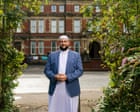
Imam Adam Kelwick outside the Abdullah Quilliam mosque in Liverpool. The mosque was targeted by a mob in the wake of the murder of three girls at a dance class in Southport. Photograph: Fabio De Paola/The GuardianView image in fullscreenImam Adam Kelwick outside the Abdullah Quilliam mosque in Liverpool. The mosque was targeted by a mob in the wake of the murder of three girls at a dance class in Southport.
Photograph: Fabio De Paola/The Guardian‘Would I sit down with Tommy Robinson? It’s not a definite no’: lessons from people who fought the far right in the 70s, 80s and beyondExtremists are on the rise globally – but UK activists have seen them off in the past in everything from football, politics, music and more. How did they do it?‘If you’re not organised, you get picked on. When you’re organised, often they flee’Tariq Mehmood encountered the far right early – at primary school. “When white children surround you in the playground and sing, ‘God made little black people, he made them in the night, he made them in a hurry, and forgot to paint them white’, and the school doesn’t clamp down on that, then you’re living within the far right.
It’s not one organisation, it’s a mass movement.”I think it’s likely those kids used another word for “black people” but I can’t quite find the stomach to ask. Mehmood is speaking to me on a video call from Beirut, where he teaches at the American University. Now 70, he migrated, in 1967, from Pakistan to Bradford, where his grandfather and uncles worked in the textile mills, and immediately experienced racism. “The headmaster would tell us to be grateful to be in England, we were beaten up by white boys on the way to school, there was an intense violence and a feeling of helplessness.”Until he realised he wasn’t helpless, or alone. “We knew we couldn’t come to school on our own, so we assembled somewhere, got off the bus together and walked together to the classroom.”Later, when he was himself working in a mill in Otley in the late 70s, Mehmood was one of the founders of the Bradford Asian Youth Movement. The AYMs were a network of anti-racist groups demanding equal rights and a fairer world as well as defending their communities against attacks from groups such as the National Front (NF) and the British Movement (BM).Following disagreements within the AYM, Mehmood was part of a splinter group, the United Black Youth League, that broke away in 1981. “The police tried to paint that our split was because the UBYL wanted violence, but this is anything but the truth,” he says. “Some wanted to work within the system – one of the founders of the AYM became an MP, something I fundamentally disagreed with then as I do now.”View image in fullscreenTariq Mehmood, a member of the Bradford 12, with a poster from 1981.
Photograph: Fabio De Paola/The GuardianThere were frequent attacks on the south Asian community in Bradford. “Whenever the National Front had a demonstration, you could always bet that after the pubs closed they would attack us, groups of skinheads – five, six, seven of them in a car, going around, seeing what they could do.”So, as Mehmood had done at school, the UBYL organised themselves. “If you’re not organised, you get picked on. When you’re organised, often they will flee and you don’t have to fight. We couldn’t trust the police; either they were incapable, or they didn’t care, or they harassed us.”When they learned that a lot of fascists were planning to go to Bradford, they got ready. “We mobilised hundreds, many of them white, walking around, making sure people knew we were out, they didn’t have anything to fear. We said we’d arm ourselves if need be.
Some of us made petrol bombs.”The petrol bombs require some context. “Remember, it was the year of the massacre of the teenagers in London,” he says, referring to the New Cross house fire in which 13 young black people died (even though it was never proved to have been a racist attack). “Members of the UBYL were blocking up their own letter boxes in case someone poured petrol in and set fire to their houses. That was a reality, and we said no, we will defend ourselves.”In summer 1981, 12 members of the UBYL, including Mehmood, were arrested after a police raid discovered 38 milk bottles filled with petrol. The Bradford 12, as they became known, were charged with conspiracy to cause explosions and endanger lives. They didn’t deny making the molotov cocktails, but said it was a precaution for self-defence.In jail, awaiting trial, Mehmood discovered another weapon: the pen.
He wrote his first novel, Hand on the Sun, about a young immigrant experiencing racism. “Stories make us human. I wanted to share with future generations that we were proud industrial workers, we weren’t just going to have crumbs, we were politically conscious and had hope. I still have that hope.” After an active campaign and a lengthy trial, on 16 June 1982 Mehmood and the rest of the Bradford 12 – who had argued self-defence – were acquitted by a jury.The situation with the far right is no better today, he says. In fact, the opposite: “The atmosphere is more vicious than it was in the 80s, primarily because we were dealing with old-style racism born out of British colonial history.
Today’s Islamophobia is a more violent, virulent form; it has always been there, under the surface, since the Crusades, but not at a scale you see today. The far right at that time were a few thousand demonstrators here and there, not 100,000, half a million. And they’re not just in Britain, but across Europe.”He sees it as a failure of the left, of the labour and trade union movements, to educate the white working class that “the real enemy is the billionaires at the top”. Plus, the loss of community organisations.
Mehmood’s message about what to do about the far right today is to do as they did: organise and fight back. “The most important lesson is that if you believe there is an injustice, then fight against it.”Tariq Mehmood’s memoir, Rebellion: Self-defence and the Story of the Bradford 12, is published by Daraja Press. A documentary, also titled Rebellion and co-directed by Mehmood, premieres at the BFI London film festival on October 14 and 15‘The idea was to harness music and politics together to fight fascism and racism’View image in fullscreen Rock Against Racism founder Red Saunders, with a poster for one of its concerts from 1978. Photograph: Fabio De Paola/The GuardianIt was half a century ago, the hot summer of 1976, but Red Saunders remembers it clearly. A photographer and at the time also a member of a radical theatre group, he was in a rehearsal at a studio in Soho, London. “Someone came in and said: ‘Have you seen this shit about Eric Clapton?’”An article in a music magazine said that at a concert in Birmingham, the musician had told his audience to vote for Enoch “rivers of blood” Powell in order to stop Britain from becoming “a black colony”, as well as chanting the NF slogan: Keep Britain White.“I was a Clapton fan, I’d been to his gigs, had the albums.
I couldn’t believe it,” says Saunders, now 80 and talking to me from his Suffolk home. He wrote a letter to the music press, and got some of his like-minded friends, including Roger Huddle and Jo Wreford to sign it. The letter pointed out Clapton’s hypocrisy, that he was “rock music’s biggest colonialist” and that his own music had its roots in blues, R&B, reggae. And it concluded with a rallying call for musicians and fans to rise up: “Keep the faith, black and white unite and fight.” (Clapton later apologised and expressed deep shame for the ouburst.)With that letter, Rock Against Racism was born. “The idea was that if we harnessed music and politics together, it might be a powerful combination to fight fascism and racism.” Music was the key, to get the






Leave a Reply