
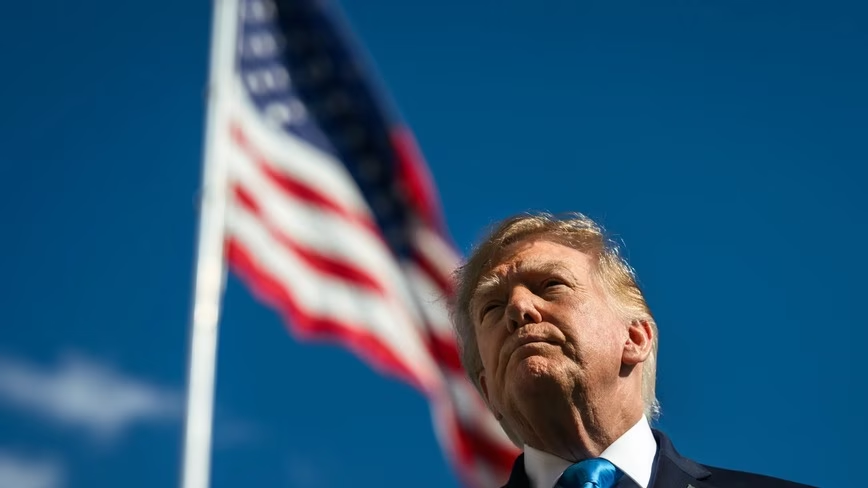
President Donald Trump on the South Lawn of the White House on October 5, 2026. Credit: Official White House Photo by Daniel Torok US President Donald Trump wrote on Truth that the White House sees anyone who says “artificial intelligence” instead of “super intelligence” as “THE ENEMY”. “The White House considers anyone that uses the term, “Artificial Intelligence,” as opposed to the highly accepted new and more accurate term, “Super Intelligence,” THE ENEMY! President DONALD J. TRUMP The President did not say what would happen to people or firms that continue to use the old term.
The journalist from Axios requested a comment from the White House after finding that some pages still use the older term= Yesterday’s post follows an executive order that Trump signed on September 29, which tells federal agencies to use “super intelligence,” or SI, in public statements, on websites, and in reports. The Justice Department told staff on October 6 to use the new term, including in court filings “when appropriate”, Reuters reported. Some tech leaders have also taken up the name, and Elon Musk said his company’s AI unit would be renamed SpaceXSI. In addition, Amazon founder Jeff Bezos backed it in a Fox News interview. “I do like SI, because ‘artificial’ is not a very flattering thing,” Bezos told Fox News.
Trump’s claim that the new term is widely accepted is more than disputed. In tech, super intelligence/superintelligence, a term popularised by Nick Bostrom, refers to an intellect that greatly surpasses human abilities in almost every area. Jean-Pierre Dubé, a marketing professor at the University of Chicago, told Newsweek that this meaning makes the new name unlikely to catch on soon. The push has also had effects outside the US, as Slovenia’s registry saw a rush of .si domains after the order, because the country code matches the new name.
What can and cannot the order do? The order is addressed only to federal departments and agencies and imposes no penalty for using the old term. Moreover, it also says it creates no rights enforceable against the government or any other person. Courts treat the government’s own words differently from what it asks of others.
Under the government speech doctrine, agencies can choose their own terms, as explained by the Freedom Forum, a free-expression group. “The Free Speech Clause restricts government regulation of private speech; it does not regulate government speech,” Justice Samuel Alito wrote in a 2009 Supreme Court ruling. Pressure on private groups is another discussion. In NRA v. Vullo, the Supreme Court ruled unanimously in May 2024 against a New York official who had pushed insurers to cut ties with the gun group. “A government official cannot coerce a private party to punish or suppress disfavored speech on her behalf,” Justice Sonia Sotomayor wrote for the court.
Eugene Volokh, a First Amendment scholar, wrote about government power over names during the 2025 Gulf of Mexico dispute. “The English name of places even within the U.S. isn’t subject to the control of the U.S. government,” Volokh wrote on Reason. Until today, we had found no statement on the post from press-freedom groups such as FIRE, the Knight First Amendment Institute or the Reporters Committee for Freedom of the Press. The Gulf of America precedent A naming dispute reached the courts in 2025, when Trump signed an order on January 20 that year directing agencies to use the name Gulf of America. As press, every trust has the freedom to keep or change its style guide; for example, The Associated Press kept “Gulf of Mexico” in its style guide, and in February the White House barred its reporters from press pool events.
The AP sued, and on April 8, 2025, Judge Trevor McFadden ordered the White House to restore its access. “The Constitution forbids viewpoint discrimination, even in a nonpublic forum like the Oval Office,” McFadden wrote. However, a federal appeals court panel voted 2-1 on June 6, 2025, to pause most of that order. It found that spaces such as the Oval Office are not public forums. The appeal was argued on November 24, 2025, according to the court docket, and no final ruling could be found.
Some renaming needs Congress, as Trump’s September 2025 order allowed the Pentagon to use the Department of War only as a secondary title. The House voted 216 to 212 on July 23, 2026, for a defense bill that would make the change law. However, the Senate had not yet passed its version. Artificial intelligence is defined in law in the National AI Initiative Act of 2020, and only Congress can change that.
Both the House and the Senate would have to pass a new law, and the President would have to sign it. As a first step, the President’s science adviser has until November 28 to write a proposal for Congress. Even if a new law passes, it would only change the words the government uses. Companies, journalists and the public could still say “AI”, because the First Amendment protects their right to choose their own words.












Leave a Reply