
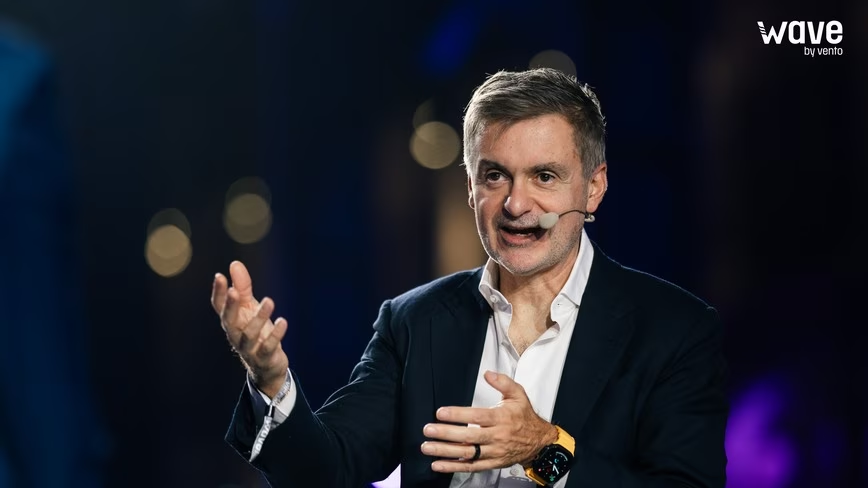
Goldman Sachs chief information officer Marco Argenti speaking at Wave by Vento in Turin, 9 October 2026 Credit: Wave by Vento Goldman Sachs is entering a third phase of AI adoption, in which the goal moves from saving money to making it, the bank’s chief information officer Marco Argenti said. He spoke with Bloomberg anchor Tom Mackenzie at Wave by Vento in Turin on Friday, in a session titled “Mindset, not skillset”. “How do you make money because of AI, not only how do you save money because of AI?” Argenti said. Argenti joined Goldman in 2019 from Amazon Web Services, where he was vice president of technology. AI now touches pretty much everyone at Goldman, he said.
The working day used to start with the first email. Now it may start with a question to the bank’s internal assistant, or with an agent. Three waves The first wave was the people who like to try new things, Argenti said: developers, more than 12,000 of Goldman’s roughly 47,000 staff. For them, working with AI is already the norm.
The second wave rethinks the bank’s processes. That means questioning every step of a workflow and asking whether it should exist at all, not doing the same thing faster, he said. The aim is what traders call straight-through processing: large processes that run end to end with no human step. The third wave, “emerging right now”, is about growth: using AI to help the company grow, as well as to be more efficient, he said.
Measuring the return Goldman used to measure AI through proxies, such as how often developers committed code, Argenti said. Nobody could trace those to dollars. In the last six months or so, outcomes have changed, he said. Teams finish a three-month project in two months.
Projects that fell below the line in zero-based budgeting now fund themselves. Asked whether that means fewer people, he said the bank might have that option. But every engineering backlog holds far more work than gets funded in each planning cycle, he said. As long as there is appetite to grow, there will be plenty of work first.
Managers of managers The developer’s job is changing, Argenti said. Developers now explain what needs doing, delegate it to AI agents and supervise their work. Agents can now create their own sub-agents, so a developer becomes a manager of managers, he said. The job is to describe clearly what a good outcome looks like, and to manage resources and priorities, almost like an entrepreneur.
On Wednesday, Miro’s chief executive told the same event that companies must redesign work around AI. Assume the model will make mistakes At the heart of AI is a statistical machine that will not give the same result every time, Argenti said. So the bank assumes its models will make errors, like humans, and builds an environment that stops them doing harm. He compared it to a kindergarten: you remove the sharp edges instead of handing each child a safety policy.
That means securing where agents run and what they can access, he said. It also means reading a model’s chain of thought, and using other AI models to challenge its work. Goldman calls the approach zero trust and defence in depth. Open weight and frontier Choice is the most important currency, Argenti said.
Open-weight models can be retrained on the bank’s own knowledge, which helps with sovereignty and protecting its intellectual property. They are also cheaper for simple tasks. On Thursday, SAP’s Sean Kask told the same event that SAP tests more than 100 models to pick the best one for each job. This week, Mistral launched Large 4, an open-weight model.
Frontier models have the strongest reasoning, he said, for problems nobody has solved before. He compared the choice to a truck and a Formula 1 car. The truck does the utility work. Where the business races, Goldman wants the most powerful car.









Leave a Reply