
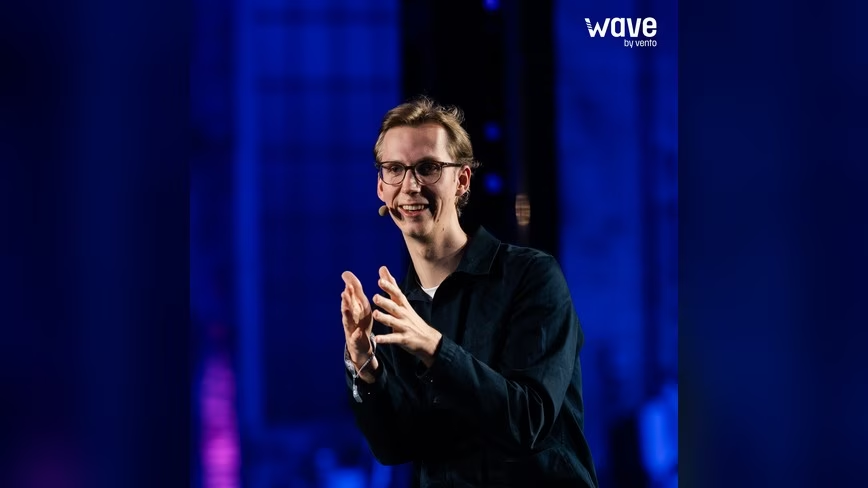
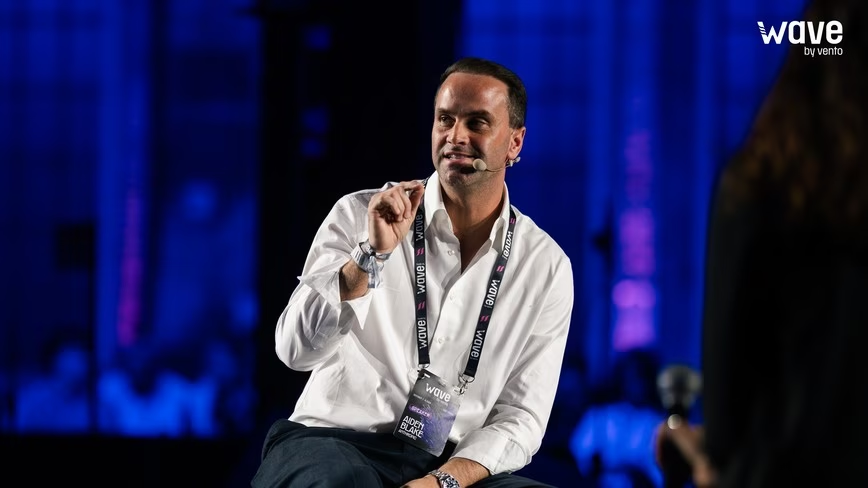
Max Junestrand, co-founder and CEO of Legora, at Wave by Vento in Turin Credit: Wave by Vento Legora co-founder and chief executive Max Junestrand says calls for European sovereignty in software are an excuse for companies that are not bold enough to go global. He spoke at Wave by Vento in Turin on Thursday. “I think sovereignty in enterprise applications, or sovereignty in consumer apps, or sovereignty at the software layer is kind of an excuse for companies who are not bold enough to compete globally. Because the enterprise layer and the software layer is the global market,” Junestrand said. The session was titled “The Compounding Bet”.
Jeannette zu Fürstenberg, president and managing director of General Catalyst, an investor in Legora, led the conversation. Legora, based in Stockholm, builds AI tools for lawyers. Sovereignty matters for energy, defence and infrastructure, Junestrand said. But companies that buy enterprise software have offices in Europe, the US and Asia.
For them, a sovereign product “doesn’t really make any sense at all”, he said. Legora’s market was global from day one. Where the value goes Zu Fürstenberg made the case for sovereignty lower down the stack. Services make up 70% of Europe’s GDP, she said, and AI is starting to replace some of that work.
Europe needs its own energy and compute clusters, she said, or the value will leave. “We are able to then really sort of lock down part of what otherwise would look like the involuntary transfer of wealth from Europe to the US or elsewhere in the world,” zu Fürstenberg said. On Wednesday at the same event, Alibaba’s Joe Tsai said open source is Europe’s only way to AI independence. In September, Junestrand said Europe should not build a frontier lab of its own. One global winner In software, the top player tends to take about 90% of a market, Junestrand said, and the rest split what is left.
Legal AI will not have one winner per region, he said, but one worldwide. Its closest rival, Harvey, closed a $550m round at a $15.6bn valuation in September. Lawyers give a product only one chance, Junestrand said. In mid-2024, Legora paused its sales push to make sure the product was good enough.
Law firms are now under pressure, he said. Work that took 10 hours now takes one, which hurts firms that bill by the hour. Once they change how they charge, they also have to reorganise. Legora uses several AI models, because each is strong at different things, he said.
A Claude model is very good at drafting, he said, and an OpenAI model at fact-checking. Four years in four quarters Legora had about $1m in revenue in October 2024, Junestrand said. It took under 18 months to reach $100m in revenue and under six more to reach $200m. He said it will reach $300m, after more than 50% growth each quarter for about two years.
The company started the year with 200 people and 22 sales staff, he said. It plans to have 300 sales staff by the end of the year. The median time people have been at the company is three to four months. Each hire needs sign-off from a “culture carrier” outside the hiring team, an idea Legora took from Amazon.
Legora’s new chief financial officer had seen a company grow from $30m to $300m in four years, Junestrand said. Legora is doing that in four quarters. He also ranks Legora’s investors. Every two months, he sends them a leaderboard of how many customer introductions each has made.
One investor that had put $150m into a round came second to last, he said. It then made 50 introductions in two weeks. Legora has just opened an office in Milan. Italy has more lawyers per person than anywhere else in Europe, Junestrand said.








Leave a Reply