
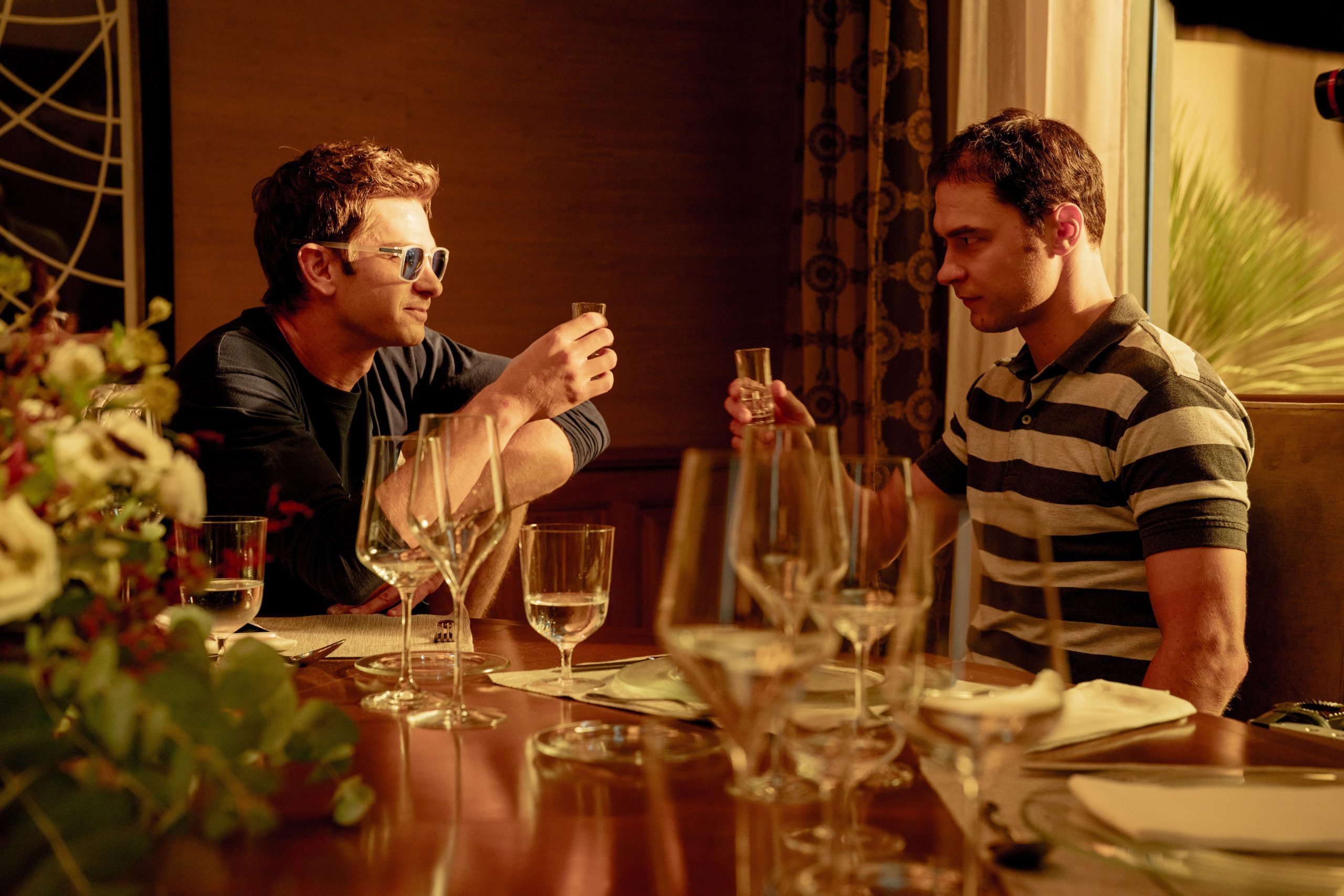
AIEntertainmentReportArtificial is a wicked satire that also sticks to the factsAccording to The Verge’s senior AI reporter, Luca Guadagnino’s dark comedy hit all the familiar tech milestones.by Hayden FieldOct 8, 2026, 2:00 PM UTCShareGift Image: FLC PressAIEntertainmentReportArtificial is a wicked satire that also sticks to the factsAccording to The Verge’s senior AI reporter, Luca Guadagnino’s dark comedy hit all the familiar tech milestones.by Hayden FieldOct 8, 2026, 2:00 PM UTCShareGiftHayden Field is The Verge’s senior AI reporter. An AI beat reporter for more than five years, her work has also appeared in CNBC, MIT Technology Review, Wired UK, and other outlets.At the New York Film Festival premiere of Artificial, Luca Guadagnino’s satirical Sam Altman biopic, the director said onstage that “[when] someone wants to play God, that’s very interesting to me.” The idea of playing God, and power in general — who has it, who desperately wants it, and who will do anything to get it — is central to the film’s narrative, which sticks remarkably close to the factual events surrounding the OpenAI CEO’s rise to power with, and brief ouster from, the AI lab.The film opens with a stunning shot of San Francisco’s Golden Gate Bridge, which will turn into a metaphor for building all-powerful AI systems over the course of the film. Again and again, Altman (played by Andrew Garfield) points to the bridge, first to convince his cofounder-to-be Ilya Sutskever (Yura Borisov) of the importance of their vision, then as a way to control the scientist.All of the characters are (at least somewhat) exaggerated, satirized versions of themselves. Elon Musk (Ike Barinholtz) is portrayed as a — at the time — widely beloved, booked, and busy visionary who’s used to people laughing at his jokes, his every pore positively oozing with millennial cringe. (He wears sunglasses more than any other character, uses the word “epic,” and starts drumrolls on tables.) OpenAI president Greg Brockman (Cooper Hoffman) comes across as an ultra-loyal bro and unquestioning right-hand man to Altman, interested mostly in money and power (at one point, he’s wearing what looks like a diamond necklace that says “ChatGPT”).
OpenAI CTO Mira Murati (Monica Barbaro) is depicted as a brilliant but easily swayed outsider. Sutskever is portrayed as the idealistic, naive hero — the ingenious mind behind the lab’s entire existence who can’t stomach lying and is reluctant to accumulate any power. And professor Geoffrey Hinton (Mark Rylance), who is known as the “godfather of AI,” is a wise sage who can foresee many of the power struggles and pitfalls ahead.Garfield is disturbingly riveting as Altman, with his hypnotizing performance painting the most damning picture of the OpenAI CEO yet in any form of media. He depicts Altman as a manipulative, power-hungry psychopath who lies as easily as he breathes and will use anyone, anytime, anywhere to get what he wants.At one point, Hinton references a 2008 quote by Paul Graham, cofounder of Y Combinator, about Sam Altman: “You could parachute him into an island full of cannibals and come back in 5 years and he’d be the king.”Garfield and Guadagnino portray Altman as astonishingly controlling, represented by the character’s penchant for physical touch.
When Murati is interviewing for her role at OpenAI, Altman expresses doubt and the possibility that she could be a spy for Musk, but once she’s hired minutes later, he immediately hugs her and holds onto her, linking arms as he announces to the room that she’s brilliant. With Sutskever, Altman begins by holding his forearm, then touching his shoulder, then almost sinisterly gripping the back of his neck, and during an OpenAI research milestone — a model winning a strategy game — jumps into his arms for a hug and wraps his legs around him. At one point during a meeting with Elon Musk, Altman sits on the arm of Sutskever’s chair and then slides into the chair with him, almost trying to fold into him. (When Musk walks out of the meeting, pulling his investment, Altman innocently asks, “I guess I’m CEO?”) And at the end of the film, when he convinces Sutskever to tell his very first lie, Altman aggressively grips his neck and shoulder again, telling him, “See? It’s easy.”Over and over, the film touches on what was a central point of tension for years of OpenAI’s trajectory — the idea that no one person or company should control superintelligent AI (AGI), and that executives should act at all costs to prevent the powerful technology from falling into the hands of one person.
The film makes the point that Altman himself wants to be that person. At one point, a prospective employee asks Murati to clear up the company’s confusing org chart. She summarizes it simply: “Sam’s in charge.”Unlike arguably the first great modern tech world movie, 2010’s The Social Network, Artificial’s themes are based on real circumstances. There was enough material (and documentation of that material, thanks to lawsuits and leaked communications) that Guadagnino’s film doesn’t have to rely much on fabricated characters or made-up scenes or events.
The film is structured in chapters by milestones that really did happen: Sutskever meeting Hinton in the early 2000s at the University of Toronto; the state of the technology in 2012, before it was auctioned off for upwards of $40 million to Google by the end of the year; Sutskever and Hinton joining Google in March 2013, during the idealistic Silicon Valley heyday of nap pods and free merch; a dinner between Sutskever, Altman, Brockman, Musk, and others in Menlo Park in 2015; the time in 2017 that an OpenAI system won a game of Dota 2 against a human champion.There are exceptions and liberties, of course; for instance, the fictional Altman strolls into a bunker full of greenhouses and guns underneath his California home, which the real-life Altman does not have in that location (that we know of). In another scene, a man clearly meant to represent the “AI doomer” cohort approaches Sutskever in a park, giving him a list of how superintelligent AI could go badly for humanity. “The question’s not, ‘How could this go wrong?’” the man tells Sutskever. “It’s, ‘How could it not?’”The film takes us beat by beat through Altman’s infamous firing — from Sutskever conferring with Murati and the board to the famed video call where Altman is informed of their decision. We’ve already seen his well-documented missteps with the board and with executives at the company, including pitting scientists and executives against one another, allegedly lying about whether the legal team said a model could skip certain safety processes, and releasing ChatGPT in November 2022 without notifying the board first.But despite Altman’s reassurances multiple times earlier in the film that the board has the power to fire anyone, including him — which he brings up whenever people are worried about an undue concentration of power at the company — he immediately dials Microsoft CEO Satya Nadella and begs for his support, then convenes a cabal of OpenAI executives and employees at his home over a few days to either get his role back or take everyone with him to Microsoft, effectively leaving OpenAI behind as a shell company. When the board invites him back to the OpenAI offices to discuss his potential return and offers its stipulations — more transparency, regular updates, no lying, etc. — Altman simply looks at his phone and gurgles a green smoothie through a straw, telling them that his demand is that they all resign immediately.
The board asks who he’d replace them with. “I’ll let you know,” Altman replies sassily, not making eye contact. While outlandish, most of the basic facts here conform to reporting about the real-life events.What’s also notable in the event timeline is what’s le


Leave a Reply