
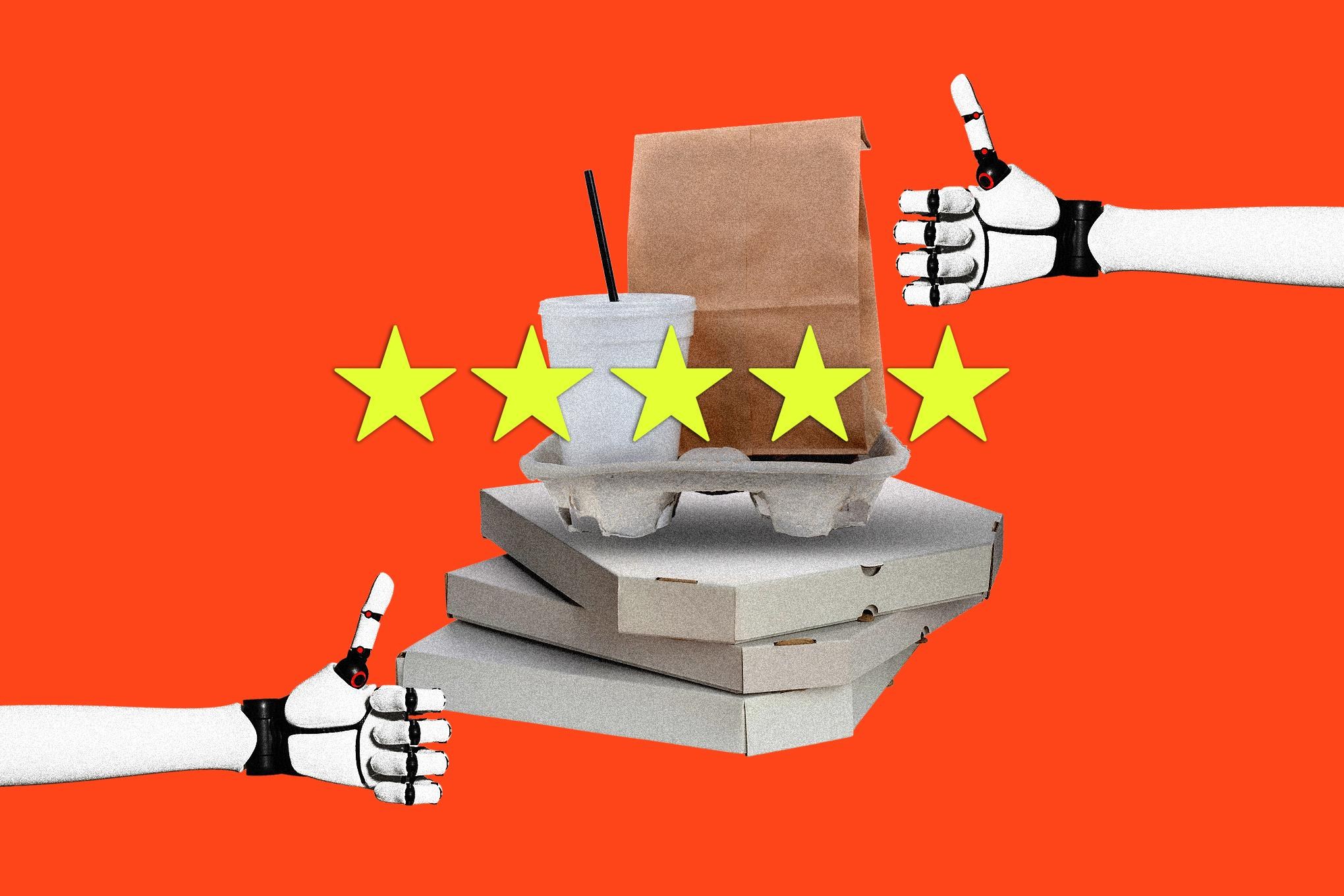
AIBusinessScienceAI could upend food deliveryDelivery apps like DoorDash and Uber Eats have changed how diners eat and how restaurants operate. AI could force a new kind of reckoning for the industry.by Mia SatoOct 7, 2026, 12:00 PM UTCShareGiftMia Sato is features writer with five years of experience covering the companies that shape technology and the people who use their tools.DoorDash, the leading food delivery app, processed 970 million orders in its second quarter this year and generated $4.5 billion in revenue. A 10-person startup called Bites is a blip in comparison: It has just around 300 restaurants signed up in the Bay Area, where it’s operating as a pre-seed startup. But this summer, Bites caught DoorDash’s attention.In August, a slew of restaurants in the Bay Area received a strange email from DoorDash, warning businesses that they may be listed without their consent on Bites.The form letter, copies of which were seen by The Verge, said that DoorDash had heard from “several partners” that were added to the third-party platform without their knowledge.
DoorDash warned restaurants that they may not have agreed to Bites’ “terms, pricing structures, or service standards”; that they may not have control over the accuracy of their menu or hours of operation on Bites; and that, depending on the state, “such practices could be illegal.” The email included instructions on how to contact Bites to request removal.One way to look at the warning is DoorDash proactively alerting its restaurant partners. But DoorDash going on the offense over a relatively small peer hints at a battle taking shape between established apps and newer, leaner startups looking to upend business in the age of AI.Tech companies have promised that the future of AI is that ordinary people will have “agents” completing tasks: scheduling meetings, looking for deals on socks, sifting through their inbox and replying to emails, and yes, ordering food on their behalf. If this really does come to bear — if billions of people shift to interact with the internet not through search engines, webpages, and apps, but through large language models — those websites and services will lose control of the relationship with consumers as they stop visiting webpages and apps. What happens to Amazon when it can’t show shoppers boosted item listings because they don’t come to the site?
What happens when Uber can’t entice riders with a free subscription trial? What happens when a food delivery service can upsell you to throw in a bottle of wine with dinner? The Verge has coined this brewing fight “the DoorDash problem.” Bites is now the literal embodiment of the term.Bites’ pitch is simple: Companies like DoorDash are the middleman, forcing restaurants to raise prices to cover the commission the platforms take, leaving customers paying more to make up the difference. DoorDash fees for restaurants range anywhere from 15 to 30 percent per delivery order — the more in commission fees a restaurant forks over, the more diners they are visible to on the platform.
Bites, on the other hand, touts simplified delivery and service fees and a flat $1 surcharge per order, which it says allows partners to keep item prices lower. (Diners typically pay the $1 fee, but some restaurants will cover it on a customer’s behalf.) Bites has a traditional app, but it bills itself as “AI native”: Diners can place orders from Bites restaurants directly in ChatGPT, which go not to a third-party platform like DoorDash, but directly to the restaurant.RelatedWould you let robots spend your money? Google is betting on itThe DoorDash problem and the great AI browser fightBites founder and CEO Bala Subramaniam says the company heard from 14 restaurant partners who had received a letter from DoorDash, and a handful of businesses who were not listed on Bites but now — having been made aware of the company — wanted to join. (Bites also acknowledges some restaurants did request to be removed from the platform; the company says they were listed on Bites from old demos.) Others got emails despite not being listed at all. One of the emails went to Jay Jayaraman, who has 13 restaurants listed on Bites and considers himself an early adopter of the platform.Before being on Bites, Jayaraman says 80 percent of orders came from DoorDash; now, 65 percent come in through Bites, he estimates, with 25 percent from DoorDash and the remaining sliver from Uber Eats and Grubhub. Jayaraman says his margins are higher with Bites orders than with DoorDash orders.“We are seeing a huge drop or a huge shift away from DoorDash, which I personally welcome because it’s adding to my bottom line,” Jayaraman says.LLMs becoming the portal to the web threatens app- and website-based businesses in myriad ways.
A shift away from visiting websites and using individual apps means those companies can’t do things like show consumers similar products, offer deals and free trials, and, significantly, monetize via ads and boosted listings. (DoorDash doesn’t only make money via subscriptions and commission fees — its ads business hit $1 billion in 2024.) The most prominent instance of the LLM-service provider tension materializing is the ongoing legal fight between AI company Perplexity and Amazon, in which Amazon sued Perplexity in 2025 to block agents from browsing and shopping on its site. Amazon has also recently blocked Meta’s Muse AI agent from shopping on its site and removed product details from order emails — data that is potentially very valuable for Google’s own agentic shopping features. Amazon’s ad business generated $19.8 billion in revenue in the second quarter of this year, driven by sponsored product listings.“All of that investment does not have to be made anymore, and yet the pricing has stayed the same.”Bites can keep prices lower for customers and restaurants because the pricing structure on bigger platforms is outdated, says Matt Maloney, who cofounded both Bites and Grubhub. (Maloney left Grubhub in 2021 after the company was acquired. His involvement with Bites hasn’t been previously reported.) Delivery services spent billions of dollars to build online ordering infrastructure, as well as courting restaurants, diners, and drivers onto their platforms — restaurants raising item prices on delivery apps to offset the high commissions and fees are a relic of that era, Maloney argues.
But post-covid lockdown, nobody needs to be convinced of the convenience of delivery.“All of that investment does not have to be made anymore, and yet the pricing has stayed the same,” Maloney says. Bites partners with point-of-sale systems — companies like Toast and Square that process orders — to pull digitized menus into LLMs and send orders directly to restaurants, instead of through an intermediary like DoorDash. Once a point-of-sale company is partnered with Bites, restaurants click a button to opt in. The Verge tested the service by ordering a pizza and beverage for delivery through ChatGPT using the Bites plugin, which came to a total of $56.73 including tip, tax, and delivery fees.
The same order on DoorDash totaled $70.29, which had higher service fees and the same pizza priced $11 more.“People think it’s the delivery apps that are egregious, [but] it’s actually the model that has made the restaurants actually increase the prices,” Subramaniam, who previously worked at Instacart, says. “And they are actually hungry for a new model.”Subramaniam says Bites is especially geared toward the diners who already know where they want to eat and don’t need a third-party platform like DoorDash to find them.“It may not become the discovery platform,” he says. “We don’t need to have sponsored ads … but if you know where you want to eat, we will get you to the place that you want to eat, with the best pricing.”The explosion of food delivery during the pandemic helped man






Leave a Reply