
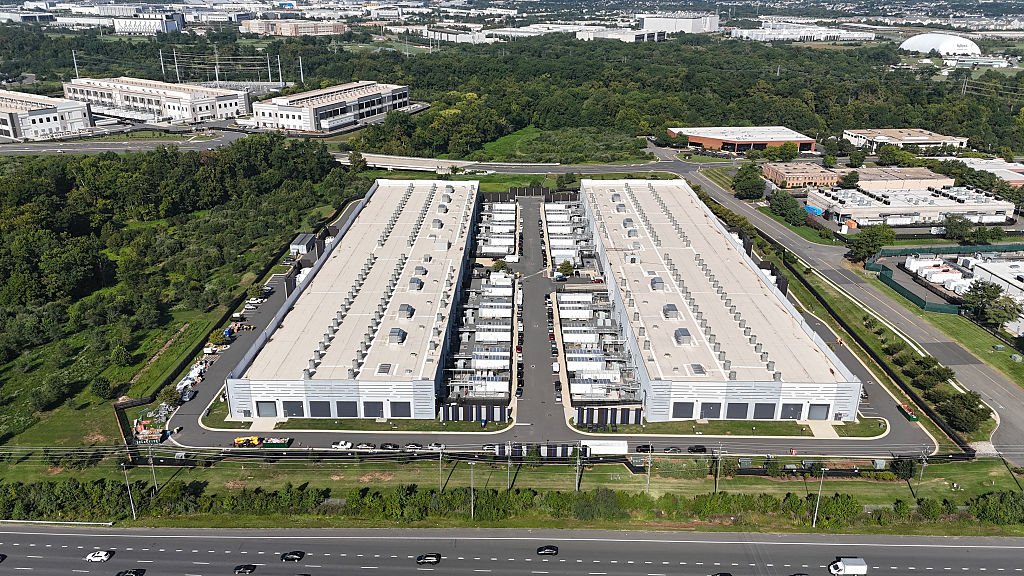
Text settings Story text Size Small Standard Large Width * Standard Wide Links Standard Orange * Subscribers only Learn more Minimize to nav On Friday, Amazon committed to donating more than $1 billion over the next five years to communities neighboring data centers. In a press release, Amazon Web Services’ CEO Matt Garman said that communities would decide how to prioritize funds across “education, job training, energy affordability, water, and energy preservation, and local priorities.” Laying out other community commitments, Amazon also promised to ensure data centers wouldn’t increase power bills or wipe out local water supplies. Regarding the latter, Amazon promised to be “water positive” by 2030, while claiming that 75 percent of projects have already met this goal. Rolling out these commitments, Amazon seemed bent on convincing Americans that the swelling data center backlash is based on lies.
Echoing Donald Trump’s claims that foreign disinformation campaigns are fueling widespread protests, Garman urged that calls for data moratoriums must end or else American frontier AI might fall behind China’s. According to Garman, US rivals are trying to “trick us into slowing down,” and Amazon’s commitments are meant to reassure Americans that everything’s okay and that we should instead plow ahead, as Trump endlessly advocates. However, advocates at Stand.Earth—a global nonprofit that’s been fighting for environmental protections in communities hosting data centers—told Ars that Amazon is the one being “misleading” by spreading “corporate propaganda.” Seemingly in crisis mode as billions of dollars in data center projects have been blocked nationwide, Amazon’s promised donations represent “a flailing attempt at damage control for the harm its data center build-out has already caused,” Stand.Earth said. Most problematic, Stand.Earth suggested, is Amazon’s plan to back a power plant that experts expect will become the largest source of US climate pollution.
Glaringly, Amazon’s data center commitments don’t mention the power plant and scarcely address pollution, apart from promising to exclusively rely on back-up generators that use the lowest possible emissions. “For all the claims Amazon makes about investing in carbon-free energy, it conveniently leaves out that it is constructing the single-largest source of climate emissions in the United States in Pecos, Texas,” Stand.Earth said. “Communities will face 33 million tons of harmful air pollution every year—with the power plant using the same amount of energy needed to run more than 1.9 million homes.” Additionally, Stand.Earth called out Amazon for claiming that most data center generators sparking pollution fears in communities typically sit “idle.” Although Amazon emphasized that most generators only run for “roughly 10 hours per year,” Stand.Earth cited cases where “Amazon data centers ran on diesel back-up power for days at a time.” Some praise: Amazon stops using NDAs At least one part of Amazon’s deal is promising, Stand.Earth suggested. The company ending its practice of using nondisclosure agreements when building new data centers will likely help make projects more transparent. However, “many of the key concerns communities have are not addressed,” Stand.Earth found. For example, Amazon’s promises to replace all water used for data centers seemingly won’t address “the massive water footprint left by energy infrastructure powering its data centers” or “the potential for forever-chemical contamination from nascent cooling technologies,” Stand.Earth told Ars.
The total amount Amazon is investing also doesn’t seem like much compared to what the company has spent. In the press release, Garman said that Amazon contributed the same amount, more than $1 billion, to data center communities over the past three years. “Compared to the $220 billion the company is investing in data centers in 2026 alone, Amazon’s commitment of $1 billion over five years for community support is a drop in the bucket,” Stand.Earth said. “It is difficult to read this statement as anything other than a plea from Amazon to continue exploiting communities at minimal cost.” Ashley Belanger Senior Policy Reporter Ashley Belanger Senior Policy Reporter 20 Comments













Leave a Reply