
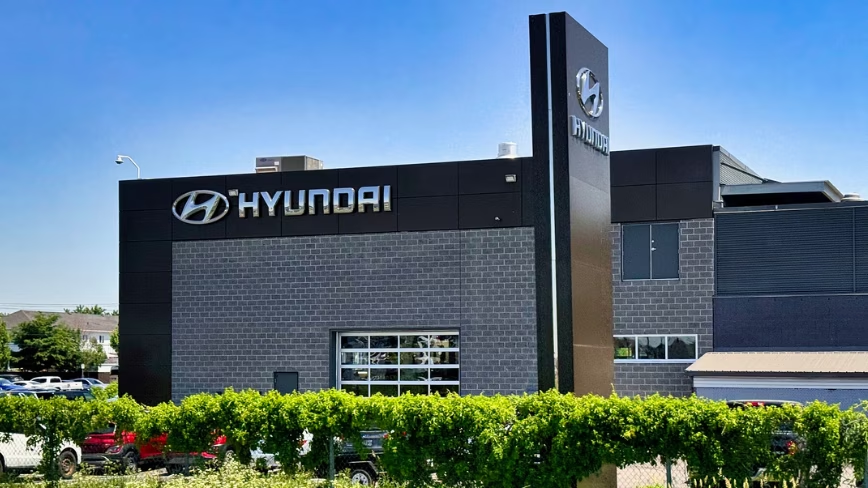
A Hyundai dealership in St-Jean-sur-Richelieu, Quebec. Credit: Harrison Keely / CC BY 4.0 via Wikimedia Commons (cropped) Hyundai research chief Manfred Harrer says carmakers cannot give up on solid-state batteries and expects small-volume halo cars within five years, but does not believe the raw material cost problem can be solved in that time. LG Energy Solution puts solid-state in electric cars roughly a decade away, and France is already subsidising a solid-state plant at Dunkirk. Carmakers cannot give up on solid-state batteries, Hyundai’s research and development chief Manfred Harrer told reporters last week, InsideEVs reported.
He expects small-volume halo cars with solid-state packs within five years. He does not expect the raw material costs to fall in that time. He is a Porsche engineer. Harrer spent his career at Porsche and BMW before Hyundai appointed him research and development chief in December.
He calls solid-state the big bet in the industry right now. Hyundai is developing cells internally and with Solid Power, because it wants to own the technology rather than buy it. The cost line is the story. Everything can be solved in the end, Harrer said, “but it comes with cost, tremendous cost.” He does not believe the raw material problem can be solved five years from now.
That keeps solid-state away from ordinary cars for considerably longer than the halo cars suggest. Others put it later still. LG Energy Solution’s North America president said in August that solid-state will reach phones about a decade before electric cars, and that large formats are where manufacturers struggle. The company is developing manganese-rich lithium-ion with General Motors instead, promising over 400 miles of range by 2028.
The two forecasts are about five years apart. France has already paid. ProLogium broke ground in February on a plant at Dunkirk, beside the Gravelines nuclear station, for all-solid-state lithium ceramic cells measured at 381 Wh per kg by TUV Rheinland. Its existing Taiwanese line runs at about 0.5 GWh a year, or roughly 6,000 packs.
The French plant is meant to start at 4 GWh. Europe has done this before. Northvolt was meant to be the continent’s answer to Asian cell making, and it collapsed after $15B of financing, having aimed at a quarter of the European market by 2030. Asian suppliers still hold 90% of it.
The second attempt is a chemistry nobody has yet built at automotive scale. Nobody has shipped one yet. Demonstration cars exist, including a Mercedes running Factorial cells and a Ducati carrying QuantumScape’s. None of them is a car anyone can buy.
Toyota has been working on solid-state for at least two decades.









Leave a Reply