
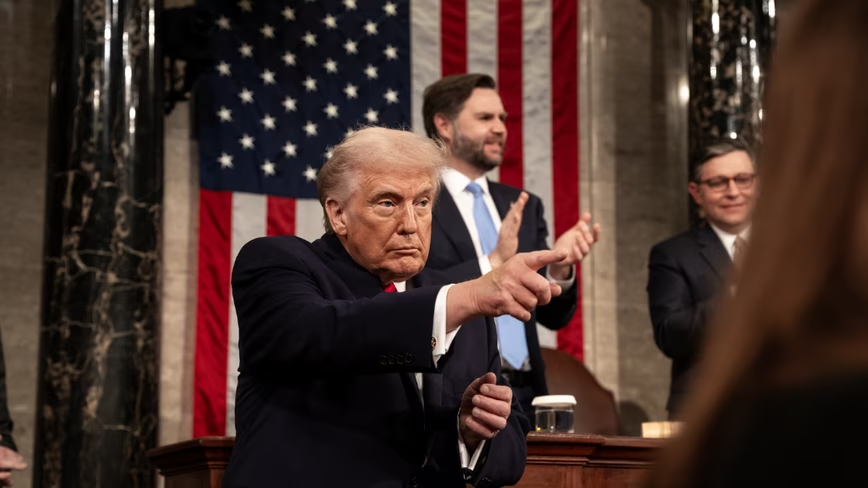
President Donald Trump’s State of the Union address, Tuesday, February 24, 2026, on the House floor at the U.S. Capitol in Washington, D.C. Credit: Official White House Photo by Emily J. Higgins President Donald Trump posted twice about artificial intelligence on Saturday. The first post asked his followers to vote on a new name for the technology. The second called the campaign against it a hoax and promised an AI Force and an AI czar.
The rename has taken most of the attention. The second post is the one that contains policy. The poll, briefly Trump offered three replacements for artificial intelligence: Superior Intelligence, Extreme Intelligence and Supreme Intelligence. Two of the three carry the same initials.
The poll had 62,329 votes and 21 hours left when TNW read it on Sunday. Truth Social does not display the split before a poll closes, so which name is winning is not public. The hoax claim is the checkable part Trump listed “the decimation, or destruction, of AI” alongside Russia, Ukraine and both impeachments as hoaxes generated by the “Radical Left Dumocrats”. He wrote that it began with an attack on data centres, which he called crazed.
That is a claim about who opposes data centres, and it can be tested. Andrew Pantazi collected the week’s polling for Axios, including a New York Times and Siena College survey of 1,503 likely voters. It found 61% opposed building data centres to power AI. Among Republicans the figure was 47%, against 75% of Democrats. Republican officials are not lining up behind him either. Greg Abbott said the data centre companies had dug their own grave, an unusually direct break with a president from his own party.
The attack has not largely failed Trump wrote that the data centre campaign had largely failed once communities saw the salaries and the tax revenue. The record does not support that. New York paused permits for large data centre projects and has not moved since, despite Trump calling the decision terrible. That is the largest single blocking action any state has taken.
There is also form here. The last claim that the backlash was manufactured came from X, which said Chinese bots were driving it, and a researcher who checked found those accounts had almost no engagement. An AI Force is not something a president can form “I am forming the AI Force, much like I did Space Force,” Trump wrote. Space Force is the comparison that undoes the announcement.
Space Force was created by Congress, in the National Defense Authorization Act for fiscal 2020, signed in December 2019. It exists in Title 10 as the sixth armed service because a statute put it there. A president cannot stand up a military branch by announcement. The post named no mission, no budget and no place in government for the AI Force.
Some coverage has rendered it as a task force rather than a force. Those are different things, and the post says force. The czar job has a clock on it Trump wrote that he would name an AI czar soon, adding that only high-IQ individuals need apply. The role has been empty since March.
David Sacks left it then. Raquel Coronell Uribe reported for NBC News that he stepped down because of limits on his term as a special government employee, and that he is expected at Trump’s state dinner with Xi Jinping. That constraint will apply again. A special government employee may serve no more than 130 days in any 365-day period, which is why the last czar’s tenure ended on a calendar rather than on a decision. The actual policy is one sentence long Buried in the post is the administration’s regulatory position.
The government will not “hinder or stifle” the industry, Trump wrote, but will be “looking for BAD” using “our already existing Criminal and Civil Justice System”. That is a statement that no new AI statute is coming. It is also, in effect, the preemption argument, which holds that existing law is sufficient and that state AI rules are the problem. That campaign has already met resistance from states and from Congress.
The Senate voted 99 to 1 to strip preemption from a defence bill, and 36 state attorneys general wrote against it. There is also a vehicle already running. Trump signed a narrowed AI order built around a voluntary model review, which is the oversight machinery any AI Force would sit beside or replace. The people asking for guardrails are not Democrats The hoax framing needs the safety argument to be partisan. It is not.
Dario Amodei, Sam Altman, Elon Musk and Demis Hassabis have all called for slowing development. Geoffrey Hinton told lawmakers in a closed-door briefing this week that Congress has maybe a year to act, NBC News reported. Trump has been consistent in response. Anthony Ha noted for TechCrunch that the president said at a golf tournament last weekend he was open to guardrails, while blaming negative forces for raising the subject at all. The number at the end Trump closed by writing that AI could reach as much as 25% of the country’s GDP.
He gave no timeframe and no method. The American economy runs to roughly $30tn. A quarter of that is about $7.5tn, which is more than the annual output of any country on earth other than the United States and China. What to watch Watch whether the AI Force turns up in a bill.
Nothing else would give it a budget or a legal basis, and the Space Force comparison sets exactly that expectation. Watch who takes the czar job, and on what terms. A special government employee appointment would put the same 130-day clock on the next holder. Watch whether the White House explains any of it.
It did not respond to requests for comment from Axios or NBC News on Saturday.











Leave a Reply