
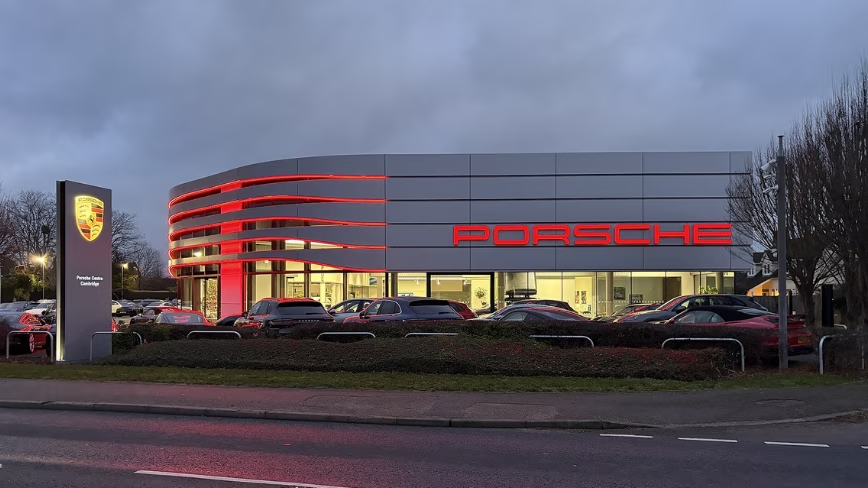
Porsche dealership in Hauxton Credit: Mr Ignavy / CC BY-SA 2.0 via Wikimedia Commons Porsche and the Aachen recycler cylib have produced pilot battery cells in which 100% of the cathode active material, the lithium, nickel, cobalt and manganese, came from Porsche’s own end-of-life packs. The EU Batteries Regulation will require only 6% recycled lithium and 6% recycled nickel in a new battery from August 2031. Porsche and the recycler cylib have produced battery cells in which all of the cathode active material is recycled, electrive reported. The lithium, nickel, cobalt and manganese all came back out of Porsche’s own end-of-life packs.
That is the whole loop, at pilot scale, and it is the third phase of a project begun last year. The batteries came from Porsche centres in Germany, and processing began in May using a water-based method, according to the release. Recycled material is meant to reach production cells in 2028. Initial tests show technical suitability, with more results due later this year.
Porsche is also an investor in the recycler. Porsche Ventures co-led cylib’s EUR 55M funding round in May 2024 with World Fund, alongside Bosch Ventures. The company is a spin-off from RWTH Aachen, founded by Lilian Schwich, Paul Sabarny and Gideon Schwich, and says its process recovers more than 90%. This is a customer praising a supplier it part-owns.
European law will ask for far less than a full loop. From August 2031 a new electric vehicle battery must contain 6% recycled lithium, 6% recycled nickel and 16% recycled cobalt. The rules cover electric vehicle batteries, industrial batteries above 2 kWh and starter batteries. Porsche’s pilot cathode is at 100%.
Those minimums rise in 2036, to 12% lithium, 15% nickel and 26% cobalt. The stricter numbers are on the other side of the process, where 50% of the lithium in waste batteries must be recovered by 2027 and 80% by 2031. Carmakers have to start documenting recycled content in August 2028. So the binding target is what comes out, not what goes back in.
Europe has other firms working on the same problem. Munich’s Tozero raised money in 2024 to process 30,000 tonnes of battery waste a year, also using a water-based route. It has raised EUR 17M in total. The constraint is arithmetic rather than chemistry.
There are not many dead European EV batteries yet, because the cars are still on the road. And Chinese and South Korean firms supplied 90% of Europe’s batteries last year, so most of what eventually comes back was never made here.









Leave a Reply