
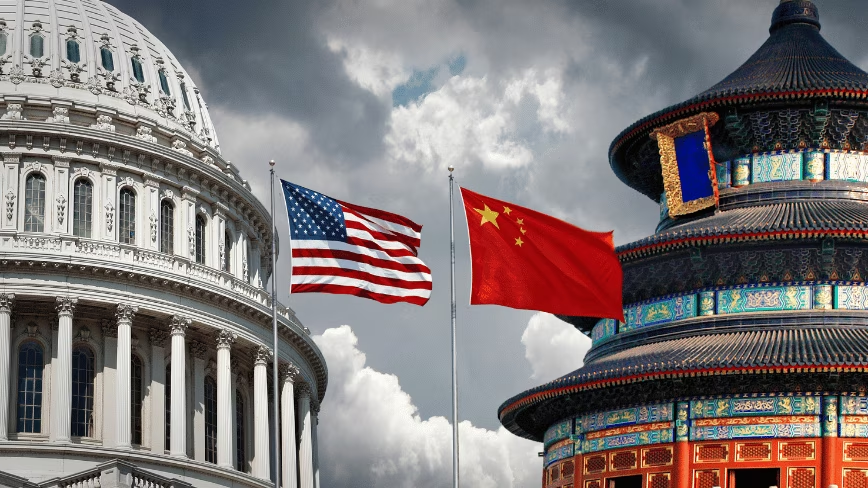
Credit: © narvikk / Getty Images via Canva.com Security experts from the US and China have proposed a set of safeguards for military AI modelled on the rules that grew up around nuclear weapons, including a ban on letting AI decide whether to launch them, Reuters reported. The recommendations, published last week, come from the US-China AI and National Security Dialogue, a track run since 2019 by the Brookings Institution and Tsinghua University’s Center for International Security and Strategy. The proposals were written by Melanie Sisson, a senior fellow at Brookings, and Tianjiao Jiang, an associate professor at Fudan University. Neither government has endorsed them.
AI should not autonomously decide to use nuclear weapons, and it should not be used to attack the other side’s nuclear command and control systems. Humans should also stay in control of any consequential cyberattack on a rival’s nuclear infrastructure. The experts also call for a dedicated US-China military hotline for AI incidents, and for the two countries to agree on what “meaningful human control” of a weapons system actually means. The phrase is widely used in arms-control debates but has no shared definition.
The ideas build on an agreement reached in November 2024, when then-President Joe Biden and Chinese President Xi Jinping affirmed that humans, not AI, should keep control over decisions to use nuclear weapons. A hotline would only help if both sides picked up. Carla Freeman of Johns Hopkins University told Reuters that no one in the Chinese system wants to talk to the US until the top leadership has settled on a response, which “may take days if not longer.” Beijing has been folding AI into its security thinking. Shen Jian, China’s ambassador for disarmament affairs, has said that military AI could increase the risk of miscalculation and escalation, and that China handles AI through its Foreign Ministry’s arms-control bureaucracy.
Washington, Reuters noted, has no equivalent central coordinator. The timing is deliberate. Donald Trump is due to meet Xi in Washington on 24 September, and the two governments are planning a fresh round of official AI talks, where the US intends to raise the issue of AI-directed cyberattacks. The proposals also land in a week when the pace of AI development has become a subject of political debate.
US lab chiefs, led by Anthropic’s Dario Amodei, have called for a slowdown in frontier development, and China’s commerce ministry has dismissed that plan as a bid for technological hegemony. The Brookings-Tsinghua group is aiming at something narrower: keeping the most dangerous military decisions in human hands. Also tagged with














Leave a Reply