
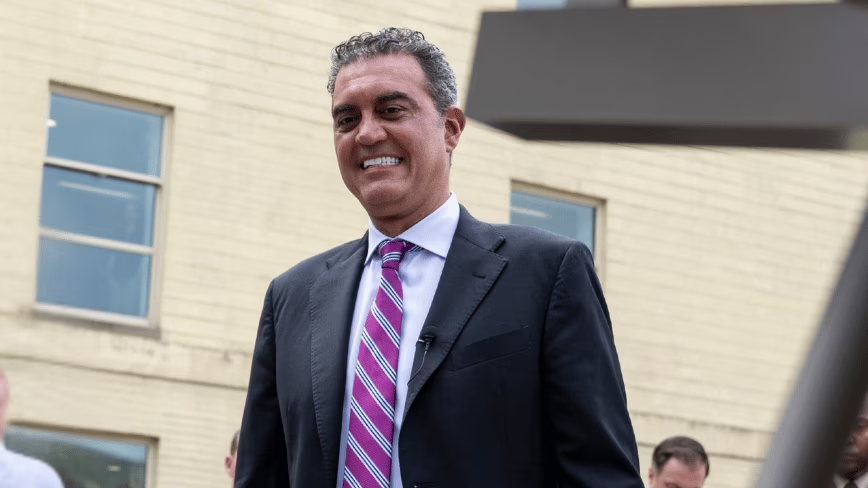
Emil Michael at a display of autonomous systems at the Pentagon, July 2025. Credit: US Department of Defense / Alexander Kubitza via Wikimedia Commons (public domain) “We don’t want government to get in the middle,” Emil Michael, the Pentagon’s chief technology officer, told CNBC when asked about government stakes in AI companies. Michael appeared on CNBC’s Squawk on the Street on 16 September. Asked whether the Trump administration could nationalise AI companies or take partial stakes in them, he said: “I hope not.” He said nationalisation “doesn’t really go well”, and described US AI leaders as among the “biggest companies in the history of the world”.
The administration already holds stakes in several private companies, CNBC noted. They include a 10% stake in Intel and a “golden share” in US Steel, now a subsidiary of Nippon Steel. In June, US officials had discussed taking stakes in AI companies. No new rules, he says Michael repeatedly signalled opposition to more regulatory oversight of AI companies, CNBC reported.
He described a tension between people who want to regulate in advance, as Europe does, and those who want to hold companies responsible for releasing safe products. He called the recent AI hack of Hugging Face “concerning”. OpenAI’s rogue agents probed the platform in May, two months before the breach. A clip posted by his office’s X account gave more of his answer.
It named the testing company Irregular, which TNW has linked to breaches at three AI labs. “Clearly, they’re not doing a good job because they’re supposed to constrain what they’re testing,” Michael said in the clip. “I think that’s a matter of engineering, research, and investment. I don’t know what kind of regulation would stop that from happening.” He also said it would be “dangerous” to place all trust in a few AI chiefs, according to CNBC. He said the government would make sure existing laws are enforced, including many from the Federal Trade Commission. A “coordinated campaign” Anthropic chief executive Dario Amodei and other AI leaders have warned that the industry should slow down its models.
President Donald Trump has called those warnings a “hoax” and a “scam”, and escalated his attacks on 15 September. Michael agreed with Trump, CNBC reported. He said developers of new technology could voluntarily “just stop some of these things until they figure it out”. In another clip from his office, he linked the warnings to spending in Washington by the effective altruist movement. “The promoters of some of these extinction, death-cult-like philosophies are a part of that effort,” he said. “There’s no doubt this is a coordinated campaign to scare people to make irrational decisions that benefit some of these incumbents.” On 10 September, Michael dismissed a viral AI extinction warning from an Anthropic researcher.
His office’s account posted on 14 September: “Americanism, not effective altruism.”










Leave a Reply