
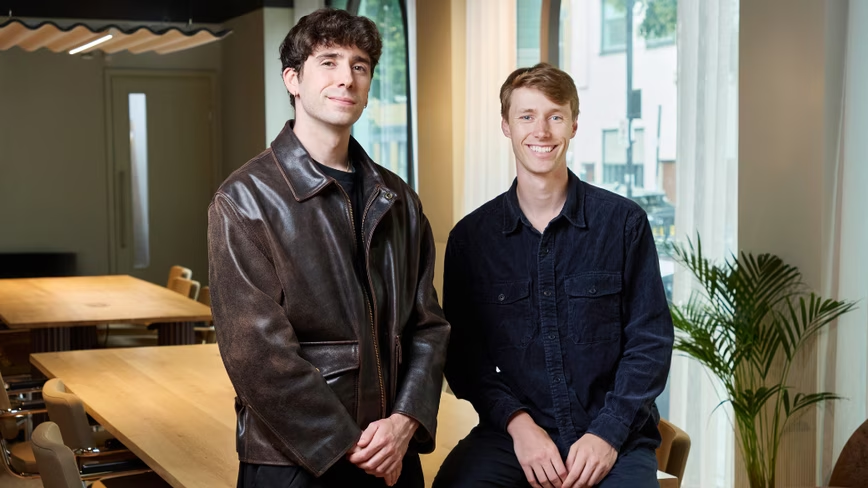
Magentic co-founders Odhran O’Donoghue, chief technology officer, left, and Robin Van Aeken, chief executive. Credit: Magentic The London-based Magentic, a start-up building AI agents for procurement and supply chain teams at large manufacturers, has raised $18M in a Series A round today, led by Felicis. Sequoia Capital and The Westly Group, which were existing investors, also took part. Also, this round comes a year after the company launched in July 2025, when it raised a $5.5M seed round led by Sequoia Capital.
What does the company actually do? Magentic builds AI agents and calls its digital workers Mages; these are multi-agent systems that operate inside a manufacturer’s software and use Microsoft Teams and email to communicate, just like a human colleague. Mages can handle every part of procurement, from choosing suppliers to negotiating contracts, placing orders, and clearing invoices. But people still need to approve important decisions.
The company handles both indirect spending and direct spending on raw materials used in products, which it says is the hardest part of the job. Its main customers often have billions of data rows and old systems, with many still relying on Excel. Magentic says one customer processes over a million orders each year through its agents, and another has already saved $4M. The company adds that among its customer base, which includes companies from the Global 500 and three of the world’s ten largest beverage producers, typical savings range from 2% to 5%, with a 60% improvement in data quality. “The physical world is dealing with the biggest capex cycle in history, driven by AI demand, during a time of trade disruption and geopolitical challenges,” said Robin Van Aeken, CEO and co-founder of Magentic. “The companies that build the best intelligence into every decision they make will be the ones that compound their competitive advantage.” Chief executive Robin Van Aeken is a former McKinsey consultant who worked with global manufacturers and pitches the business as a response to a spending boom.
Felicis partner Feyza Haskaraman said the task’s difficulty was the attraction. “Supply chains are the least glamorous part of the economy, yet the most consequential, deciding what gets built and what does not. That’s also what makes them so hard to automate,” she said. Adding that the firm had not seen anyone else build autonomous AI workers for what she called the physical economy. Many companies are still careful about allowing AI agents to operate within their important systems, and Magentic addresses this concern directly.
The company provides zero-data-retention agreements with leading AI model providers, can deploy in any cloud, and supports isolated installations in any data region. “Bringing frontier AI to the physical world requires pushing beyond AI systems with limited context windows. We’re building AI that can diagnose problems, plan the fixes, take action, and see work through across gigabytes and terabytes of multimodal data at once,” said Odhran O’Donoghue, CTO and co-founder of Magentic. Chief technology officer Odhran O’Donoghue holds a PhD in machine learning from Oxford and previously worked on AI projects at OpenAI. For now, the company has offices in both London and New York and anticipates that its human resources teams will grow rather than shrink as each individual’s output increases.











Leave a Reply