
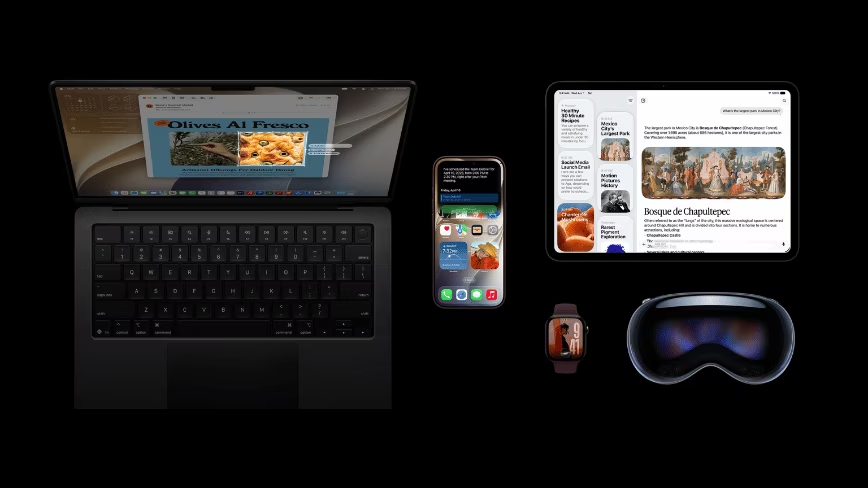
Siri AI launched in beta with iOS 27 and Apple’s other software updates on 14 September Credit: Apple Apple has released iOS 27, and with it the first public version of Siri AI, its rebuilt voice assistant. The Siri AI beta started rolling out in English on 14 September. It arrived alongside iPadOS 27, macOS 27, watchOS 27, visionOS 27, and tvOS 27. Apple first showed the software at WWDC in June.
Craig Federighi, Apple’s senior vice president of software engineering, summed up the release in the June announcement: “Apple products are an essential part of people’s lives, and this year we’re bringing powerful new capabilities to empower our users in even more ways. We’re delivering the next generation of Apple Intelligence across our platforms; introducing Siri AI, a profoundly more intelligent, knowledgeable, and capable Siri; expanding child safety features with intuitive new tools for families; and making our software platforms faster, more reliable, and more delightful than ever before.” A day after the software launch, Apple also changed what its iCloud+ subscription includes in more than 100 countries and regions. Eddy Cue, Apple’s senior vice president of services and health, announced the change: “We’re excited to bring Apple TV and Apple Arcade to iCloud+ users in over 100 countries in one convenient subscription. iCloud+ users can now securely store and share personal content across their devices, enjoy the absolute best in original storytelling from Apple TV, and explore an incredible lineup of hundreds of games through Apple Arcade.” What Siri AI does Siri AI runs on Apple Foundation Models that Apple says were custom-built in collaboration with Google and its Gemini models. Requests that need more computing power go to Private Cloud Compute, Apple’s own server system.
TNW covered the Gemini partnership when Apple unveiled the assistant in June. Apple lists several new abilities. Siri can use personal context from a user’s messages, notes, and other apps. It can see what is on the screen and answer questions about it.
It can also draw on world knowledge to answer general questions. The assistant can take actions inside apps. Apple names WhatsApp and Audible as early partners, with Microsoft Outlook, Notability, and Tripsy to follow. Siri also has its own app for the first time.
It keeps a history of conversations and syncs them across devices through iCloud. Other additions include a Siri mode in the Camera app, which answers questions about what the camera sees. Visual Intelligence, which lets users ask about what is on screen, now also works on iPad, Mac, and Vision Pro. Write with Siri drafts and edits text, and users can choose from new, more expressive voices.
Who can use it, and where Installing iOS 27 does not switch Siri AI on. Users go to Settings, tap Siri, then tap Try Siri AI (Beta), according to Apple’s support page. That adds them to a waitlist, and Apple says wait times can vary. Siri AI downloads automatically once the wait is over.
The assistant launches in English only, and the device and Siri language must match. Apple says French, Japanese, Korean, Portuguese, and Spanish will follow in October. It is not available to users under 13. On iPhone, Siri AI runs on the iPhone 15 Pro and Pro Max, the iPhone 16 range and later, the iPhone Air, and the iPhone Duo.
It also runs on M1 or later iPads and Macs, the iPad mini with the A17 Pro chip, the MacBook Neo, and Apple Vision Pro. On the wrist, it needs an Apple Watch Series 9 or later, an Ultra 2 or later, or an SE 3. The assistant is not available on iPhone, iPad, or Apple Watch in the European Union. Apple blamed the Digital Markets Act when it announced the delay in June.
EU users can use Siri AI on the Mac and on Vision Pro. In a statement at the time, Federighi said Apple was “deeply disappointed” that EU users would not get Siri AI on iPhone or iPad. He added that Apple did “not currently have a timeline” for its arrival there. Siri AI is also unavailable in China, where Apple says it is awaiting regulatory review.
Apple has also set daily usage limits on features that rely on its server-based models, including Siri AI. It says “expanded access” to those features “will be available for a fee in the future.” It has not published the limits or a price. More Apple Intelligence features iOS 27 adds AI tools outside Siri. In Photos, Spatial Reframing changes the framing of a shot, Extend fills in the edges of an image, and Clean Up has been improved.
Image Playground can now create photorealistic images. Safari can group open tabs by topic. A new Notify Me option tells users when a web page changes, for example when an item is back in stock or its price drops. Users can also build their own Safari extensions.
Apple also lists Smart Reply suggestions, Call Context during phone calls, and suggestions in Calendar. Users can create Shortcuts by describing what they want in plain language. The Home app can now describe what happens in security camera video. Speed and design Apple says apps launch up to 30% faster on iPhone and iPad under iOS 27.
It says photos load up to 70% faster after capture and AirDrop transfers are up to 80% faster. On iPad, file browsing and USB transfers are up to five times faster, according to the company. The software update also changes Liquid Glass, the design Apple introduced last year. A new slider lets users adjust how transparent it looks, and icons are sharper.
Apple also lists improvements to Mail search and to switching between Wi-Fi and cellular data. Shared Albums in iCloud now keep photos at full resolution, and people on Android and Windows can view them. The Health app adds support for tracking perimenopause. Photographic Styles gain new texture and grain controls in iOS 27 on the iPhone 16 range and later, the iPhone Air, and the iPhone Duo.
New child safety tools Apple also switched on the child safety features it previewed at WWDC. Parents get a simpler setup with age-based protections. A new Ask to Browse option means children must request approval before visiting a website. Communication Safety now also detects gore and violence, including during live FaceTime calls.
Screen Time has been redesigned and adds Time Allowances for scheduling. Apple says it worked with the American Academy of Pediatrics on the features. Watch, Vision Pro, TV, and AirPods watchOS 27 brings Siri AI to supported Apple Watch models outside the EU. The Smart Stack suggests more widgets, and Workout Buddy now works in Spanish.
On Vision Pro, visionOS 27 turns panoramas into spatial scenes and adds a new environment called Thórsmörk. tvOS 27 brings lossless audio to Apple Music and a redesigned Podcasts app. AirPods users get a custom equaliser and support for GymKit. Apple Maps adds Flyover views created with AI. The new hardware ships with iOS 27 The software arrives days before Apple’s new devices reach stores.
The iPhone 18 Pro and iPhone 18 Pro Max come with iOS 27. Pre-orders opened on 12 September. Both run on the A20 Pro chip, which Apple calls “a powerhouse for on-device AI workloads.” They have a 48MP Fusion Main camera with variable aperture. The two iPhones go on sale on 18 September, together with the Apple Watch Series 12, Apple Watch Ultra 4, and AirPods 5.
The watches use a new Health Sensing System and the S11 chip, and add a readiness score. AirPods 5 have open-ear active noise cancellation, and users can respond to Siri with head gestures. The Mac mini and Mac Studio reach stores on 22 September, running macOS 27. They use Apple’s M6 and M5 family of chips.
Apple says the M6 Mac mini delivers up to four times faster AI performance than the previous generation. It pitches the machine for “always-on, deskside agentic computing.” Mac Studio offers up to 4.3 times faster AI performance and up to 512GB of unified memory, with that configuration coming in late October. iCloud+ now inclu










Leave a Reply