
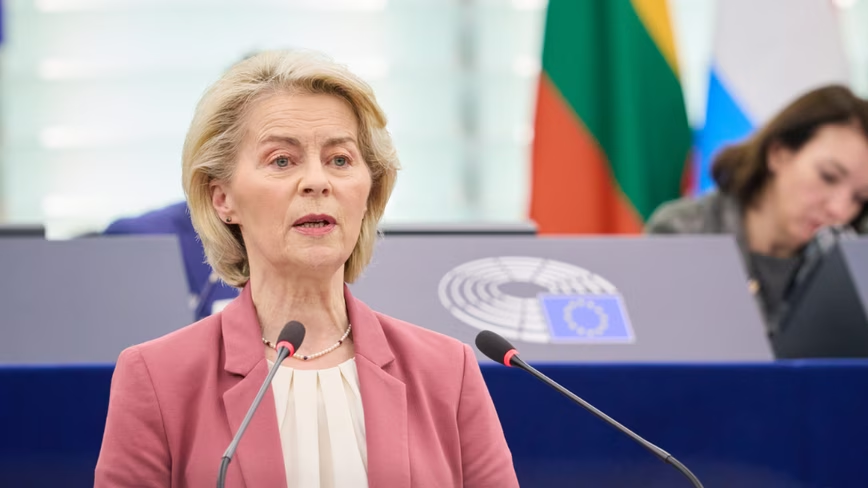
Ursula von der Leyen addressing the European Parliament plenary in Strasbourg in March 2026. Credit: © European Union, 2026, licensed under CC BY 4.0 (cropped) The European Commission will present the EU Kids Act on Thursday, its legislative response to more than a year of pressure from member states and parents over the impact of social media on children. Ursula von der Leyen and Henna Virkkunen, the EU’s technology chief, will introduce the proposal in Brussels. The central idea is “safe by design”.
Rather than focusing mainly on what children see online, the Commission wants to tackle the features that encourage excessive use, including addictive design and systems that keep users coming back. Two age thresholds are still being discussed: 13, which the Commission’s expert panel recommended and which is close to the age most platforms already claim to enforce, and 15, which France supports. The options have narrowed since July, when we reported that a formal proposal was expected within weeks. Spain had pushed for 16, France for 15 or lower, while the German-led expert panel recommended 13.
The European Parliament had also called for a common age of 16. Not every country supports an age-based approach. Estonia and Belgium have opposed outright bans, arguing that the platforms should be regulated rather than putting the burden on children. It is still unclear whether the higher age limits have been dropped or whether the debate has simply gone quiet ahead of Thursday’s announcement.
The timing of the launch is also deliberate. Ursula Von der Leyen is due to address the European Parliament in Strasbourg on Wednesday, putting the Kids Act directly after one of the Commission’s main political set pieces. The harder problem is one the Act inherits rather than solves. TNW reported in April that Europe’s child safety rules can require the collection of information that its privacy rules are designed to protect.
If platforms have to enforce an age limit, they first need to establish whether someone is a child. That means collecting or inferring personal information about users. The Commission’s proposed answer has been an age verification app based on zero-knowledge proofs. The system is supposed to confirm that someone is above a certain age without revealing their identity.
Researchers, however, were able to bypass it in less than two minutes. Meanwhile, member states have started moving ahead without waiting for Brussels. Norway is legislating for an under-16 ban, with platforms facing liability and fines of up to 20 million kroner. F rance has already banned social media for under-15s, while Spain is pursuing 16.
Austria, Denmark and Slovenia are working on their own measures, with proposed limits of 14, 15 and 15 respectively. Australia introduced a national under-16 ban in late 2025 and remains the only country to have done so nationwide. Four questions will determine how much the EU’s proposal actually changes. The first is the age threshold, assuming the Commission sets one.
The second is whether the Act introduces a straightforward ban or a broader, risk-based regime focused on how platforms are designed, which is what signals from July suggested. The third is who will be responsible for checking age, the platform or the operating system. The fourth may be the most important: what will the new rules do that the Digital Services Act cannot already do? The Commission has used the DSA to bring cases against both Meta and TikTok over child safety, so the new legislation will need to explain why another framework is necessary.
For now, those answers are still missing. The text has not been published, its legal basis has not been confirmed, and there is no penalty regime on the table yet. Thursday is when the EU Kids Act moves from months of political debate to something that can actually be examined.













Leave a Reply