
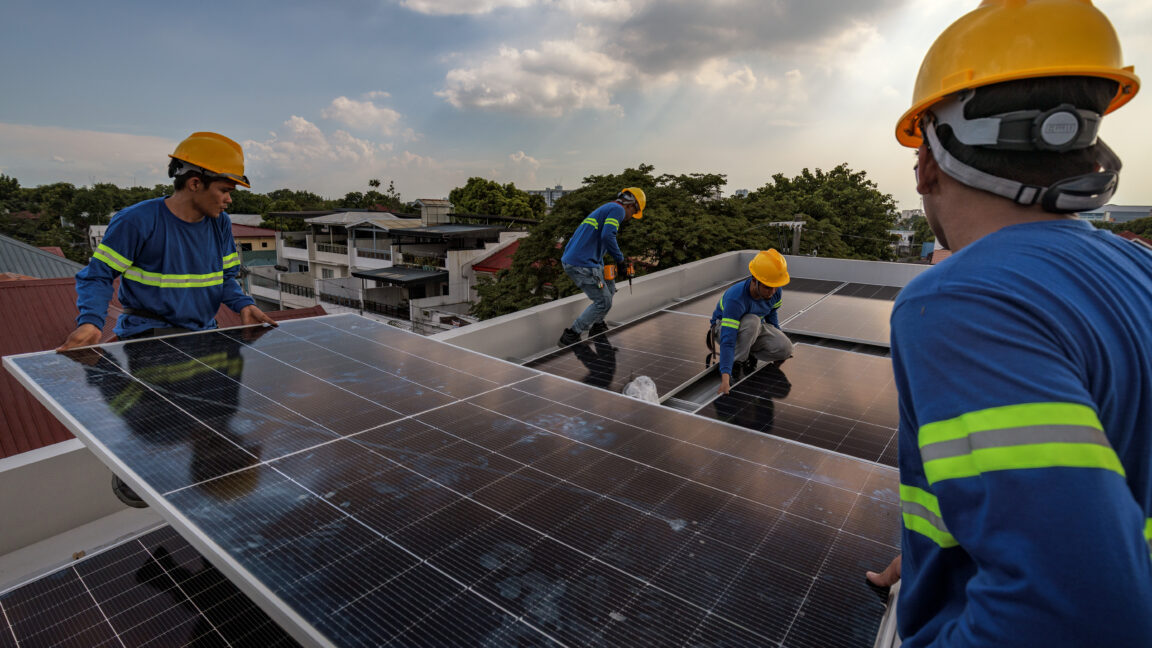
Text settings Story text Size Small Standard Large Width * Standard Wide Links Standard Orange * Subscribers only Learn more Minimize to nav In the badlands of Chakwal, in north-central Pakistan, Bestway Cement is transforming plots of dry earth and olive and peach groves into a forest of solar panels. Its efforts will add 6.34 megawatts of generation capacity by the end of the year, the company says, in addition to the 26 MW of photovoltaic cells currently in place. Already, solar generates over a quarter of the electricity powering its cement plant. “It’s the only way we can compete,” says Abdul Waheed, the general manager at Chakwal, which produces over 3 million tonnes of cement per year. “Our rivals have already gone in this direction.” Bestway and its competitors are among millions of businesses and households around the world that have installed solar panels on roofs, in yards, gardens and other land, helped by a flood of cheap components from China. At the end of 2025, such capacity totaled almost 1.2 terawatts worldwide, according to the Energy Institute’s Statistical Review of World Energy.
While the nature of solar power, which depends on the availability of sunlight, means it only produces a fraction of its theoretical potential, that total equates to roughly three times the size of the global nuclear power fleet. Credit: Financial Times Credit: Financial Times The solar revolution made possible by cheap Chinese photovoltaic panels—and the rise of small-scale, individual power generation—is transforming energy in the developing and industrialized world alike. Millions of people in poorer countries now have more reliable access to electricity, often through their own endeavors rather than massive installed infrastructure. And across the globe, consumers are using cleaner energy and bringing down their bills at a time when the cost of living is a constant concern, not least because of the Iran and Ukraine wars.
But such a massive, ungovernable influx of energy carries risks, too—the world’s power infrastructure was not designed for solar self-generation—and investment, pricing models, and even the security of supply could be affected as a result. In some countries, the rise of such domestic generation is starting to undermine the economics of power generation and distribution—just as utilities need to invest heavily in re-engineering grids to allow power to flow both to and from consumers. The UK and several US states have now approved the sale of the low-cost “plug and play” solar panels already widely available in other parts of Europe. Some fear such equipment, which simply plugs into domestic wiring, will introduce yet more unpredictability to the already complicated task of forecasting and managing overall power demand.
That challenge was dramatically illustrated last year by a day-long blackout across much of Spain and Portugal. Professor Janusz Bialek, an expert in power systems at Imperial College London, said in a recent paper that while solar and other renewables did not directly cause the outage, Spain had failed to sufficiently adapt its power system to reflect their growth. Solar generates over a quarter of the electricity powering Bestway’s cement plant in Chakwal, Pakistan, with 6.34 MW of generation capacity due to be added by the end of the year. Credit: Humza Jilani/FT Solar generates over a quarter of the electricity powering Bestway’s cement plant in Chakwal, Pakistan, with 6.34 MW of generation capacity due to be added by the end of the year.
Credit: Humza Jilani/FT “The rapidly increasing share of renewables in many power systems causes a profound change in the way power systems behave which we do not yet fully understand,” he wrote. Josefin Berg, research manager for solar and energy storage at S&P Global, says the growth of solar is “completely transforming the system from the centralized structure to something where anyone can produce power.” “Distribution grids may not always be prepared to take a big influx of electricity… and if you have more and more solar and batteries, reducing the sales of electricity for the grid, who is paying for the grid charges?” she adds. Syed Muhammad Taha, the chief executive of K-Electric, is all too aware of this issue. For the power utility that serves 20 million people in Pakistan’s coastal metropolis of Karachi, solar panels are a “curse and a blessing,” he says.
The concrete villas in Karachi’s wealthy Defence Housing Authority neighborhood below his office are covered in photovoltaic panels. “These are my best customers,” he laments, “and they’re opting for solar.” At the turn of the millennium, solar panels cost $5-$6 per watt of generation capacity. Today, they sell for around 12 cents per watt, a level described as “offensively cheap” by Dave Jones, co-founder of think-tank Ember. That reduction is entirely the result of an explosion in China’s production capacity, which, according to research firm Wood Mackenzie, stands at roughly 1.36 terawatts, even as Beijing tries to rein in output to combat price deflation. Cheaper panels enabled a vast rollout in China itself and helped solar generation evolve from a subsidized technology deployed mostly in markets looking to decarbonize to a vital source of electricity in areas where power is scarce, expensive or unreliable.
That process started in countries like Pakistan, Brazil, and South Africa and has now spread to other parts of Africa and the Philippines. Based on analysis of customs data, Ember estimates that Africa will install around 17 gigawatts of new solar this year. It believes most of that will be small-scale installations at factories or other businesses. “If you’re a business, you’re using electricity during the day—it’s a natural fit for you to use solar,” says Jones. But solar is also a boon for households. “A home goes from burning two or three kerosene lanterns to a light that is 20 to 40 times brighter, [turned] on every day,” says Anish Thakkar, co-founder of Sun King, a Kenyan business which lends families money to pay for solar and battery installations.
In the Philippines, Ember estimates rooftop solar capacity may have almost doubled over the 12 months to April and its calculations suggest residential solar panels can now pay for themselves in just over three years. Meralco, the country’s electricity distributor, said rooftop solar generated 372 gigawatt hours in the first six months of the year. The Indian government’s national subsidized rooftop solar program, launched in February 2024 with a budget worth nearly $8 billion at current exchange rates, has so far put solar panels on over 5 million homes and is adding roughly 500,000 per month, according to Praveer Sinha, chief executive of Tata Power. “It’s a democratization of the use of electricity,” he says. The fallout from the US-Iran war has led to more interest in rooftop solar in Britain, where since the end of August households have been able to buy 800-watt solar panels in supermarkets or DIY stores to plug in at home, a move the government says will give them “breathing space” on bills.
Several US states have also been making it easier for households to do the same, with New Jersey governor Mikie Sherrill saying she was “laser-focused on driving down energy costs” as she exempted the devices from metering requirements. Plug-and-play panels are proving popular in the US despite President Trump’s general antipathy to renewables and his decision to eliminate a tax credit for rooftop solar systems. Sanjeev Raghubir, head of sustainability at Shoprite, Africa’s biggest supermarket group, says the company could “power an entire suburb” with the panels it has been installing on its roofs and trucks in South Africa and Namibia since 2015. But what has been good for Shoprite, which now has around 43 MW of peak capacity at its












Leave a Reply