
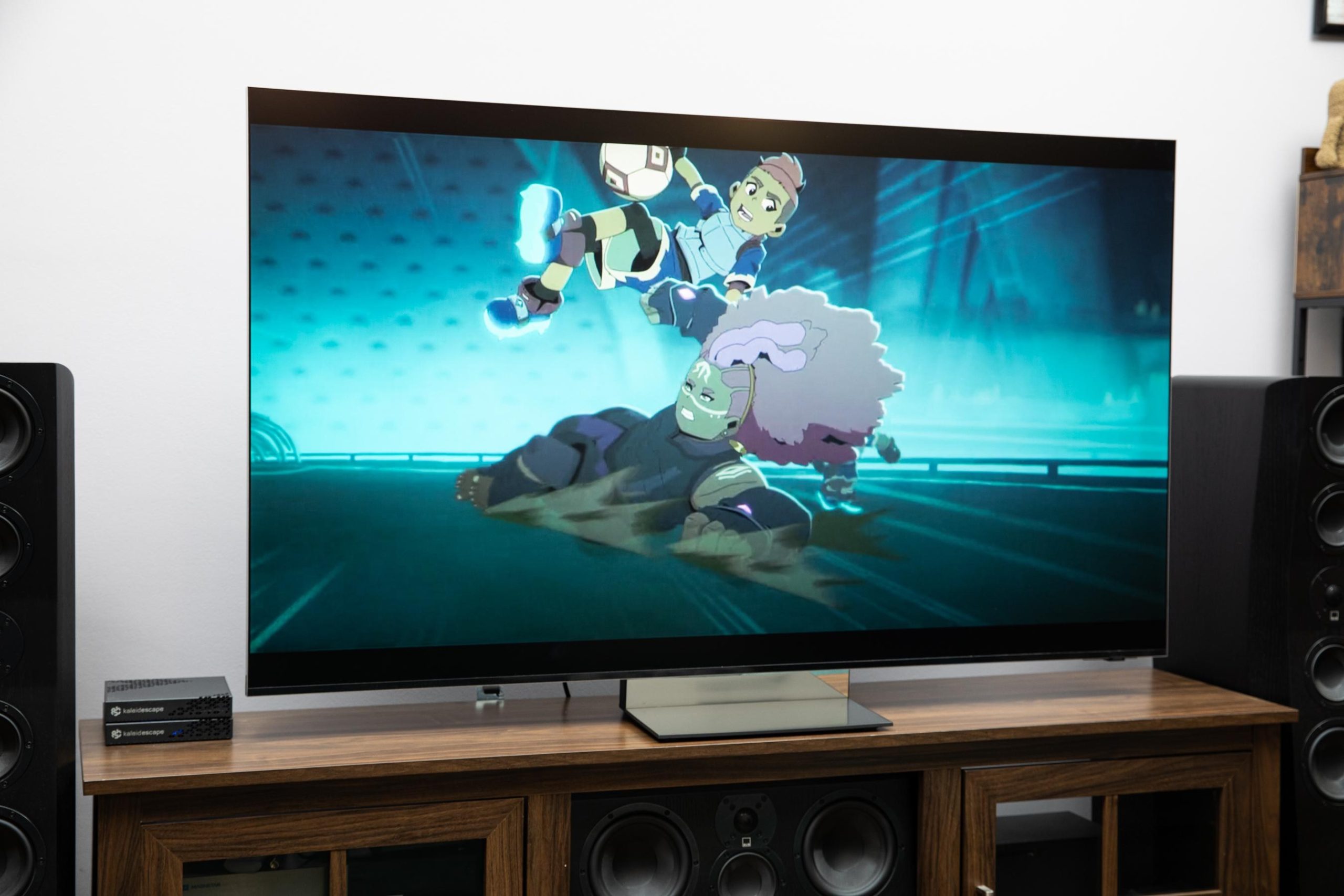
TechGadgetsReviewsSamsung’s R95H TV shows what RGB LED is capable ofThe excellent matte screen and ability to display a vast amount of colors makes the R95H one of the top RGB LED TVs available.If you buy something from a link, The Verge may earn a commission. See our ethics statement.by John HigginsNov 26, 2026, 2:00 PM UTCShareGiftIf you buy something from a link, The Verge may earn a commission. See our ethics statement.Samsung’s premium RGB LED TV has the widest color gamut I’ve measured this year.John Higgins is a senior reviewer covering TVs and audio. He has over 20 years experience in AV, and has previously been on staff at Digital Trends and Reviewed.RGB LED TVs finally became affordable in 2026, and there’s always a lot of promise when new TV technologies come out.
More color, higher brightness, improved performance — RGB LED TVs have a lot to prove. The Samsung R95H does a lot to deliver some of those promises. It can display more colors than other TVs I’ve seen so far this year, and the combination of light output and its matte screen makes it great for a bright room. RGB LED TVs might still be in their infancy, but the R95H is a solid TV that shows off the benefits of the new backlight tech.Because RGB LED TVs use individual red, green, and blue LEDs for their backlight (instead of a field of white or blue LEDs), they can deliver more colors than LED TVs.
The Samsung R95H is one of the best examples of this in RGB LED TVs. It can fully display all the colors used in the vast majority of movies (which use the P3 color space) as well as the few that use the wider BT.2020 color space.8Verge ScoreSamsung R95H RGB LED TV$2500$320022% off$2500The GoodMatte screen handles reflections incredibly wellGood color accuracy in Filmmaker modeThe BadSome color crosstalk in white textGrayscale leans a bit cyanNo Dolby Vision support$2500 at Best Buy (65-inch)$2500 at Samsung (65-inch)How we rate and review productsThe accuracy of those colors is also really good in HDR (it’s not quite as good in SDR, because the TV overbrightens most of them). Some earlier reviews called out mediocre color accuracy on the R95H, which I experienced with the first sample Samsung provided me in June. Samsung replaced that sample because I was worried something was wrong with it.
But in Filmmaker mode with firmware version 1247 on my current 65-inch TV, I was pleasantly surprised by the R95H.Display type: RGB LEDHDR formats: HDR10 Plus, HDR10, HLGTV OS: Tizen OSHDMI inputs: 4 x HDMI 2.1 (one with eARC), up to 8 with Wireless One Connect box (sold separately)Audio support: Dolby Atmos, Dolby Digital, Auracast, Q-SymphonyGaming features: VRR (up to 165Hz), ALLM, Game Bar, FreeSync Premium ProSizes available (inches): 65, 75, 85Colors are wonderfully lifelike. The green of the jungles in Planet Earth II, which uses the expanded BT.2020 color gamut, is beautifully vibrant, as are the hummingbirds that populate the trees. With movies that use P3, the foliage in the demo material on the Spears & Munsil Ultra HD Benchmark disc doesn’t have quite the same brilliance, but it still looks accurate and lifelike. Skin tones are natural.
White and gray tones, like those in snow scenes, have a slight blue tint. It’s pretty minor, though.The R95H also has a good amount of light output — a full-field white screen measured 694 nits, while specular highlights hit 2,206 nits in Filmmaker mode (the TV’s most accurate picture mode). That’s similar to the Sony Bravia 7 II but short of the Bravia 9 II by a few hundred nits, and well short of the TCL X11L. Flagship 2026 OLEDs also have brighter highlights but dimmer full white screens, as is expected from OLED panels.
Black levels on the R95H are really good for an LED display. There’s a bit of blooming, but not as excessive as I’ve seen on some RGB LED TVs this year. Overall, the Samsung R95H delivers an impactful image.The matte glare-free finish on the screen limits reflections well. I was never distracted by seeing the ceiling lights reflecting, as I can be with glossy screens.
The black-level raise issue — where ambient light gets caught behind the matte coating, causing the screen to look more gray than black — is much better. With a bright room, the black level rises a small amount, but it’s not washed out, and dark images still have depth.I had a great time gaming on it, too. Some earlier reviews noted issues with smearing, but recent firmware seems to have addressed this for the most part. While racing in F1 24 in 120Hz mode, motion was smooth.
The TV struggled a bit more when I set the Xbox to 60Hz, but I still enjoyed playing.Colors are lifelike and natural on the R95H in Filmmaker mode.The back panel connections cutout includes four HDMI 2.1 ports, although additional can be added with a Wireless One Connect box.One inherent issue with RGB LED TVs, though, is color crosstalk — I’ve seen it to some extent on every RGB LED TV, though it’s least apparent on the Sony Bravia 9 II. It can happen when there’s a dominant color onscreen near a lighter color, such as white text, lighter skin tones, or white clouds. The dominant color can bleed into those lighter colors, influencing their tint. This happens a bit on the Samsung R95H.
It’s most noticeable with white text. I saw it with news tickers on a red background, making the text look subtly pink, and with gaming, particularly while playing No Man’s Sky. Text displayed above a large yellow hologram has a slight yellow coloration that disappears if I move my view away from the hologram. In fleeting moments, it’s not too distracting, but when the color around the text is consistent, the effect is noticeable.Some TVs avoid this by defaulting the backlight to white and relying on the color filter, as LED TVs have for years.
While doing that gets rid of any possibility of color crosstalk, it also diminishes the TV’s color brightness and wider gamut. So with RGB LED TV technology where it currently is in its development cycle, there’s going to be a tradeoff between some color crosstalk or a more limited color gamut.The R95H still has the same limitations as all Samsung TVs. There’s no Dolby Vision support (Samsung is an original backer of HDR10 Plus and will likely never support competitor Dolby Vision). It also runs on Tizen OS, which is continually one of my least favorite interfaces.
Everything is buried a click or two deeper than it should be, including input selection, which makes it cumbersome to use. The remote, rechargeable via both USB-C and the solar panels on the back, is small, and I’m not a fan of the button layout — they’re bunched together, and the volume control feels clunky to me.The R95H has a sturdy pedestal stand.The remote is the same that Samsung has used for a few years, and while it’s small, I find its layout is cramped.The R95H is also still more expensive than most of its competitors. The Sony Bravia 9 II has better processing and is brighter, although it also has more blooming than the R95H. If you can fit a 75-inch in your space, the TCL X11L is significantly cheaper since it launched.
I think it’s a better overall TV. Then there are the flagship OLEDs — Samsung’s S95H and the LG G6 — which are both less than or the same price as the R95H, depending on size. And OLED is still a step ahead of RGB LED in overall picture quality because of its better contrast.There’s still room for RGB LED TVs to improve. With its wide color gamut coverage, good out-of-the-box accuracy, and excellent matte screen, the Samsung R95H is one of the better ones to come out this year.
Put up against those RGB competitors, it makes a strong case. But OLEDs are still better overall performers with superior contrast, and even cheaper non-RGB LEDs can get you most of the way there for less.Photography by John Higgins / The VergeI set up each TV in my living room on my home theater credenza. I stream movies and shows through t














Leave a Reply