
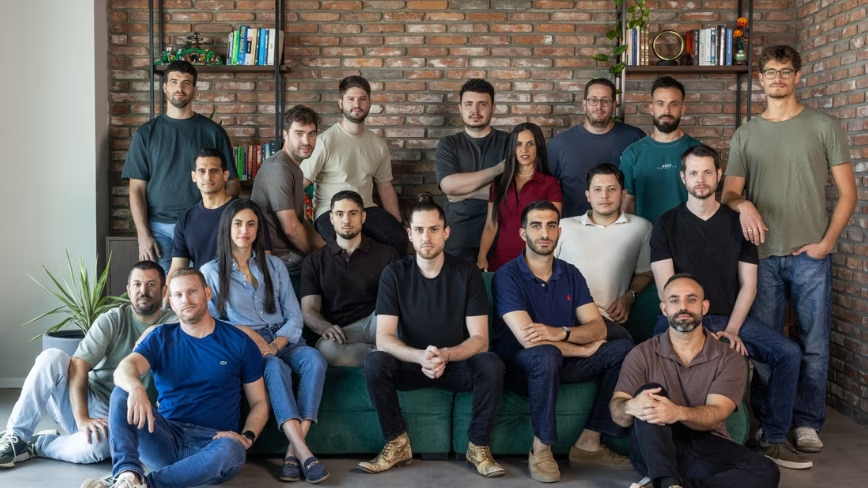
Credit: ACCESS Newswire / Corma Corma, a cybersecurity startup that trains its own AI models for defence, has raised $125m in a Series A round at a $1bn valuation. The round comes three months after Corma came out of stealth with a $60m seed round led by Sequoia Capital. NEA led the Corma Series A, as Angus Loten reported for The Wall Street Journal on Monday. Sequoia Capital, Khosla Ventures and Coatue invested again.
The round takes Corma’s total funding to $185m, the company said in its announcement. Server capacity up 24 times Corma says demand from Fortune 100, Fortune 500 and Fortune Global 500 companies has surged since August. It has increased its server capacity 24 times to keep up. “Since we came out of stealth, demand from the world’s largest organizations has been overwhelming, and one of our hardest problems has been securing capacity fast enough to keep up with the demand,” Alon Pluda, Corma’s co-founder and chief executive, said in a statement. Its customers work in healthcare, financial services, energy and critical infrastructure, retail and telecommunications, Calcalist reported.
Pluda did not give a revenue figure. “Our revenue is growing very rapidly, to the point that anything we say today might already be outdated,” Pluda told Calcalist. In a blog post, Pluda wrote that organisations are on a waitlist while Corma adds compute. The new money will scale its models, add compute and selectively expand the team. Black October Corma ties the round to a gap it sees between AI attack and AI defence.
In October, a wave of critical software flaws and breaches became known as Black October. Governments from Washington to Tokyo issued warnings. “Cybersecurity is now a battle of intelligence against intelligence, and Black October made that impossible to ignore,” Pluda said. The company argues that coding models also get better at finding and exploiting flaws. Defence, it says, means sifting audit logs, security events and network traffic for weak signals over long periods.
Corma trains its models for that work. It sells them as an AI workforce of agents that use a company’s existing security tools. “Our agents work with all these products, and the entire process is fully autonomous, with no human intervention involved,” Pluda told Calcalist. A swipe at the AI industry Corma’s homepage says the AI industry is pouring billions into models that get better at offence every month. It names no company. “Some of these companies are happy to profit from those offensive capabilities while preaching safety,” the page says.
The same page shows a chart labelled DefenseBench V5. It puts Corma v0.4 ahead of Claude Fable 5.2, Gemini 4 Carbon, GPT-6 Astra, GPT-6.1 Sol, GPT-6.1 Terra, Kimi K3.1 Pro and Grok 4.7 on defensive task performance and execution speed. “Corma is the only company taking this on in a way that is scalable across organizations to prevent the next big cyberattack,” said Aaron Jacobson, a partner at NEA. Corma employs about 25 people, according to Calcalist. Pluda is an alumnus of Israel’s Unit 8200.
The team includes researchers from Google DeepMind and cyber specialists from the same unit, the company said. Pluda wrote that Corma will share the next generation of its models “soon”. Get the TNW newsletter ✕ Close Get the TNW newsletter Get the most important tech news in your inbox each week.










Leave a Reply