
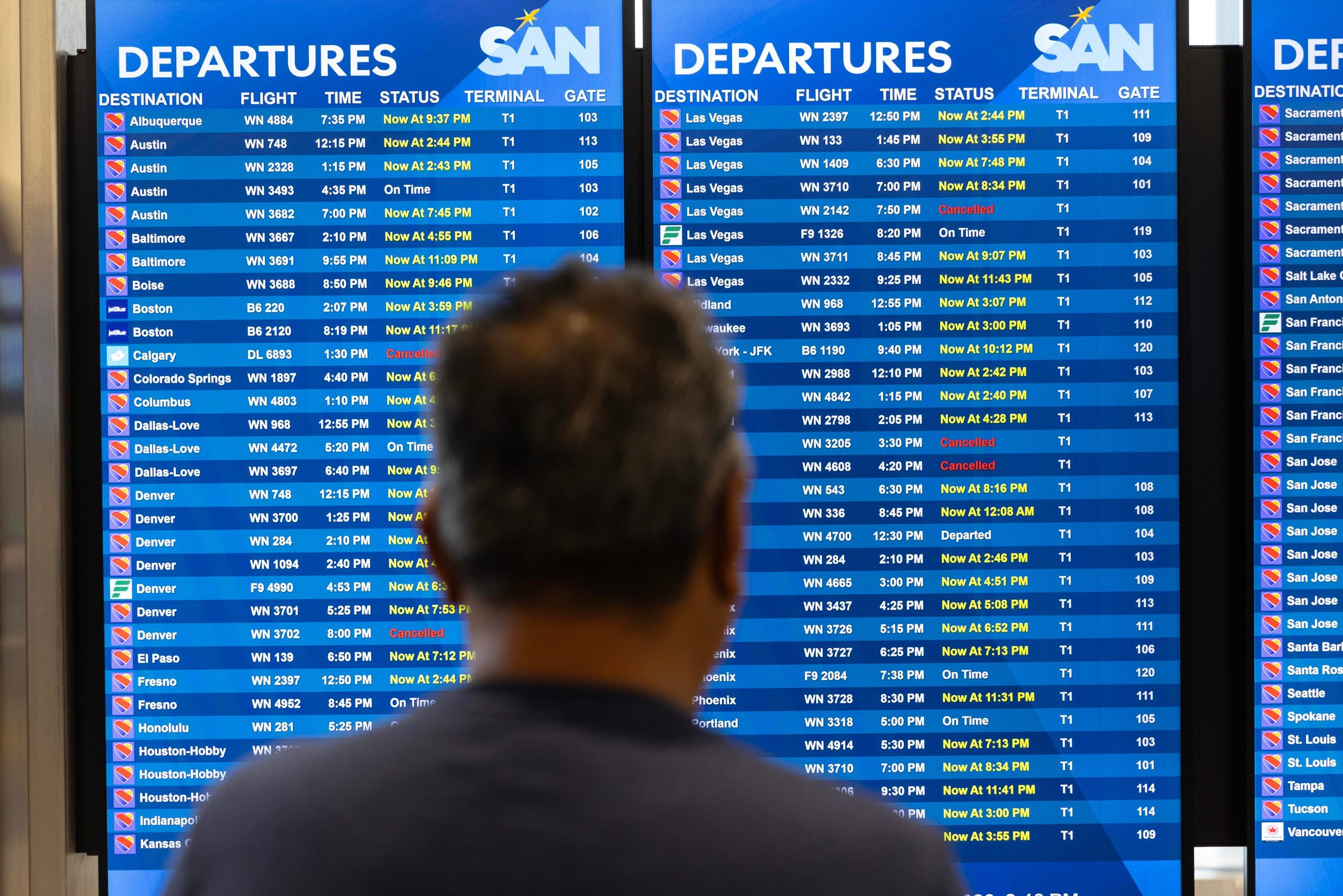
TransportationPolicyTechAmerica’s air traffic control system couldn’t handle a single bad routerInside the Friday the 13th telecommunications breakdown that stranded 1.5 million flyers, and the chaotic briefings that fueled conspiracy theories instead of public trust.by Darryl CampbellNov 16, 2026, 2:43 PM UTCShareGiftFlight statuses change from delayed to canceled at the San Diego International Airport after the FAA issued an emergency nationwide ground stop on November 13th, 2026. | Photo: Luke Johnson / The San Diego Union-Tribune via Getty ImagesTransportationPolicyTechAmerica’s air traffic control system couldn’t handle a single bad routerInside the Friday the 13th telecommunications breakdown that stranded 1.5 million flyers, and the chaotic briefings that fueled conspiracy theories instead of public trust.by Darryl CampbellNov 16, 2026, 2:43 PM UTCShareGiftThirty minutes outside Atlanta, the pilot got on the intercom to announce that something was wrong.A communications issue with the Federal Aviation Administration was cascading across the country. The pilot didn’t offer much detail except to say that the issue might affect gate access and connecting flights.For Amanda Khera, the timing couldn’t be worse. Her family vacation to a small island off the coast of Belize had already turned into a medical scare when her 22-month-old son Rio developed a high fever and had to be rushed to a local clinic. Exhausted, they were trying to get home to Virginia Beach, Virginia, to see his pediatrician and rest in their own bed.
First, they had to connect through Atlanta.“It was honestly pretty scary,” Khera said. “We didn’t know if the pilot was flying blind without any access to the control towers, or if planes would run into each other.”“We didn’t know if the pilot was flying blind without any access to the control towers, or if planes would run into each other.”— Amanda KheraShe had every right to be scared. She didn’t know what was going on in the cockpit or on the ground. She had no idea that pilots are trained to follow strict procedures that minimize safety risks during major air traffic control outages. All she knew was that several recent incidents, including a midair collision over Reagan National Airport in 2025 that killed 67 people, have called into question the safety of America’s skies.
So she spent the rest of the descent looking out the window for nearby aircraft.Her flight landed safely. But she deplaned into a terminal frozen in place. More than 600 flights out of Atlanta, including their connection to Norfolk, had been canceled. And no one knew when they would be able to take off because every flight across the United States had been grounded.An airport departures board displays multiple flights marked as canceled in Krakow, Poland, on November 14th, 2026.
Photo: NurPhoto via Getty Images Santiago Tovar (front, lying down), Nataly Tovar, Luis Tovar (seated, left), Claudia Tovar (center, seated), and Romina Tovar (right) wait to hear about the next flight of their vacation trip at Miami International Airport. Photo: Getty ImagesAircraft are seen at Miami International Airport after the FAA announced a nationwide ground stop on November 13, 2026. Photo: Getty ImagesA view of Charlotte Douglas International Airport in Charlotte, North Carolina, on November 13th, 2026. Photo: Getty ImagesOn Friday, November 13, the nation’s air traffic control system began to fail.
Around 3:15PM ET, pilots and air traffic controllers in the Midwest started reporting difficulty communicating with each other over the radio.“We’re 11,000 [feet] over Grand Rapids airport, about nine miles to the west,” said the pilot of Allegiant Flight 547, his transmission already becoming garbled. “Unable to get… contact… approach on any [frequency].”Four minutes later, controllers at Quad Cities Airport in Moline, Illinois, reported similar issues across the region.“We’re dealing with some communication issues on a larger scale than we initially anticipated,” said one. “It sounds like Chicago Approach is going ATC zero, so it might be worse than we initially thought. We thought it was just here.”With communication outages spreading around the country, the FAA issued a nationwide ground stop at 3:54PM ET “due to extraordinary circumstances and for reasons of safety.” From that moment on, no airplanes were allowed to take off in US airspace.The sudden halt surprised both pilots and controllers.“Just a heads up, we went in a national ground stop,” said a controller in Seattle.“Are you saying national as in Reagan National,” asked one United pilot, “or national in the whole country?”“Across all en route facilities, they’re having communication issues.”Like so many of the safety incidents that have plagued the air traffic control system over the last few years, this latest failure began with a fragile and outdated piece of FAA infrastructure. In this case, according to the agency, the faulty system was the FAA Telecommunications Infrastructure, or FTI.Built by defense giant L3Harris in the early 2000s, FTI is the data backbone of the entire air traffic control system. It links more than 4,400 aviation facilities and carries the voice and radar data controllers rely on to keep planes separated, bridging the gap between the FAA’s legacy phone-based transmission systems and modern,Internet Protocol-based ones.FTI is scheduled to be replaced in 2028.
Until then, L3Harris must make incremental upgrades to keep FTI operational.“We’re dealing with some communication issues on a larger scale than we initially anticipated.”— Air traffic controllerOne of these upgrades accidentally brought down the entire system, according to The Wall Street Journal. Early in the day, L3Harris contractors replaced an old wired telephone switch with a new wireless data router at the FAA radio facility in El Dorado, Arkansas. Once activated, however, the router began to flood the network with hundreds of connection attempts every second.This may have added enough extra load to the system to degrade the whole network’s performance, according to I-Hong Hou, professor of electrical and computer engineering at Texas A&M University.Hou explained that telecom networks break pieces of information — radio transmissions or radar coordinates, for example — into data packets small enough to be transmitted over the network and reassembled at the other end.“When the network is degraded, it may start to lose a small portion of packets,” Hou said. “Since you need all packets to reassemble the data feed, just dropping one out of 10 packets may cause your feed to completely stop.”Most modern communications apps are built to compensate for packet loss. FaceTime, for example, will blur the video or switch to audio-only to preserve the connection.Air traffic control doesn’t have that luxury.“Many NAS [National Air Space] applications … require a highly reliable synchronization source with exceptional stability,” according to FAA technical documentation, which warns that instability may cause widespread failure of critical systems.FAA technicians believe the El Dorado router’s repeated connection attempts created enough instability within the FTI to cut off radio and radar feeds to 17 of the FAA’s 22 Air Route Traffic Control Centers and several Terminal Radar Approach Controls.“We sometimes call this a cascading failure, meaning that one failed device can cause nearby devices to fail, and so on,” explained Hou.“We sometimes call this a cascading failure, meaning that one failed device can cause nearby devices to fail, and so on.”— I-Hong Hou, professor of electrical and computer engineering at Texas A&M UniversityL3Harris’s contractors isolated the malfunctioning router and another one at a nearby radar facility in Amarillo, Texas.
Once those two routers were taken offline, the network began








Leave a Reply