
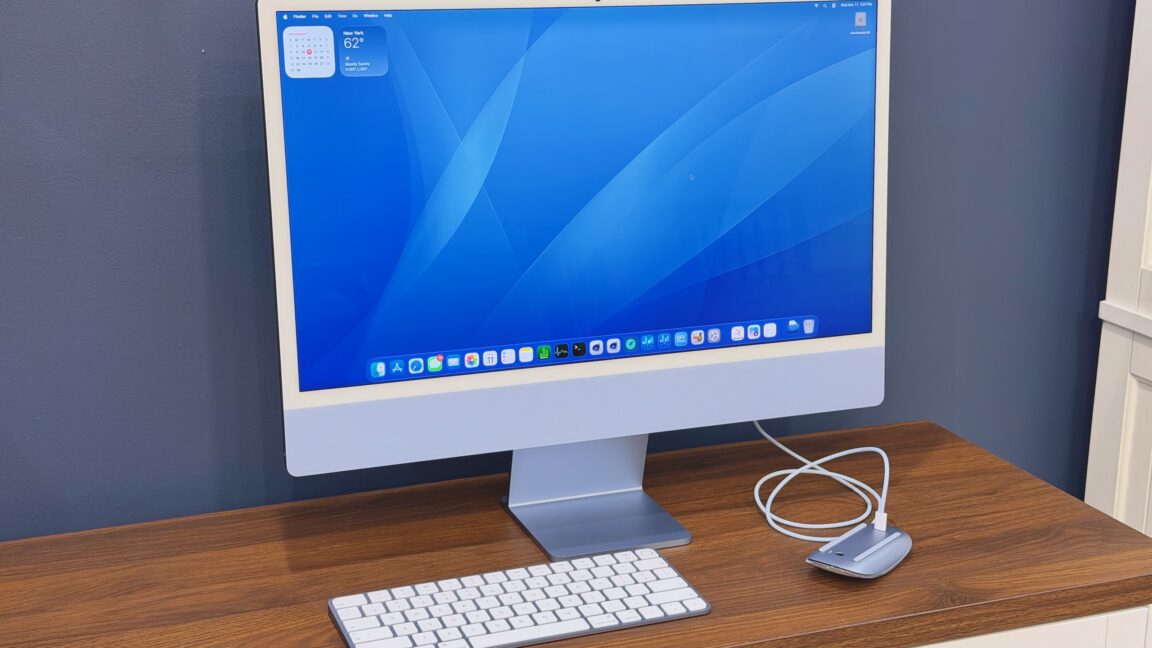
Text settings Story text Size Small Standard Large Width * Standard Wide Links Standard Orange * Subscribers only Learn more Minimize to nav The Apple Silicon iMac got its fourth refresh this month. Every other Apple Silicon Mac has found a way to move forward over the last half-decade—we’ve gotten a more Pro design for the MacBook Pro, a mini-er design for the Mac mini, and a Mac Studio that has finally made Apple admit it doesn’t want to make the Mac Pro anymore. But the Apple Silicon iMac has always been more interested in looking backward. It’s the thin, screen-on-a-stand iMac design by way of the original Bondi Blue G3 iMac.
It’s a clean and pretty desktop computer, one I see all the time in small offices and on TV shows that depict small offices. We’re long past the days when it was Apple’s primary workstation computer. So I wanted to write about this new iMac from the perspective of that entry-level iMac buyer, who chooses the iMac because it’s simple and then uses it until it breaks. What does a new iMac get you if you’re stepping up from the M1 model or comparing it against an older refurbished M4 model?
Without any real external updates, what makes this iMac iteration interesting? Same friendly face If you haven’t used an Apple Silicon-era iMac before, here’s a brief primer. The new iMac is much thinner than the older aluminum Intel models. Its front is mostly one big 24-inch screen, surrounded on all sides by a relatively thick white bezel (I still wish black were at least an option, but Apple apparently doesn’t agree).
White bezel aside, it’s by far Apple’s most colorful computer. The iMacs ship with color-matched fronts, backs, stands, keyboards, mice, trackpads, and cables. Apple has tweaked the color offerings and changed the tints of each specific color a few times over the years, but the M6 iMac uses the same six color tints (plus silver) that the M4 iMac did. The basic $1,499 iMac is essentially a MacBook Air in terms of ports—it has two Thunderbolt ports on the back and a headphone jack on the left side.
Choosing this model also locks you into a lesser version of the Apple M6 with 10 CPU cores and 10 GPU cores instead of 12 of each, a maximum of 24GB of RAM, a minimum of 256GB of storage, and a maximum of 1TB. Its default keyboard doesn’t have Touch ID support, and the only way to get it is to buy the version with the built-in number pad, an $80 upsell. The M6 iMac still comes with either two or four Thunderbolt 4 ports. The four-port version can run two external displays; the one-port version is limited to one.
Ethernet is available on the power brick for an extra $30. Credit: Andrew Cunningham The M6 iMac still comes with either two or four Thunderbolt 4 ports. The four-port version can run two external displays; the one-port version is limited to one. Ethernet is available on the power brick for an extra $30.
Credit: Andrew Cunningham The $1,699 version is the one to get if you still intend to use the iMac as a workstation. It includes the full-speed version of the M6 with all its CPU and GPU cores intact (though there are performance caveats here we’ll talk about later), plus options for 32GB of RAM and up to 2TB of storage. This version also includes four Thunderbolt ports on the back for connecting additional accessories. Both available keyboards on this version have Touch ID.
A 2.5 gigabit Ethernet port can be added to any iMac for $30. This port is located on the desktop’s power brick rather than the iMac itself, an elegant solution that keeps even a wired Internet connection hidden beneath your desk with the other cables. All iMacs also offer a VESA mount adapter option in place of the default stand at no extra charge. I still really like the effect created by the color-matched keyboard, mouse/trackpad, and cables—even the white bezel complements the white keycaps and mouse.
Just know you’re paying quite a lot for how the desktop looks. The $899 Mac mini is $800 cheaper than the iMac with the same chip, the same amount of RAM, and the same amount of storage. Sure, it would cost something to add a nice-looking 4K monitor, but not $800, even if you go for extra frills like a high refresh rate. It’s fine that the iMac upcharges you for style and convenience.
That’s the point of the computer. Just make sure that’s what you want to pay for. The evolution of the iMac 2019 iMac 2021 M1 iMac 2023 M3 iMac 2024 M4 iMac 2026 M6 iMac CPU/GPU 8th-gen Intel Core/AMD Radeon Pro 555X (2GB) Apple M1 Apple M3 Apple M4 Apple M6 Neural engine N/A 16-core 16-core 16-core 32-core RAM 8-32GB 8-16GB 8GB-24GB 16-32GB 16-32GB Starting storage 1TB Fusion Drive (SSD + HDD) 256GB SSD 256GB 256GB 256GB Screen 21.5-inch 4096 x 2304 IPS LCD 24-inch 4480 x 2520 IPS LCD 24-inch 4480 x 2520 IPS LCD 24-inch 4480 x 2520 IPS LCD, optional nano-texture 24-inch 4480 x 2520 IPS LCD, optional nano-texture Ports 2x Thunderbolt 3, 4x USB-A, gigabit Ethernet, SD card, headphone jack 2x Thunderbolt 3, headphone jack, 2x optional 10 Gbps USB 3, optional gigabit Ethernet 2x Thunderbolt 3, headphone jack, 2x optional 10 Gbps USB 3, optional gigabit Ethernet 2x OR 4x Thunderbolt 4 ports, optional gigabit Ethernet 2x OR 4x Thunderbolt 4 ports, optional 2.5 gigabit Ethernet External display support 1x 5K 60Hz or 2x 4K 60Hz 1x 6K 60Hz 1x 6K 60Hz 1x 6K 60Hz (2-port) OR 2x 6K 60Hz (4-port) 1x 6K 60Hz (2-port) OR 2x 6K 60Hz (4-port) Starting price $1,299 $1,299 $1,299 $1,299 $1,499 Here are the basic specs for every entry-level iMac Apple has shipped, going all the way back to the last of the Intel models. The iMac’s evolution has been slow and gradual during the Apple Silicon era.
The computer has never gotten a base storage upgrade, and the base M4 and M6 models still only support a single external display (the upgraded models support two external displays, finally surpassing the old Intel model). If you have any kind of Apple Silicon iMac and you’re happy with how it’s performing and you’re not hankering for more RAM or more displays, I don’t think the M6 model really adds anything worth upgrading for. It’s definitely faster, but even six years on, the Apple M1 remains perfectly serviceable for daily use, especially when it’s attached to 16GB of RAM. And if you’re in the market for an iMac now, I think the M4 model still gets you the best bang for your buck if you can find one refurbished or on sale.
That one still gets you a minimum of 16GB of RAM, Thunderbolt in all four ports for the four-port model, the 32GB RAM option, the nano-texture display option, and support for multiple external displays (again, in the four-port model). The M6 iMac builds on that, and it comes with real performance benefits (more on that shortly). But the brightest dividing line in the Apple Silicon iMac model history is between the M3 and M4 model, not the M4 and M6 model. And that’s true despite the two-generation silicon upgrade.
Performance and power CPU S/P/E-cores GPU cores RAM options Display support (including internal) Memory bandwidth Apple M6 2S/4P/6E 12 16/24/32GB Up to three 153GB/s (16GB), 170GB/s (24GB/32GB) Apple M5 4S/6E 10 16/24/32GB Up to three 153GB/s Apple M4 4P/6E 10 16/24/32GB Up to three 120GB/s Apple M3 4P/4E 10 8/16/24GB Up to two 102.4GB/s Apple M2 4P/4E 10 8/16/24GB Up to two (one external) 102.4GB/s Apple M1 4P/4E 8 8/16GB Up to two (one external) 68.25GB/s (est.) A quick recap on the M6: a total of 12 CPU cores (two super cores, four performance cores, six efficiency cores), either 10 or 12 GPU cores, 16/24/32GB RAM options, and a doubled Neural Engine NPU with 32 cores instead of 16. For the iMac, the M6 also introduces some of the architectural tweaks introduced with the Apple M5, including the addition of neural accelerator hardware to the GPU cores. This boosts the speed of some kinds of local AI workloads compared to the M4, including MetalFX upscaling and frame generation i








Leave a Reply