
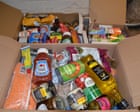
There is no evidence government’s advice has triggered mass panic stockpiling of groceries and other essentials. Photograph: Simon Leigh/AlamyView image in fullscreenThere is no evidence government’s advice has triggered mass panic stockpiling of groceries and other essentials. Photograph: Simon Leigh/Alamy‘Realistic and reassuring’: UK public ‘responding calmly’ to Be Ready campaignGovernment’s emergency planning advice has sparked sales of essentials but no panic stockpiling, say prepping shop ownersWhen the UK government launched its “Protect and Survive” public information campaign in 1980 on how to stay alive after a nuclear attack, it was met with a combination of scepticism, disbelief and derision.The advice included how to build a “fallout room” at home, how to whitewash windows to protect from a blast, and how to store a dead body for up to five days.You might expect this would have prompted widespread panic, but in fact it led to a political backlash, and was later lampooned on TV and in music.It shows the risks governments take when launching such campaigns, and the fine balance that must be struck between hammering home a practical message without causing panic – or other unintended reactions.The government’s new Be Ready campaign is advising the public to stock up on three day’s worth of supplies for use during severe weather or cyber-attacks, so help can be directed to the most vulnerable first.Be Ready documentTwo-page document advises the public to stock up on three day’s worth of supplies for use in an emergency.In a concise, two-page document, it suggests people stock bottled water and non-perishable food for three days, a torch with spare batteries, a wind-up FM radio, a first aid kit and a copy of their passport. To stave off panic buying, it advises people to check their cupboards first and build up items gradually on regular shopping trips.While there is no evidence the advice has triggered mass panic, the public is clearly responding.
Jack Brown, who co-owns Sgt Prepper Shop, which stocks emergency food and survival tools, said he received a month’s worth of orders in the first 24 hours of the Be Ready campaign.“I thought my phone was glitching or being hacked with the number of orders coming in,” he said.Brown said the advice seemed sensible and proportionate. Three days was the “sweet spot”, he said, with most everyday emergencies like power cuts, a burst water main or flooding sorted within that timeframe.It is also “realistic, affordable and fits in a cupboard”, he said, adding that asking people to stock up on a month’s worth of supplies would feel overwhelming and most people would do nothing at all.A wind-up radio was also a sensible suggestion, and ones with a built-in torch and phone-charging USB port make them “one of the most useful bits of kit you can own”, he said.Dr Sarita Robinson, associate dean for the school of psychology and humanities at the University of Lancashire, said there was little evidence to suggest these kinds of messaging campaigns cause panic.View image in fullscreenAn original copy of Protect and Survive, a government booklet of advice on surviving a nuclear attack issued in 1980. Photograph: sjbooks/Alamy“There’s this perception that if we tell people the truth we’re somehow going to panic them and it isn’t the case,” she said.“When we use accurate messaging about emergency situations, the public will engage with that proactively. It’s when we start to hide information and there’s a void of information, that’s when things can go wrong for government.”She said Be Ready was “realistic, quite low level, and should be reassuring because it’s basically treating the public like the grownups they are”.Dan Goss, who runs Start Prepping UK, said traffic to his website was up 700% since news of the campaign emerged in August.
He said he was glad to see the subject finally being taken seriously and spoken about in “plain language” by the government, and felt the risk of panic was low.“The level of uptake required for that would be huge – you would need to have an enormous number of people all take the government’s advice very seriously and all jump on it as a priority,” he said.“We’re definitely in a phase now where we’re seeing lots of more disruption to people’s lives – not necessarily apocalyptic disasters, but things that have a big impact on small areas, so this advice is very much needed.”Robinson said the campaign showed how the perception of “prepping” has shifted, especially since the Covid-19 pandemic when most people will remember seeing empty supermarket shelves.“We did a study during Covid that showed people who did mild levels of prepping, such as having food, masks and hand gel in the house a few weeks before the pandemic, had lower anxiety and depression, and less stress,” she said.“The government really needs to portray that this is just normal, everyday, very common in other countries, and isn’t wearing a tinfoil hat and building a nuclear bunker in your back garden.”Explore more on these topicsEmergency planningCyberwarInternetInfrastructureDefence policyHackingClimate crisisfeaturesShareReuse this content











Leave a Reply