
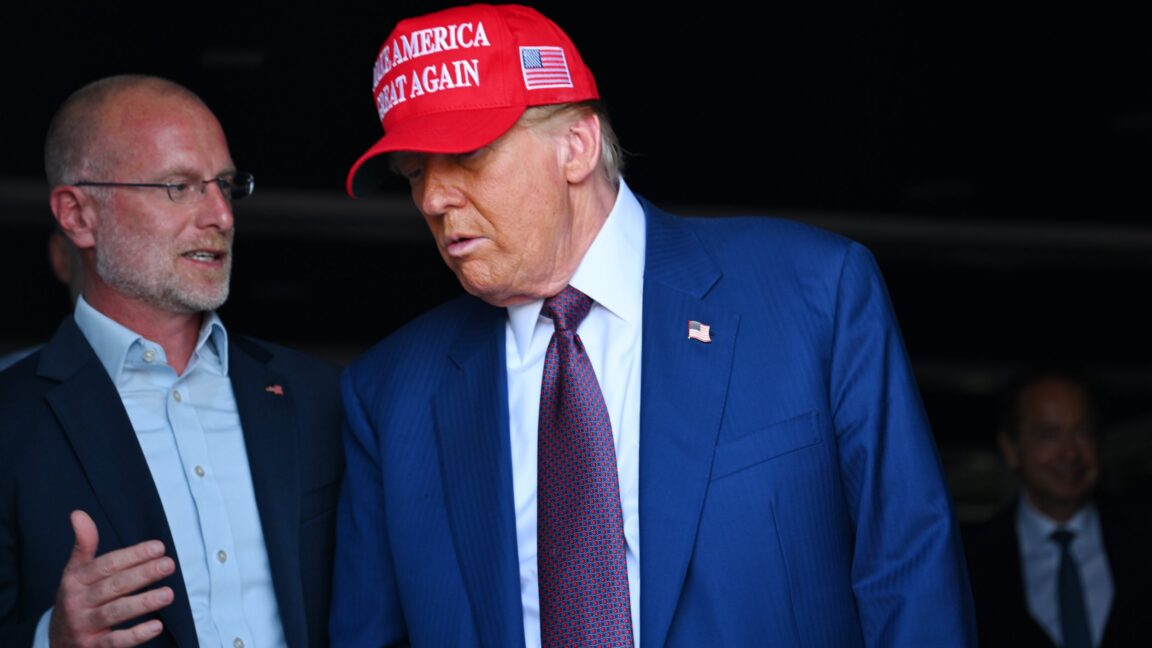
Text settings Story text Size Small Standard Large Width * Standard Wide Links Standard Orange * Subscribers only Learn more Minimize to nav Federal Communications Commission Chairman Brendan Carr today warned broadcasters about airing “fake polls,” amplifying one of the many complaints that President Trump has regularly made about the news media. Carr’s post on X said, “Many journalists and broadcasters have been amplifying or airing these Polls without regard to basic journalistic ethics and without informing the public that those Polls lack a scientific, accurate, or even real basis… Broadcasters are advised to avoid engaging in News Distortions or running Broadcast Hoaxes by airing Polls that would violate their regulatory obligations.” Carr urged broadcasters to “provide their viewers with additional context and information about Polls they have covered.” In fact, one small polling outfit was exposed as a hoax this week, and a similar incident occurred in August. News outlets have reported on these hoaxes, providing the very “context” that Carr said is needed. Carr’s post did not mention any specific fake polls or any specific broadcasters that aired them.
The vagueness of Carr’s post may be useful for his and Trump’s ongoing battle against the news media. In August, Trump demanded that the FCC punish or rebuke an NBC journalist for saying he has “mixed results” in election endorsements, and wrote that the FCC must do something about “THE FAKE POLLS USED BY OUR CROOKED MEDIA.” Ex-FCC chairs: Carr wants “self-censorship” Carr’s latest warning to broadcasters came as no surprise, given that he has spent much of the past two years threatening broadcast licenses and opening investigations into Trump’s least favorite news companies. Former Republican and Democratic FCC chairs and commissioners recently said Carr is seeking to censor and chill the speech of broadcasters through a proceeding that threatens the licenses of ABC-owned stations. “FCC Chair Brendan Carr’s threat against broadcasters over their reporting on political polls is yet another truly outrageous attempt to censor and control the information available to Americans as they prepare to vote… Carr is now seizing on reports about fabricated political polling as an excuse to once again try to scare broadcasters into self-censorship,” said a statement today from a group of former FCC chairs and officials. Today’s statement was attributed to former Chairman Tom Wheeler, a Democrat; former Chairman Mark Fowler, a Republican; and seven former high-ranking FCC officials. “Good-faith reporting on public polls—even ones that turn out to be made up—is not a violation of the FCC’s news distortion or hoax rules.
And the FCC has zero authority to dictate editorial decisions,” they said. Wheeler, Fowler, and others previously signed a letter objecting to the ABC investigation. The letter called it “the latest attack in a sustained campaign by Chairman Carr and the Trump administration of threatening legal sanctions against licensees whose speech President Trump dislikes.” Anna Gomez, the only Democratic commissioner on the current FCC, wrote today that “Pollsters who intentionally mislead the public should answer for it, but broadcasters who report publicly available polling data should never be punished when a poll is wrong. FCC rules on news distortion or hoaxes do not apply to a station that reports this data in good faith.” Pollster admits hoax An entity called Wedgewood Polls said yesterday that it published fabricated polling data “to test whether media outlets, aggregators, and commentators would report on data without verifying the source, methodology, or underlying firm legitimacy.” It claimed to be running an experiment on the modern political polling industry. “Despite having no history, formal credentials, or real data behind the vast majority of our releases, Wedgewood Polling was added to major polling aggregators, including The New York Times, FiftyPlusOne, and VoteHub, and repeatedly treated as a legitimate news source,” the statement said.
Notably, the three polling aggregators mentioned in the statement are not broadcast stations or news networks whose programming is carried on local broadcast stations. That’s relevant because Carr has repeatedly said he merely uses the FCC’s regulatory authority over broadcasters with licenses to use public spectrum, and not media outlets that do not have FCC licenses. Carr’s post yesterday warned broadcasters to “comply with their public interest obligations” under “the terms of their federal licenses.” While Wedgewood Polls claimed that its data faced no scrutiny from news organizations, FiftyPlusOne said it was preparing to publish an article exposing the fraud and had sent a request for comment to Wedgewood. “They did not respond to our request, but instead posted a public statement on social media admitting that they had been fabricating data,” FiftyPlusOne wrote. FiftyPlusOne, The New York Times, and VoteHub all say they did some vetting of Wedgewood before deciding to use its polls.
FiftyPlusOne wrote: Their statement alleges that FiftyPlusOne, The New York Times, and other poll aggregators did not conduct appropriate vetting of their firm prior to aggregating their polls; this is false. We reached out to them to ask who they were and confirm the methodology statement on their website. We were given two names, Jack Sims and Andrew Prater. We were able to independently confirm that Sims had previous experience in the polling industry and reviewed their methodology statement in detail.
It is not atypical for a pollster to leave an existing firm, form their own, and self-fund some surveys to build reputation; we had no reason at the time to believe this case was any different. Wedgewood operated as if it were a legitimate polling firm, including collecting money from donors to conduct crowd-funded polls, and sharing raw survey data (which we now have confirmed was fraudulent) with FiftyPlusOne on Oct. 15, 2026. NYT and VoteHub explain poll inclusion VoteHub Head of Data Science Zachary Donnini said that after talking to Wedgewood’s “head pollster,” Votehub “assigned them a D grade and included their polling data on our site.” Meanwhile, the New York Times updated its polling page with a statement about Wedgewood. The New York Times said it sends all new pollsters “a series of questions regarding the identities of the pollsters; the methods they were using to draw their sample, contact respondents and weight their polls; and the source of their funding.” Wedgewood answered the questions, and the NYT used 15 of its polls for state and congressional-district races.
The Wedgewood “polls were never included in the tracker or average of President Trump’s approval rating or of the national polls tracking overall preference for control of Congress,” the NYT said. In the previous incident this year, a group called Median Strategies admitted it faked poll results as part of a “social experiment.” The NYT said it never included that group’s results in its trackers “because the group did not respond to our questions about its methodology.” Nate Silver removed Wedgewood from his polling site today. Wedgewood polls tended to be about 1 percentage point more favorable for Democrats than other polls, according to Silver. Jon Brodkin Senior IT Reporter Jon Brodkin Senior IT Reporter 66 Comments








Leave a Reply