
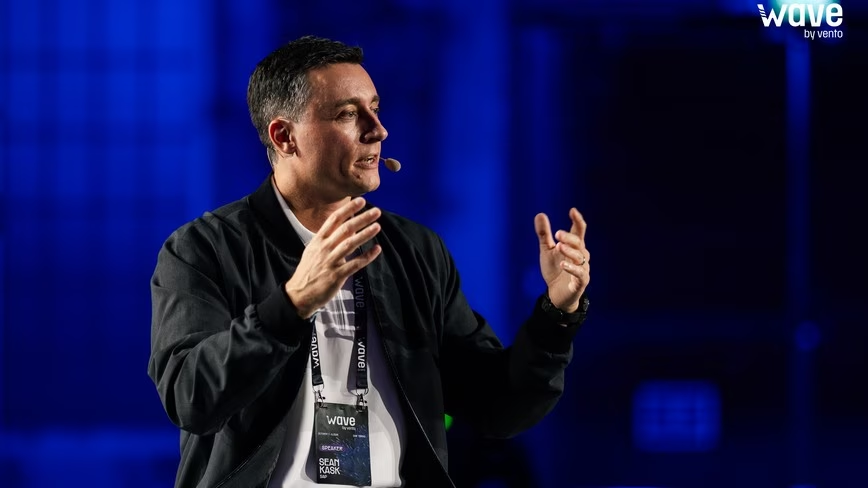
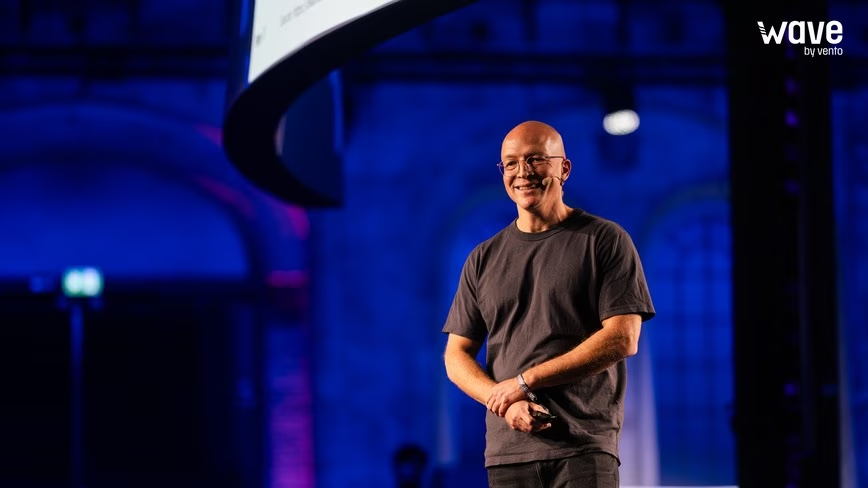
Sean Kask, chief AI strategy officer at SAP, speaking at Wave by Vento in Turin. Credit: Wave by Vento Established software companies have to rebuild their products around AI, not add it as one more feature, SAP’s chief AI strategy officer Sean Kask said. He spoke at Wave by Vento in Turin on Thursday. “Like the famous quip that every company is becoming a software company, every software company has to become an AI company, or they’ll perish,” Kask said. CNBC’s Carolin Roth moderated the session, titled “The Model Europe Built”.
It centred on SAP’s purchase of Prior Labs, a German startup that builds tabular foundation models: AI models made for data held in tables. SAP completed the deal in July. It has committed more than €1bn over four years to grow Prior Labs into a frontier AI lab. Why tables Large language models learn by predicting the next word in text, Kask said.
Mathematically, they cannot handle data held in tables, such as the rows and columns of a spreadsheet. Tabular models can make numerical predictions and classifications that language models cannot. About 80% of business data is unstructured, such as text, email and images, he said. But he argued that the 20% held in tables generates 80% of a company’s value.
The big AI labs focus on scaling language models instead, he said. Why Prior Labs SAP started building tabular models in-house a couple of years ago, Kask said, and uses its own, SAP-RPT-1, in production. Prior Labs fitted because its model leads the TabArena benchmark, he said. Prior Labs was also already applying it to cancer diagnosis and bank transactions, and SAP was doing research with it.
SAP promised to keep Prior Labs as a separate lab with room for its own research, Kask said. Its model will stay open weight, so researchers and startups can build on it. In the past, he said, a machine learning team built one model for each problem, which could take weeks or months. A company might train and tune 100 models.
With a tabular foundation model, one model does that work in days, he said, and beats methods such as XGBoost on accuracy. Picking the best model SAP does not build its own large language model, Kask said, because it is costly and the models are converging. Customers can use models from Google, OpenAI, Anthropic and Mistral, and SAP uses more than 100 models internally. It tests each use case against all of them and picks the best one.
For SAP, AI-first means rebuilding its interface, he said. Users can ask in plain language, and the system generates the tables they need on screen. Europe’s place Europe should not jump into the “red ocean” of large language models, Kask said. Spending $10bn on a model that is outdated in six months does not set anyone apart, he said.
Europe should build the assets that make those models useful instead. SAP’s knowledge graph links 500,000 tables and 7 million fields, he said, which makes its AI agents accurate enough to use at work. Not every European company is taking that route. On Tuesday, Mistral launched Large 4, a 1-trillion-parameter open-weight model.
Every dollar of SAP software sold generates $6 to $10 for its ecosystem of partners, Kask said. SAP licenses startups’ technology into its products, resells partners through its store, and sometimes buys them. On Tuesday, it agreed to buy TechWolf, a Belgian AI workforce startup.







Leave a Reply