

A Universal Quantum trapped-ion system in the lab Credit: Universal Quantum Quantum computing startup Oratomic has raised $475 million at a $5.4bn valuation, Isabelle Bousquette reported for The Wall Street Journal on Thursday. The round came three months after its Series A and lifted its valuation from $1.5bn. The same day, British startup Universal Quantum announced a Series A of more than $100 million. Gartner then forecast that quantum computing revenue will reach $1.1bn worldwide in 2027.
The research firm also expects more than half of quantum computing startups to go out of business by 2030. Oratomic: $5.4bn three months after its Series A ARCH Venture Partners, Spark Capital, Khosla Ventures, Index Ventures, General Catalyst and Bezos Expeditions co-led the Series B, according to the Journal. Oratomic has now raised $775 million in total. The Pasadena, California company was founded in 2025 and raised $300 million in its Series A in July.
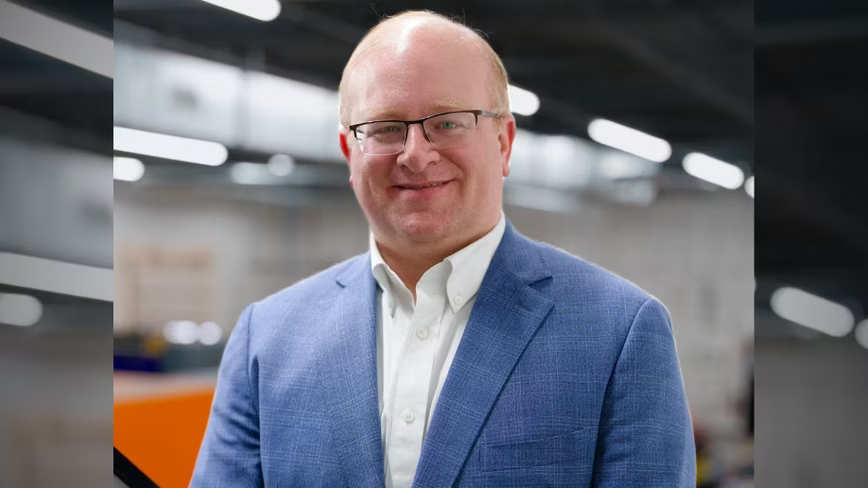
Oratomic is building a large, error-corrected quantum computer that can run reliably. Its chief executive and co-founder, Dolev Bluvstein, told the Journal the company thinks a useful machine needs only 10,000 qubits. The previous industry consensus was about one million. He expects the computer to be ready by 2030. “We need to cross this tipping point where we can build a working computer that is cheap and manufacturable,” Bluvstein told the Journal.
Universal Quantum: the largest UK quantum Series A Universal Quantum says its round is the largest Series A ever raised by a quantum company headquartered in the UK. DCVC and Firgun Ventures co-led it. Singapore’s sovereign investor EDBI and Roblox founder and chief executive Dave Baszucki joined, among others. Firgun also backed Swiss startup ZuriQ in its $25.5M round in July.
Sebastian Weidt and Winfried Hensinger founded the company in 2018 as a University of Sussex spinout. It is based in Haywards Heath and has more than 100 technical staff. Its machines link many small trapped-ion chips together. In a trapped-ion system, charged atoms held in place by electric fields act as qubits.
The money will fund the company’s first research centre outside Europe, in Singapore. It will also pay for expansion in the US, Japan and its German hub in Hamburg. Universal Quantum is delivering a $77 million contract for the German Aerospace Center (DLR). “This round unites an extraordinary group of investors from the world’s most important pools of capital around a single mission: delivering utility-scale quantum computing,” said Weidt, the chief executive. Weidt declined to share the company’s valuation or revenue, Mark Bergen reported for Bloomberg.
He told Bloomberg the company did not get UK public support in this round. He expects to build a useful quantum computer within the next decade. Gartner: a $1.1bn market, then a shakeout Gartner forecasts worldwide quantum computing revenue of $869.9 million in 2026, up 22.9% from a year earlier. It expects $1.1bn in 2027. “The early quantum advantage era has arrived because noisy intermediate-scale quantum processors now have enough qubits to do limited complex tasks with improved error reduction,” said Gaurav Gupta, a vice president analyst at Gartner.
The public sector will lead spending through 2027, according to Gartner. It expects public sector spending to rise from $219 million in 2026 to $245 million in 2027. From 2028, it expects banks, financial firms and insurers to take the lead, spending $289 million that year against $280 million from the public sector. Gartner also calls the market overcrowded.
By 2030, it expects more than half of quantum computing startups to close as revenue runs out. Gartner says buyers will reject qubit types that cannot deliver fault-tolerant quantum computing, which corrects its own errors. In September, an EU official called for consolidation among Europe’s quantum startups. A SPAC deal and a partnership in Japan Korea Quantum Computing, based in Busan, plans to go public on Nasdaq through a merger with Charlton Aria Acquisition Corporation, a blank-cheque company.
Its US parent, KQC Quantum, announced the deal on Wednesday. The merger agreement filed with US regulators sets the equity value at $80 million. The two companies held an investor webcast on Thursday. In Tokyo, NTT DOCOMO BUSINESS signed a memorandum of understanding with quantum software company Classiq.
NTT will sell Classiq’s development platform to Japanese companies and help them find uses for quantum computing. On Wednesday, DARPA moved Atom Computing, Diraq, IBM and IonQ into its final quantum test stage.




Leave a Reply