
Text settings Story text Size Small Standard Large Width * Standard Wide Links Standard Orange * Subscribers only Learn more Minimize to nav An attempt to save NASA’s $500 million Neil Gehrels Swift Observatory from dropping out of orbit fell short, but the behind-the-scenes machinations required just to make a rescue possible deserve recognition, government and commercial space officials said in a recounting of the mission. The rescue mission was developed by Katalyst Space Technologies, working under a $30 million contract awarded by NASA last September. NASA gave Katalyst nine months to build and launch a satellite to capture Swift flying some 200 miles above the Earth and boost it into a higher orbit. Katalyst’s rescue spacecraft, known as Link, successfully launched July 3 and completed some of its initial checkouts before a malfunction caused it to spin out of control a few weeks later.
NASA announced in August that Link would not be able to reach Swift as intended, and the rescue mission was aborted. Still, designing and building a satellite, finding a rocket to launch it, and getting it to work in the harsh environment of space was a remarkable achievement. It would usually take several years to design, build, and test a satellite of Link’s size and complexity from scratch. Link weighed nearly a half-ton at launch, with electric thrusters, robotic arms, and large deployable solar arrays.
In the end, though, the Link satellite did not reach the Swift Observatory. The failure was bad news for scientists who rely on data from Swift, which has unique capabilities combining sensitivity to gamma rays, X-rays, and visible light with the agility to quickly turn toward astronomical targets. This has made Swift the go-to observatory for detecting gamma-ray bursts, the most powerful explosions in the Universe. But Swift was going to fall out of orbit anyway.
The spacecraft launched in 2004 and has far outlived its original design life. Swift does not have its own propulsion system, so it is unable to raise its orbit without help, leaving its fate at the mercy of aerodynamic drag in low-Earth orbit. Increased solar activity in recent years led to an increase in drag at Swift’s altitude, hastening its demise. Racing against the clock NASA and Katalyst officials are reviewing lessons learned from the mission to better prepare for the next time they need to rapidly call up a satellite rescue mission.
First and foremost: Don’t wait until the last minute, said Shawn Domagal-Goldman, director of NASA’s astrophysics division, in a meeting last week of the National Academies’ Committee on Astronomy and Astrophysics. “The way that the timeline worked out, we didn’t have the ability to open up the doors fully to proposed solutions. We went with the teams we had on [contract] already. That is not a regret of the team we ended up with. It’s just I think I prefer the more open solutions.” NASA commissioned 30-day studies from three teams—Katalyst, Starfish Space, and a joint proposal from Cambrian Works and Astroscale—in August 2025 to show how they planned to rescue Swift from destruction.
The teams eligible for the studies were limited to partners NASA already had on contract for technology development. Under federal acquisition rules, it would have taken months or longer to start a brand new procurement and bring on a new provider. The studies led to NASA’s selection in September 2025 of Katalyst to try to rescue Swift. Officials knew the odds were stacked against them.
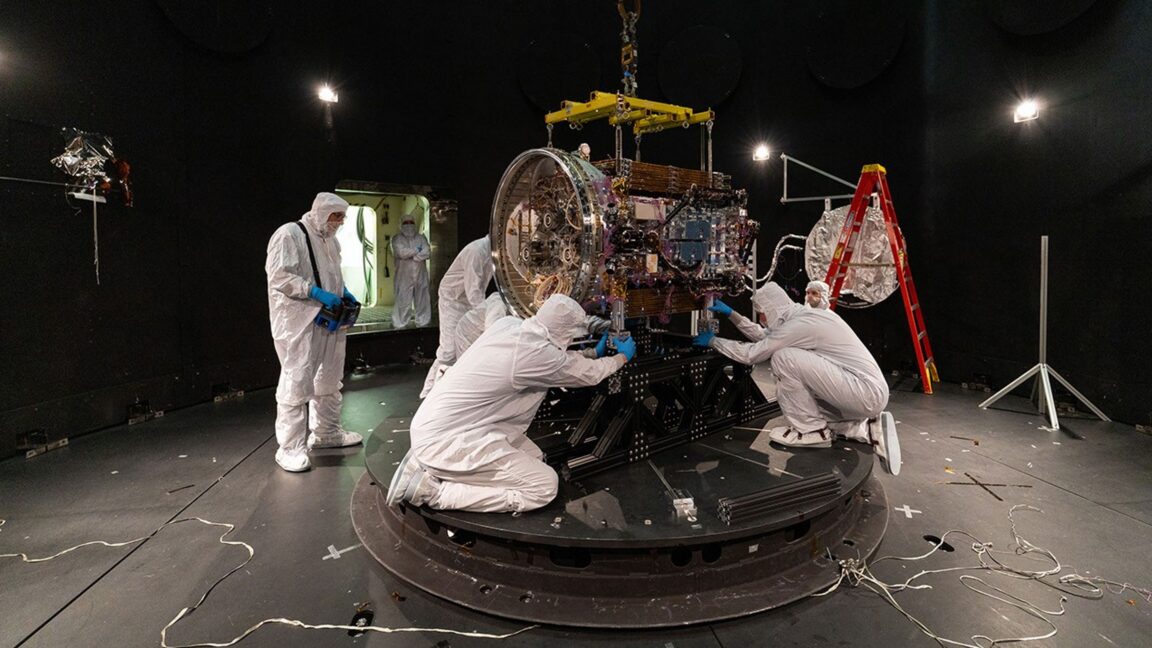
Katalyst quickly put out orders to suppliers for all the parts required to assemble the Link spacecraft. In some cases, Katalyst found its suppliers couldn’t deliver in time, so it decided to build parts itself. Engineers also had to decide what to test on the spacecraft before handing it over to the launch provider, Northrop Grumman. NASA’s strategy was to tell Katalyst what to do, but not how to do it. “On paper, it was five requirements,” said Kieran Wilson, principal investigator for the Link mission at Katalyst. “In practice, it boiled down to do no harm and boost Swift.
It was not specified how that was going to happen. That allowed us, in turn, to put engineering judgment ahead of exhaustive process, which allowed us to move much more quickly.” The Link spacecraft attached to Northrop Grumman’s Pegasus XL launch vehicle. Credit: NASA/Ron Beard The Link spacecraft attached to Northrop Grumman’s Pegasus XL launch vehicle. Credit: NASA/Ron Beard Working inside a factory near Denver, Katalyst completed the Link spacecraft design at the end of last year and had the satellite ready for final prelaunch testing in April. “We didn’t have a systems engineering organization,” Wilson said. “We didn’t have the traditional structure that you would see for most places that are trying to do something like this—a very complicated mission.” The successful launch in July was followed by several weeks of in-orbit checkouts.
Remarkably, it looked like the Swift rescue mission might actually succeed in reaching its objective, but a series of malfunctions in late July left the spacecraft spinning. It’s always a valve “We experienced a failure of a reaction wheel switch on our power system,” Wilson said. “This was something that we developed in-house. The reaction wheels themselves were from Rocket Lab, which is third party. They’re great.
We would fly them again, absolutely. But it was the control electronics for those, particularly the regenerative braking circuit. That experienced a fault, and the transistor on that essentially shorted, and that caused it to overheat and render that circuit inoperable. The spacecraft used cold-gas Reaction Control System (RCS) thrusters in combination with reaction wheels to control the spacecraft’s pointing. “We implemented a bunch of software changes on the spacecraft and operational changes in order to mitigate the cause of that issue, which was kind of breaking too hard, too fast, too often, and that worked for a few weeks, and then we ended up having a series of events that started with an unresponsive RCS valve, causing the spacecraft to spin up,” Wilson said.
Those events prevented Link from rendezvousing with Swift and completing the reboost, and Katalyst had to forego its final incentive payment from NASA. This image of NASA’s Swift observatory was captured at a distance of 12 to 15 kilometers by Katalyst’s Link satellite. Credit: Katalyst Space Technologies This image of NASA’s Swift observatory was captured at a distance of 12 to 15 kilometers by Katalyst’s Link satellite. Credit: Katalyst Space Technologies Some of the Link spacecraft’s most complicated elements, like its robotic arms and plasma thrusters, worked as expected.
For a time, ground teams at Katalyst thought they might be able to use the plasma thrusters to regain control of Link’s pointing as it zipped around the Earth at nearly 5 miles per second. “We were able to do some pretty significant orbital maneuvers,” Wilson said. “We did do a whole bunch of interesting things from the GNC (Guidance, Navigation, and Control) side in order to try to keep going even after we had lost two wheels, and those are what enabled us to get within about 10 kilometers [of Swift].” A little more development time would have given Katalyst a better chance of finding the faulty circuit and valve before launch. Engineers made “gut-wrenching” decisions in the months leading up to launch on which tests to perform and what tests they simply did not have time to do, Domagal-Goldman said. Wilson acknowledged shortcomings on Katalyst’s side, too, such as “overly light” staffing on the company’s power systems team. The satellite industry supply chain couldn’t deliver critical components for Link’s electrical system, like power conversion and distribution units, on schedule to meet the deadline for rescuing Swift











Leave a Reply