
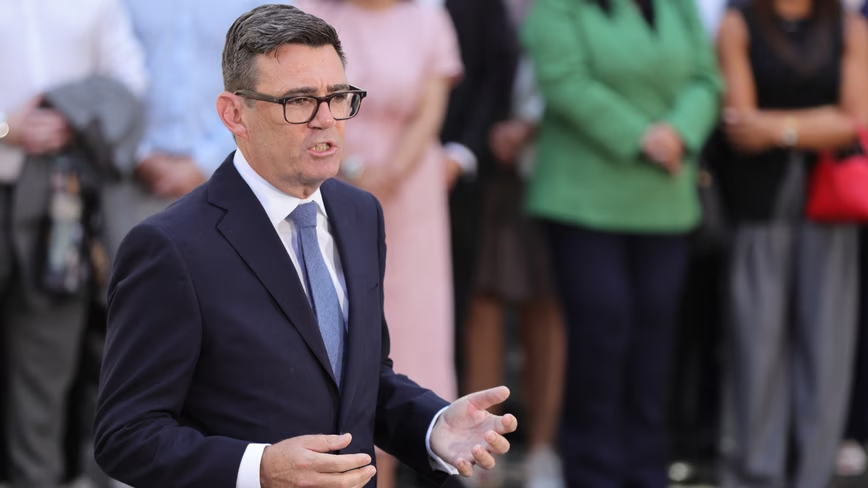
Andy Burnham at 10 Downing Street in London on 20 July 2026, as he took charge of government as prime minister. Credit: repic / Shutterstock Fundamental decisions on this technology are too important to be left to chance. They must be taken by elected governments who serve working people. Andy Burnham said that about AI on Tuesday evening.
It was his first speech to the UN General Assembly as British prime minister. He used it to announce three things. The UK is developing an AI defence partnership with the United States. Security chiefs will start work on a national centre to fight hostile state disinformation.
And AI will sit at the heart of the UK’s G20 presidency next year. The aim is a single set of global principles and standards. Hours earlier, Donald Trump had told the same assembly that the US rejects any global scheme to control the technology. An AI defence partnership with Washington I am announcing today that we are developing a new AI defence partnership with the United States to protect our critical national infrastructure.
Burnham gave no further detail on the partnership in the speech. He set it against the risks he also named. AI is already speeding up cancer diagnosis in the UK, he said. It will also be key to economic growth, education and security.
It will also be a source of disruption to the way people live and work, and a multiplier of risk. We’ve all heard the warnings, which we must heed. I know how worried people are. So we have to rise to this moment.
A centre to fight information attacks Burnham said he was asking UK security chiefs to begin work on a new National Centre for Information Defence. Its job will be to detect, attribute and disrupt hostile state information attacks. He named Russia directly. The Kremlin spends around £1.3bn a year on manipulating information, he said.
Russian agencies have used bots, fake websites and falsified newspaper articles. They have forged the branding of 28 British organisations, including universities and the BBC. He said the UK has evidence that Russia tried to interfere with the 2019 general election. He added that cyber attacks have hit companies and institutions, and that AI will multiply the threat.
The UK has already helped Moldova protect its elections from Russian interference, Burnham said. He offered to share that experience with other countries as elections approach across Europe. Emily Thornberry chairs the Commons foreign affairs committee. She said the centre was the main recommendation of her committee’s March 2026 report on disinformation, the Guardian reported.
AI rules through the G20 The G20 plan builds on the meeting King Charles hosted for AI leaders last week, Burnham said. He first set out the idea to reporters on Monday. The UK could act as an honest broker on AI, he said then. In New York, he pointed to how the G20 handled the 2008 financial crisis.
Countries agreed principles together, then each implemented them at home in its own way. We will work towards agreeing a single set of global principles and standards to ensure the transparency and access we need to increase our preparedness and to ensure that AI development is safe. He said that effort would draw in other initiatives, naming one proposed by Norway this week. That is the joint statement from 21 countries and the European Commission calling for international oversight of frontier AI.
Burnham also told the British public the government would bring forward new laws if needed. More than 70 UK lawmakers asked him last week to back a superintelligence ban. The UK’s AI Security Institute already works with the US and the leading labs on AI safety, he said. Trump said the opposite the same day Trump addressed the General Assembly earlier on Tuesday, and rebranded AI as super intelligence.
The United States also totally rejects any attempt to construct a globalist scheme to control for the artificial intelligence being spoken of so much now. Burnham and Trump met for the first time on the sidelines of the assembly that day. Burnham did not mention Trump’s remarks in his speech. He closed the AI section with a lesson from the first industrial revolution, which started in northern England two centuries ago.
For workers, he said, the disruption brought huge suffering and exploitation, and things got a lot worse before they got better. So this time we need to get it right.














Leave a Reply