
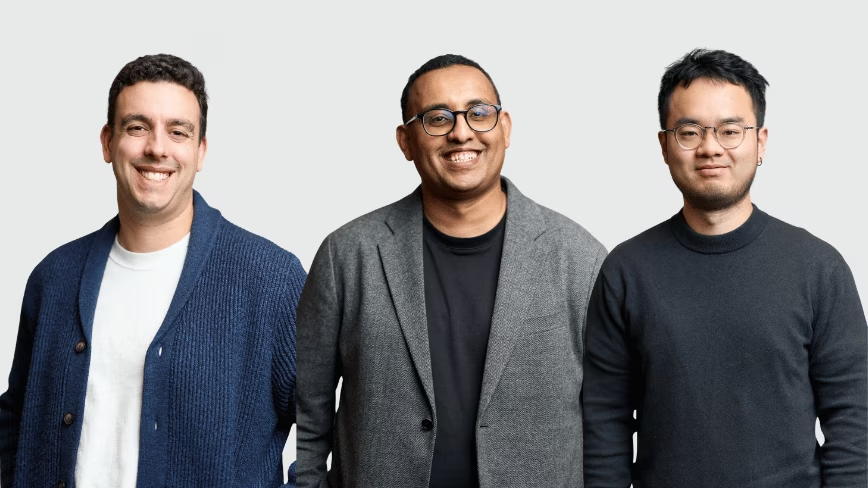
Heidi cofounders Dr Tom Kelly, Waleed Mussa and Yu Liu, left to right. Credit: Heidi From the day I started Heidi, the ambition was always bigger than writing doctor’s notes. Dr Thomas Kelly said that on Tuesday, as the company he cofounded announced US$340m of new funding. The money arrives in two parts.
In its announcement, Heidi said Blackbird led a US$100m Series C that values the Melbourne company at US$900m. Phoenix Court, Point72 Private Investments and Headline also took part. That price is almost double the US$465m Heidi carried last October, when Point72 led a US$65m Series B. The other US$240m is not equity The larger half comes from General Catalyst’s Customer Value Fund, and it buys no shares.
Olivia Poh reported for Bloomberg that the CVF is a debt-like instrument. General Catalyst holds no stock and no warrants in Heidi. It funds sales and marketing, then takes a capped share of the revenue that spending produces, on top of getting its money back. Pranav Singhvi, who cofounded the fund, said it exists so companies with good unit economics can push their growth engine without spending their own balance sheet on it.
Heidi has now raised US$436.6m in total. The numbers behind the round Annual recurring revenue went from US$1m to US$50m in two years, reaching that mark in April. Heidi says its product has supported more than 175 million patient visits, up from 73 million at the Series B, and more than 67 million clinical hours. It puts weekly volume at about 2.8 million patient interactions, across 110 languages and 190 countries.
A year ago it counted 116 countries. At the Series B last October, Heidi reported about two million patient interactions a week across 116 countries. Those are the figures the new ones are measured against. Enterprise activation sits at around 62%, by the company’s own measure.
Heidi employs close to 600 people. Kelly founded the company in Melbourne with Waleed Mussa and Yu Liu. Blackbird has held a stake since the pre-seed in 2021 and leads this round. Michael Tolo of Blackbird, which has backed the company since its pre-seed in 2021, said generic AI will not close the healthcare deficit because clinicians ignore it.
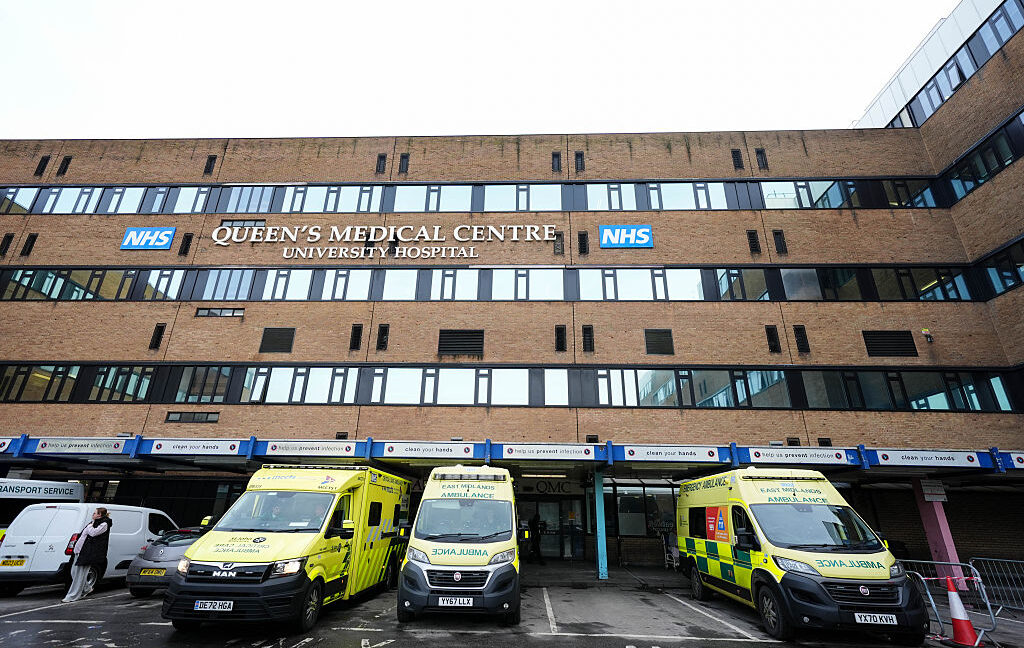
Kelly told Bloomberg the company plans to add as many as 150 staff over the next year, and to push into Asia and the Middle East. Where Heidi already runs In the UK, Heidi is sole supplier to NHS England Midlands, in what the company calls the largest clinical AI procurement in NHS history. In the US it is used by Beth Israel Lahey Health in Massachusetts. In New Zealand it runs in every emergency department in the country.
Australian deployments include the Royal Children’s Hospital Melbourne, Children’s Health Queensland and Metro South Health. Britain is buying clinical AI at scale at the moment. Palantir’s £330m NHS contract is heading for renewal with a former deputy Labour leader newly on its payroll. What the money pays for Kelly said the round funds a move from documentation to agents that take on clinical work under supervision.
He told Bloomberg that within six to twelve months Heidi should handle most of what a doctor asks of it. Heidi has built its own models rather than renting frontier ones. It says transcription and note generation, which account for most of its compute, now run almost entirely on in-house technology. Beyond the scribe it has shipped Evidence, which answers clinical guideline questions and has handled more than 10 million queries since March.
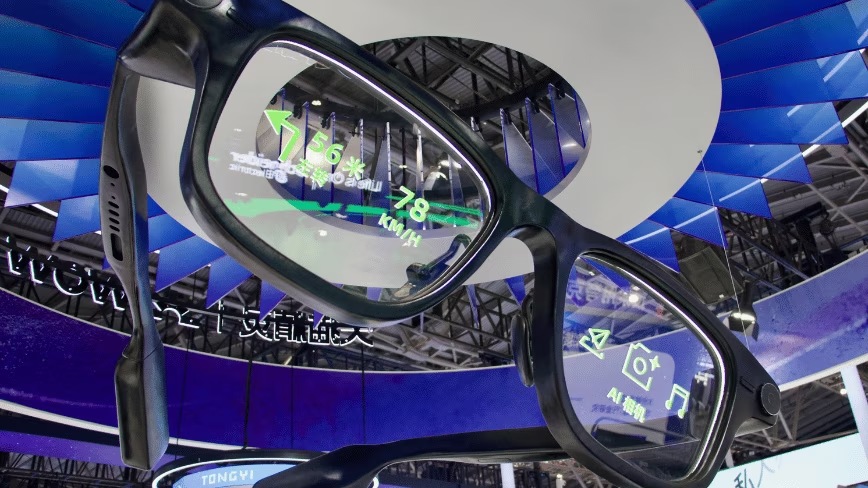
It has also shipped Remote, a wearable for audio capture, and Dictate. Part of the round pays for clinical evidence, quality management systems and regulatory submissions. Heidi says it will work with regulators on the appropriate pathway. The General Catalyst money is tied to go-to-market spending by the structure of the fund, so the equity is what pays for the rest.
Not in the UK or EU Heidi added one line under its investor quotes. The coming product capabilities will not be available in the UK and EU. The company gave no reason and no timeline. It does list the paperwork it holds: ISO 27001, SOC 2 Type II, Cyber Essentials Plus and ISO 42001, plus alignment with NHS requirements, GDPR, HIPAA and the Australian Privacy Principles.
Europe has a route for autonomous clinical AI, and it is slow. Vara spent years securing CE certification for AI that reads breast screening images without a second radiologist. The scrutiny around clinical AI We reported in August that NHS AI scribes were making errors in patient records, with Healthwatch raising concerns and the MHRA involved. In a separate case, an AI receptionist mishandled a stroke patient.
Heidi says every agentic decision stays under clinician control. Its clinical research team runs testing, validation and published research ahead of release. Bloomberg points to a 2023 Pew Research Center survey in which 60% of American adults said they would be uncomfortable if their doctor relied on AI to diagnose them. Other scribe rounds this year Tandem Health raised $100m on 15 September to turn its own AI scribe into clinic software.
That is the same amount of equity, for the same strategic move, one week earlier. Bloomberg notes two more. Forus took $150m this month at a $3bn valuation, and Latent raised $80m earlier in the year. Kelly’s pitch against general-purpose assistants is retention.
He told Bloomberg that healthcare involves a lot of setup and configuration, and that the company’s data shows customers stay. The World Health Organization projects a shortfall of 11 million health workers by 2030. Heidi cites that gap as the market it sells into.










Leave a Reply